Postal mail: what it is, features, advantages and how it works
The service that carries letters and parcels from door to door: features, how it works and how it differs from email
Postal mail is the service that collects, transports and delivers physical letters, postcards and parcels from a sender to a recipient through a network of post offices and mail carriers. It’s also called traditional mail, regular mail or simply mail.
In each country it is provided by a postal operator, such as Correos in Spain or Correos de México. For centuries it was the main means of long-distance communication, until email came along.
What is postal mail used for?
It’s used to send physical items and documents that need to arrive on paper. Today it’s mainly used for:
- Personal letters and postcards.
- Official documents: notices, fines or communications from government agencies.
- Mail with legal value, such as registered mail or burofax, which provides proof of delivery.
- Parcels from online purchases.
- Printed advertising: catalogs, brochures and coupons, known as direct marketing.
Features of postal mail
| Feature | What it means |
|---|---|
| Physical | What is sent is a real object: paper, a card or a parcel |
| Needs a postal address | The recipient’s name, street, number, postal code and city |
| Requires postage | Paid with stamps or a rate based on weight and destination |
| Takes days | Delivery takes from one to several days, depending on the distance |
| Reaches the whole country | The universal postal service guarantees delivery to any address |
| Can provide proof | Registered mail records who received it and when |
How does postal mail work?
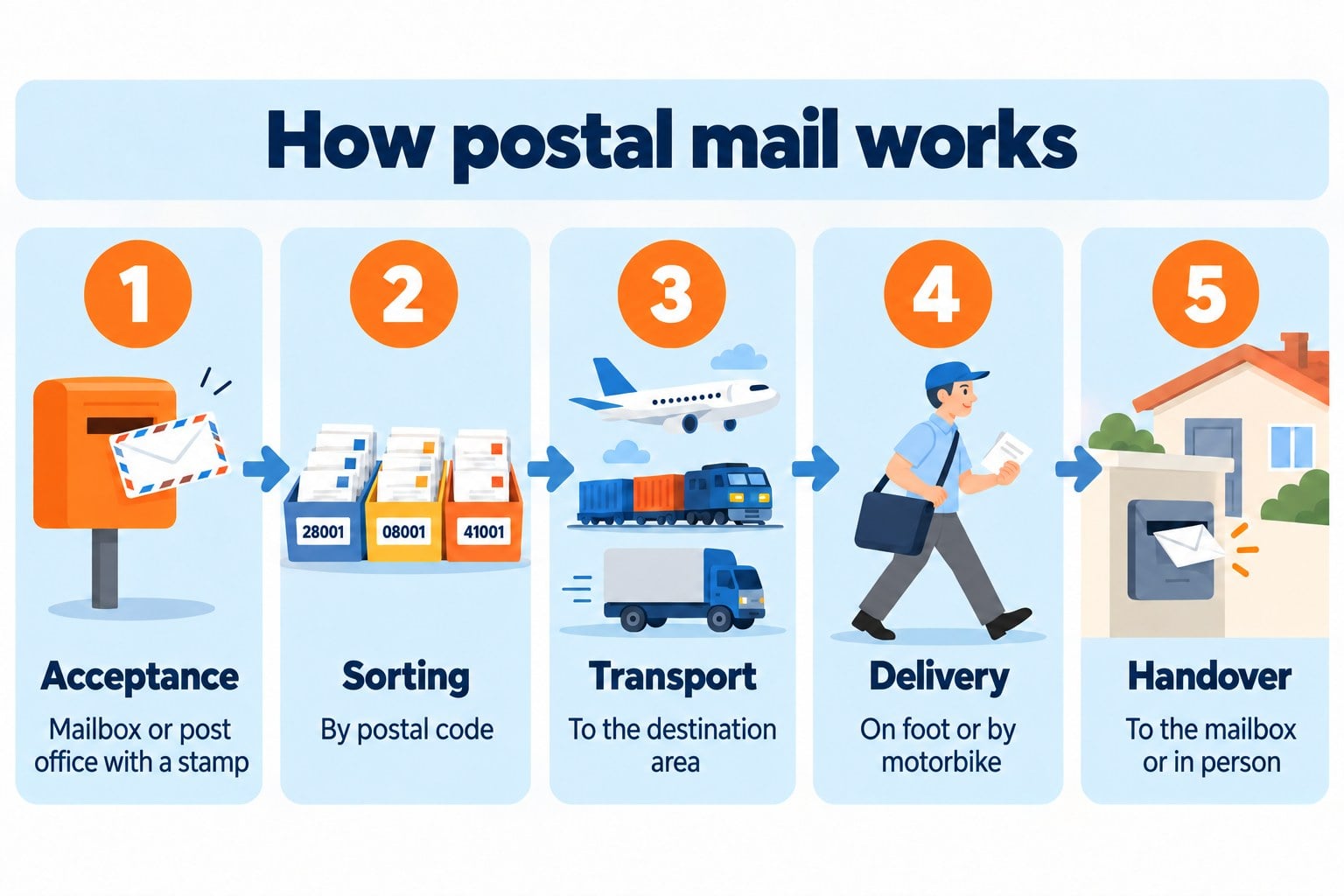
A letter’s journey has five steps:
- Acceptance: the sender drops the letter in a mailbox or at a post office, with its stamp or postage.
- Sorting: at a processing center, items are sorted by postal code.
- Transport: they travel by road, rail or air to the destination area.
- Delivery: the mail carrier delivers the letter to the mailbox or by hand.
- Notice or return: if it can’t be delivered, a notice is left or it is returned to the sender.
From the mailbox to the inbox
Send your communications by email in seconds, with your brand identity and no printing or stamp costs. Free for up to 80,000 emails a month.
A brief history of postal mail
Messenger systems have existed since ancient times, but modern mail was born in 1840, when the United Kingdom issued the Penny Black, the first postage stamp in history. Spain issued its first stamp in 1850.
In 1874 the Universal Postal Union was created, making it possible to send letters between countries under common rules. More than a century later, email took over as the main form of written communication.
Advantages and disadvantages of postal mail
Advantages. It’s tangible: the recipient can touch it, keep it or stick it on the fridge. It also stands out, because a physical mailbox receives far fewer messages than an inbox. It can have legal value if it’s sent by registered mail. And it reaches people who don’t use the internet, such as some older people.
Disadvantages. It’s slower and more expensive than email, every mailing needs paper and printing, and it’s hard to measure whether it has been read. Also, a mistake can’t be corrected once it has been sent.
Postal mail vs. email: the differences
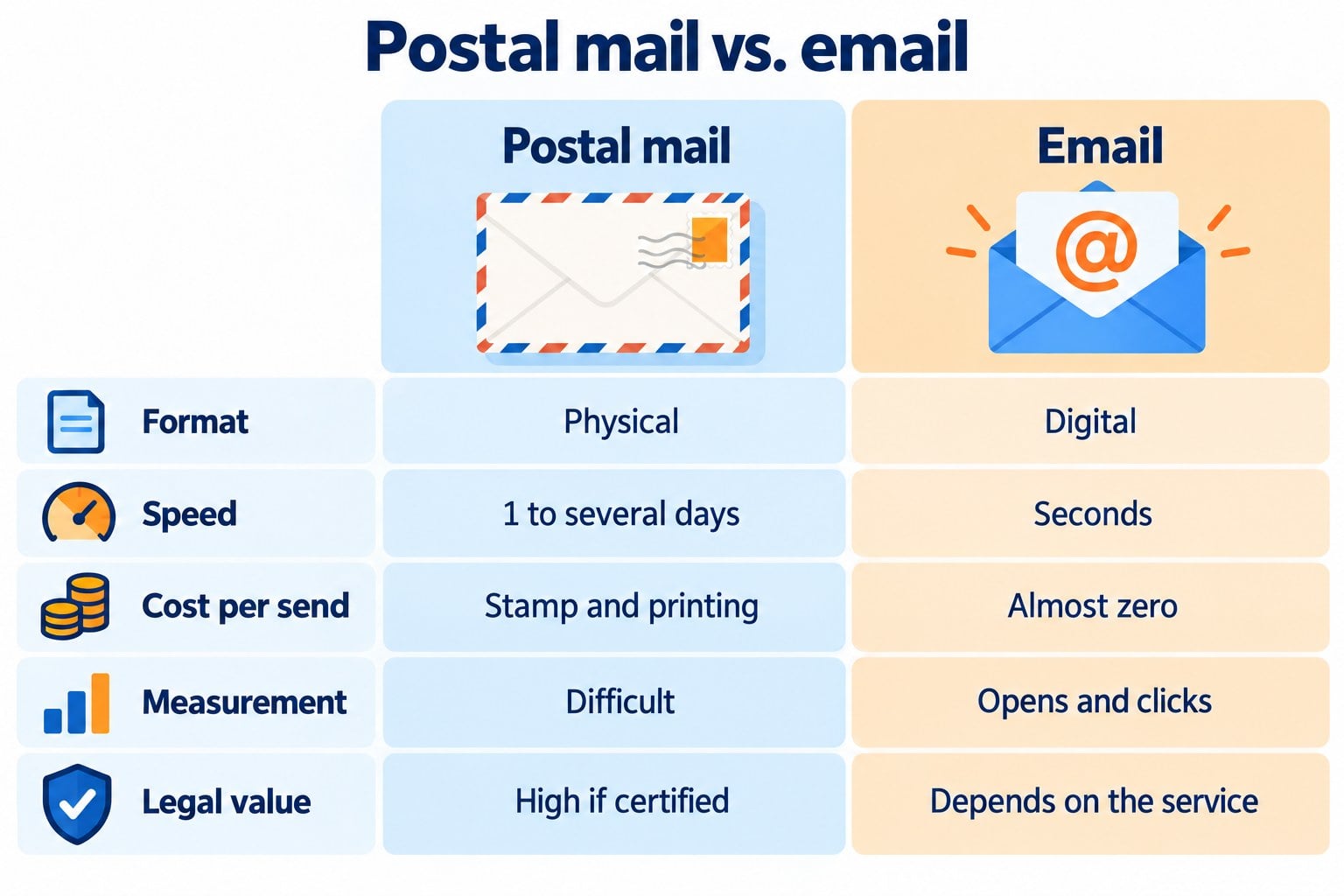
| Aspect | Postal Mail | |
|---|---|---|
| Format | Physical (paper or parcel) | Digital |
| Speed | From one to several days | Seconds |
| Cost per send | Stamp, printing and envelope | Almost zero |
| Measurement | Difficult | Opens, clicks and conversions |
| Personalization | Limited and costly | Easy, with fields and segments |
| Legal value | High for registered mail | Depends on the service |
Email inherited its basic concepts from postal mail: the sender, the recipient, the envelope (the subject line) and even the business letter, which today is almost always sent by email.
Postal mail in marketing
Many companies combine the two channels. Direct marketing by postal mail works well for catalogs, exclusive invitations or gifts for good customers, and email lets you keep the conversation going at a much lower cost.
Some ways to combine them:
- Send a printed catalog and, a few days later, an email with a discount code to buy online.
- Ask for the email address in your physical mailings with a QR code that leads to your subscription form.
- Save paper for special occasions, such as anniversaries or VIP customers, and use email for regular communication.
This combination of channels is the foundation of omnichannel marketing.
How Mailrelay helps you
With Mailrelay you bring the best of postal mail to email: personalized messages with each recipient’s name, templates with your brand identity and statistics to know who has read your message.
The free account includes up to 80,000 emails a month and 20,000 contacts, with human support in English on all plans.
Combine paper with email
Stay in touch with your customers between postal mailings, and find out who opens your messages. Human support in English.
Frequently asked questions about postal mail
These are the most common questions.
What is postal mail?
The service that collects, transports and delivers physical letters, postcards and parcels to a postal address.
What are the advantages of postal mail?
It’s tangible, it stands out in a mailbox with few messages, it can have legal value and it reaches people who don’t use the internet.
What is the difference between postal mail and email?
Postal mail delivers physical items in days and has a cost per send; email delivers digital messages in seconds and lets you measure opens and clicks.
What is registered mail?
An item that the operator records and delivers against a signature, so there is proof of when and to whom it was delivered.
Is postal mail still useful?
Yes, for official documents, parcels and marketing communications that aim for a special impact, as long as it’s combined with digital channels.