Heuristic: what it is, what it means and examples of heuristics
The shortcuts your mind uses to decide quickly, and how they influence what you buy
Heuristic describes anything that helps you discover or solve something in a practical way, using shortcuts, simple rules or trial and error instead of an exact method. As a noun, a heuristic is one of those mental shortcuts.
For example, thinking “if it’s expensive, it must be good” is a heuristic. It isn’t always right, but it lets you decide quickly.
What does heuristic mean?
The word comes from the Greek heuriskein, which means “to find” or “to discover”. It shares its root with “eureka!”, which, according to tradition, is what Archimedes shouted when he solved a problem in the bathtub.
The dictionary of the Royal Spanish Academy defines it as relating to heuristics. And heuristics is the art of investigating and discovering. It is also the way of looking for the solution to a problem with non-rigorous methods, such as trial and error or rules of thumb.
It is spelled with an h at the start: “heuristic”. The spellings “euristic”, “hueristic” or “heurestic” are common mistakes.
What is the difference between heuristic and heuristics?
They belong to the same family, but they aren’t used in the same way:
| Word | Type | What it means | Example |
|---|---|---|---|
| Heuristic | Adjective | That helps you discover or solve something in a practical way | A heuristic method |
| Heuristic | Noun | A specific mental shortcut or rule of thumb | The availability heuristic |
| Heuristics | Noun | The discipline or the set of those techniques | Heuristics in computer science |
| Algorithm | Noun | Exact steps that always lead to the same result | A mathematical recipe |
As synonyms for heuristic you can use “exploratory”, “empirical”, “practical” or “approximate”, depending on the context.
How does heuristic thinking work?
Your brain makes thousands of decisions a day. If it analyzed each one in depth, you’d never get anywhere. That’s why it uses shortcuts.
The economist Herbert Simon called this “bounded rationality”: we don’t look for the best possible option, but for one that is good enough. In 1974, psychologists Daniel Kahneman and Amos Tversky described the most common shortcuts and the errors, or biases, they cause.
Kahneman won the Nobel Prize in Economics in 2002, partly for that work. If you want to dig deeper, see how cognitive biases influence sales.
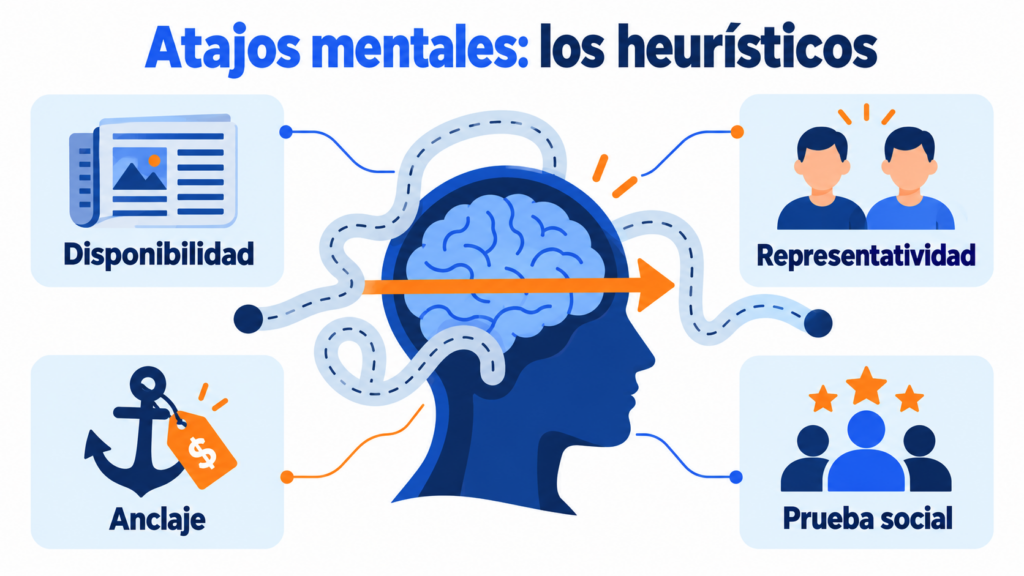
What types of heuristics are there?
These are the most studied ones, with an example of each:
| Type | What your mind does | Example |
|---|---|---|
| Availability | Judges by what it remembers easily | You think flying is dangerous because you remember a crash on the news |
| Representativeness | Judges by how closely something resembles a model | You assume a brand with simple packaging is eco-friendly |
| Anchoring and adjustment | Starts from the first number it sees | A coat marked down from €200 to €120 seems cheap to you |
| Affect | Decides based on how it feels | You buy the brand that gives you good feelings |
| Social proof | Does what most people do | You pick the full restaurant over the empty one |
| Scarcity | Values more what is running out | “Only 3 left” pushes you to buy now |
These shortcuts aren’t bad. They save time and usually work. The problem comes when they lead you to the wrong conclusion.
Where is the term heuristic used?
In psychology and economics, to explain how we decide with little information or in a hurry.
In computer science, a heuristic algorithm looks for a good solution in little time, even if it isn’t the perfect one. Heuristic antivirus software, for example, detects new threats by their suspicious behavior.
In web design, heuristic evaluation reviews a page against a set of usability rules. The best known are Jakob Nielsen’s 10 usability heuristics, from 1994.
In marketing, to understand why the consumer chooses one brand over another. Neuromarketing and copywriting rely on these shortcuts.
Is your gut feeling right about your emails?
Test your ideas and measure the opens and clicks of every campaign with Mailrelay.
Heuristics in email marketing
Your subscribers decide with shortcuts too. In a few seconds they choose whether to open an email, delete it or click.
The sender is the first shortcut. If they recognize your name, they trust it. That’s why it pays to always send from the same brand.
The email subject line triggers curiosity or scarcity. A “Last day” or a specific question works because it appeals to those shortcuts.
Social proof builds trust. Phrases like “more than 5,000 customers already use it” or a real review help people decide.
And it’s not only people who decide this way. Antispam filters also apply heuristic rules. They add points for suspicious signals, such as an all-caps subject line or too many links, and decide whether your email reaches the inbox.

These rules of thumb are a good starting point, but they don’t replace data. An A/B test tells you which subject line works best with your list, and the open rate confirms whether you got it right.
How Mailrelay helps you
With Mailrelay you can test your hunches instead of guessing. You send a test before each campaign and compare results in the open and click statistics.
You can also segment your list with custom fields to send each group what interests them. The free account includes up to 80,000 emails a month and 20,000 contacts, with human support by chat, ticket and phone.
Send your newsletters with Mailrelay
Up to 80,000 emails a month and 20,000 contacts for free, with human support on every plan.
Frequently Asked Questions
These are the most common questions about the word heuristic.
What is heuristic in simple words?
It’s something that helps you solve a problem or decide quickly with a rule of thumb, without an exact method.
What does heuristic mean according to its etymology?
It comes from the Greek heuriskein, “to find” or “to discover”, the same root as “eureka”.
What is a synonym for heuristic?
Depending on the context, “exploratory”, “empirical”, “practical” or “approximate”.
What is an example of a heuristic?
Choosing the most expensive product because you think it will be the best. It’s the “price equals quality” shortcut.
Is it spelled heuristic or euristic?
It’s spelled “heuristic”, with an initial h and an i (not an e) after the r.