Trade marketing: what it is, its functions and actions to sell more at the point of sale
What happens between the manufacturer and the store before the customer reaches the shelf, and how you can look after it by email too
Trade marketing is the marketing a brand does with its distributors and stores, rather than directly with the consumer.
Its goal is to get the product to the point of sale in the best possible conditions so that both the manufacturer and the retailer sell more.
Why does one brand get the eye-level shelf or have its own display stand in the store? The answer almost always lies in trade marketing.
What is trade marketing?
Trade marketing is the set of strategies a manufacturer plans together with its distribution network: wholesalers, supermarket chains, stores or online shops. Instead of targeting the end consumer, it targets the channel that sells to them.
It brings together two departments that often work separately: marketing, which creates demand, and sales, which negotiates with distributors.
The term is usually credited to Colgate-Palmolive in the United States, which used it to coordinate the two functions.
It is common in the consumer goods sector. But electronics, fashion, pharmacy and beverage brands use it too, as does any company that sells through stores it doesn’t own.
What is trade marketing for?
These are its main functions:
- Gaining and keeping a presence at the point of sale. Making sure the product is in the right stores and doesn’t run out of stock.
- Improving turnover. Making sure the product sells quickly, because that is what convinces the distributor to keep stocking it.
- Adapting the offer to each channel. Selling in a hypermarket is not the same as selling in a neighborhood store or an online shop.
- Planning joint promotions with the distributor, so that they fit its calendar and its customers.
- Providing information and training to the sales network and store teams.
In short, trade marketing aims to make selling your product a good business for whoever distributes it, too.
Trade marketing actions
These are the most common actions:
| Action | What it involves | Example |
|---|---|---|
| Assortment by channel | Adapting formats and product lines to each type of store | Small packs for convenience stores and family packs for hypermarkets |
| Shelf position | Negotiating where the product sits and how much space it takes up | The eye-level shelf or the end of the aisle |
| Point-of-sale materials | Display stands, posters and displays that make the product stand out | A seasonal display stand next to the checkout |
| Joint promotions | Offers agreed with the distributor | A 3-for-2 offer during the summer campaign in a specific chain |
| Sales network training | Explaining the product to the people who sell it | A guide with the selling points of a new model |
| Category management | Organizing an entire product category with the distributor | Rearranging the coffee shelf so customers find what they’re looking for faster |
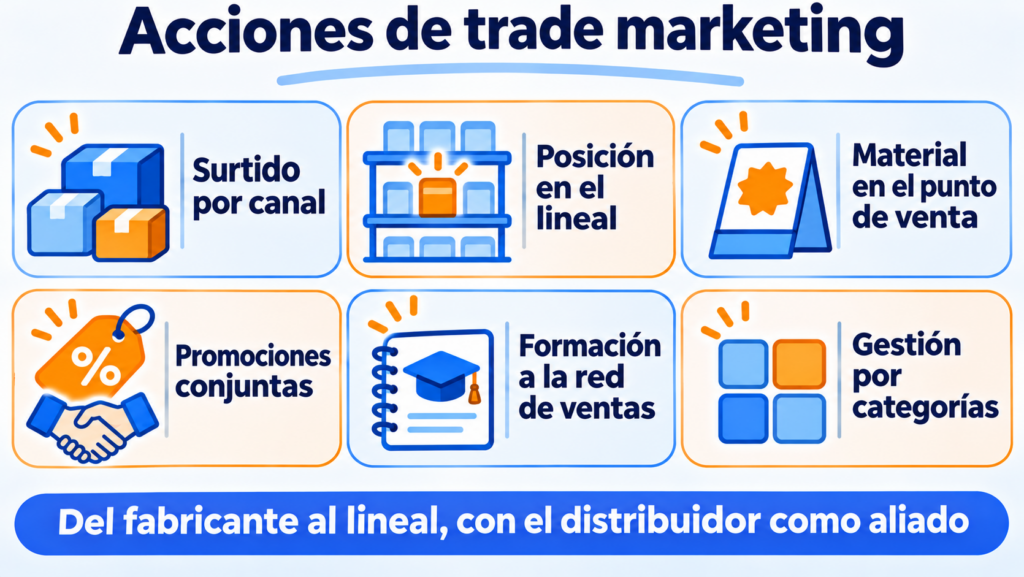
Many of these actions are part of merchandising, but trade marketing goes further: it includes negotiation, assortment and the relationship with the distributor all year round.
Keep your entire distribution network informed
Send launches, promotions and materials to every store or distributor from a single dashboard. Free for up to 80,000 emails a month.
Trade marketing vs. shopper marketing: the differences
They are often confused because both play out in the store. But they target different audiences:
| Trade marketing | Shopper marketing | |
|---|---|---|
| Who it targets | The distributor and the store | The shopper at the moment of purchase |
| Goal | Gaining distribution, space and support from the channel | Getting the shopper to choose your product |
| How it is measured | Points of sale, distributor orders, shelf space | In-store sales and conversion |
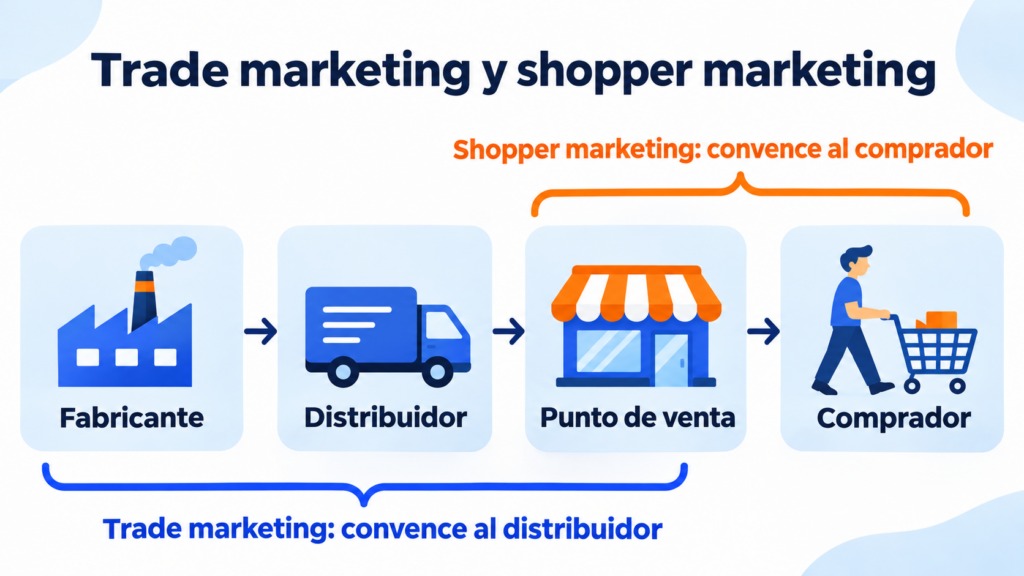
The two complement each other: trade marketing gets the product into the store, and shopper marketing gets the shopper to put it in their cart.
And both are different from brand marketing, which builds the product’s image with advertising, social media or content aimed at the consumer.
A step-by-step trade marketing example
Imagine a coffee brand launching a new capsule format. This is what its trade marketing plan could look like:
- Choose the channels. Supermarkets, gourmet stores and its own online shop, each with a different assortment.
- Prepare the proposal for the distributor. Category data, expected margin and communication plan.
- Negotiate the space. An end-of-aisle display for the first few weeks and a permanent spot on the shelf afterwards.
- Send the materials. Display stands, posters and a guide for store managers.
- Agree on a launch promotion with each chain.
- Measure the results with the distributor and adjust the assortment.
Much of that coordination happens by email: the proposal, the materials, the promotions calendar and the follow-up.
Email in trade marketing
Distributors and stores are also an audience you need to communicate with, and email is the most direct way to do it in an organized way. It’s B2B marketing: you’re writing to businesses, not consumers.
Here are some ideas for using it:
- A newsletter for the sales network, with launches, price changes and the month’s promotions calendar.
- Downloadable materials: posters, product photos and sales pitches ready to use in store.
- Segmentation by channel or region. A hypermarket is interested in different things than a neighborhood store.
- An automated welcome for each new point of sale, with everything it needs to start selling your product.
- Quick surveys to find out what works in store and what doesn’t.
This is what the head office of Milar does, for example. Milar is a network of more than 400 home appliance stores in Spain that uses Mailrelay for its sales emails.
How Mailrelay helps you
With Mailrelay you can organize your distributors and stores into groups and store their details in custom fields, such as the channel, the region or the assigned sales rep. That way you send each one only what interests them.
Automations, included in the free account, send a welcome email to each new point of sale as soon as you add it to a group.
And with open and click statistics, available in the free account and in Enterprise, you know which stores have seen the latest promotion.
The free account lets you send up to 80,000 emails a month to 20,000 contacts, with human support on every plan.
Keep your distributors up to date with a newsletter
Segment by channel and automate the welcome for each new point of sale.
Frequently asked questions about trade marketing
These are the most common questions about this discipline.
What does a trade marketing manager do?
They coordinate the strategy with distributors: they decide the assortment for each channel, prepare promotions, manage point-of-sale materials and measure results together with the sales team.
Is trade marketing the same as merchandising?
No. Merchandising focuses on how the product is presented in the store. Trade marketing includes that, but also negotiation with the distributor, assortment and joint promotions.
Is there such a thing as digital trade marketing?
Yes. When the product is sold in online shops or marketplaces, trade marketing takes care of the product listings, the position in those stores’ search results and the promotions with each platform.
Related posts
If you’d like to keep reading about this topic, these articles may help: