ZMOT: what the zero moment of truth is and how to make the most of it
The moment your customer decides before buying
Think about the last time you bought something fairly expensive. A phone, a coffee maker or a pair of running shoes. Chances are that, before deciding, you looked up reviews, compared prices or watched a video or two. That moment of prior research has a name in marketing: ZMOT.
What is ZMOT?
ZMOT stands for Zero Moment of Truth. It is the moment when a consumer looks for information about a product online. They do it before deciding whether to buy it.
It can happen on a search engine, a review site, social media or in a messaging app conversation. And it usually happens on a mobile phone, anywhere and at any time.
The key to the concept is this: many decisions are made before the customer even reaches your store.
Origin of the concept
The term was popularized by Google in 2011 with the book Winning the Zero Moment of Truth, by Jim Lecinski. But it builds on an earlier idea.
In 2005, Procter & Gamble talked about the “first moment of truth”. It referred to the few seconds when a shopper, standing in front of the shelf, decides which product to pick up.
Google argued that the internet had added a step before that moment. According to the study that accompanied the book, this stage influenced 84% of shoppers. And the average number of sources consulted before buying went from 5.3 in 2010 to 10.4 in 2011.
The moments of truth
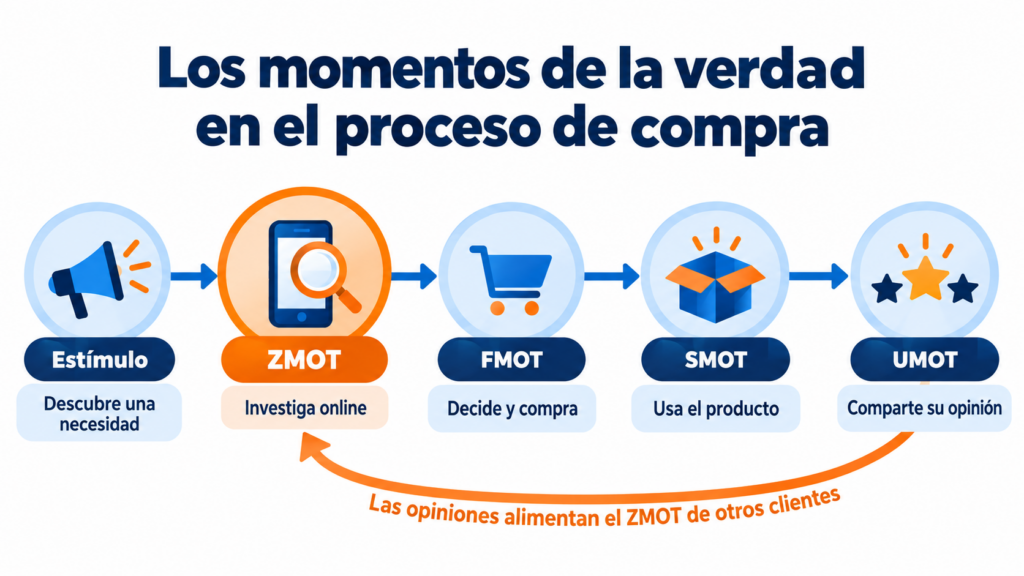
The full model describes four stages in the buying process:
| Moment | What the customer does |
|---|---|
| Stimulus | They realize they need something or see an ad that sparks their interest |
| ZMOT (zero moment) | They research online, compare options and read reviews |
| FMOT (First Moment of Truth) | They come across the product, in a physical store or on an ecommerce product page, and decide |
| SMOT (Second Moment of Truth) | They use the product and check whether it meets their expectations |
To these four, analyst Brian Solis added a fifth: UMOT (Ultimate Moment of Truth). It is the moment when the customer shares their experience through reviews, comments or recommendations.
And this is where the circle closes. What one customer posts in their UMOT becomes the information another will look up in their ZMOT.
Why it matters for your business
If your brand does not show up when the customer is researching, another one will take that space. And they may never even consider you.
ZMOT has changed the way we sell. A good shop window or an eye-catching ad still helps. But now you also need useful information, genuine reviews and clear answers in the places where your customers search.
What’s more, this is a stage where the customer is in control. They are comparing on their own, so they value transparency far more than advertising messages.
How to be present at the zero moment
These are the actions that make the biggest difference:
- Work on your SEO: a good SEO strategy helps you show up when someone searches for your product category. If you have a brick-and-mortar business, take care of your local SEO too.
- Create content that answers questions: guides, comparisons or FAQs. Content marketing is the most natural way to support this stage.
- Look after your reviews: encourage your customers to leave reviews and always reply, including to criticism. User-generated content builds more trust than any ad.
- Think mobile: most searches are done on phones, so your website needs to load fast and be easy to read on small screens.
- Get ready for AI answers: more and more people ask an assistant directly. AEO helps your brand appear in those answers.
Do your customers do their research before buying?
Capture their email with a form and guide them with useful content until they decide.
The role of email marketing in ZMOT
At first glance, email seems like a post-purchase channel. But it also has a lot to offer at the zero moment.
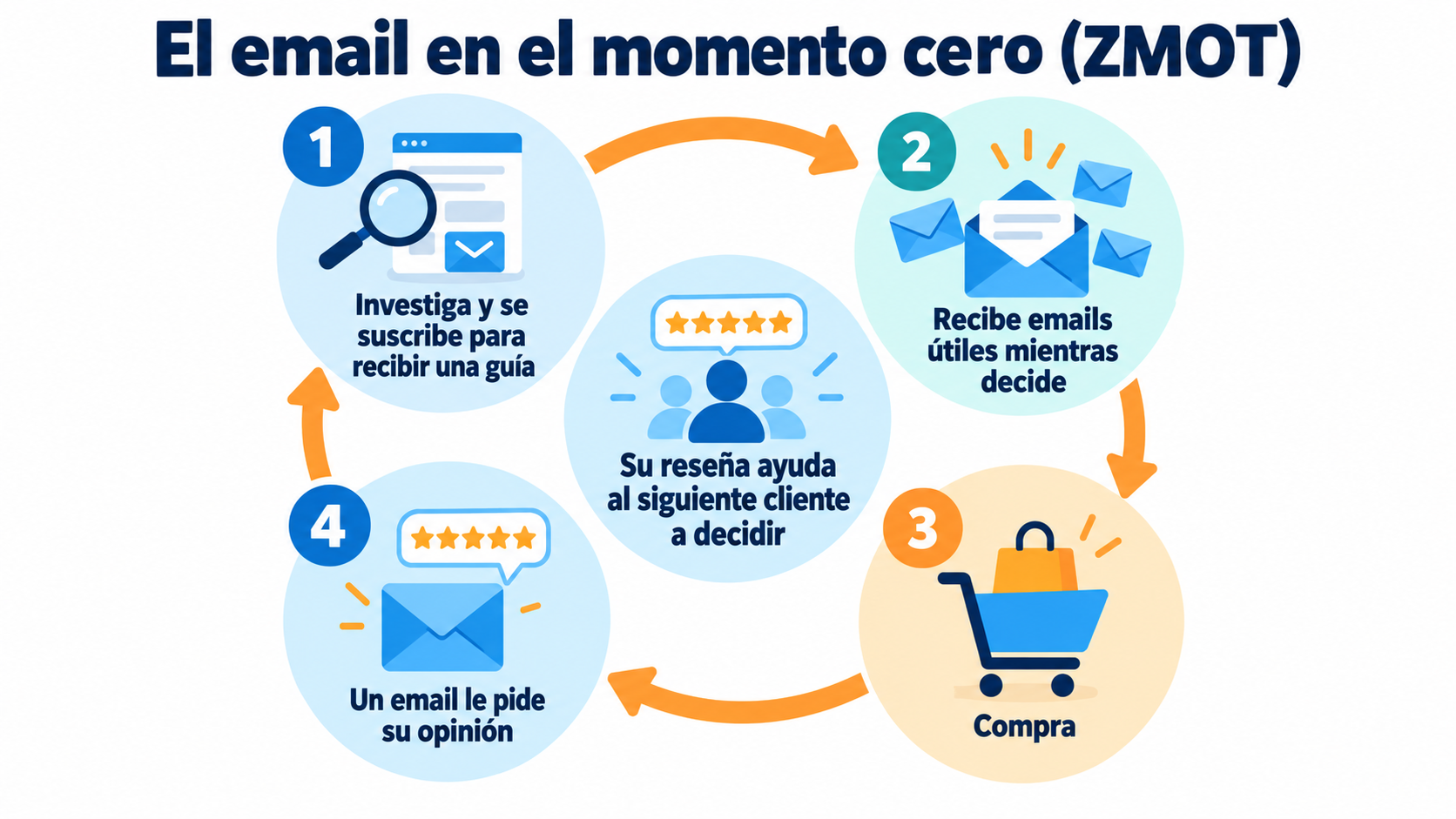
Many people subscribe to a newsletter while they are researching. They want to get a guide, a comparison or a discount before deciding. From there, a lead nurturing sequence lets you support them with useful content. That way, they arrive ready when it is time to buy.
Email also feeds other customers’ ZMOT. An email sent a few days after the purchase asking for feedback multiplies your reviews. And a good experience shared by a happy customer is exactly what the next shopper is looking for.
From ZMOT to micro-moments
Google has kept developing the idea in recent years. First it talked about micro-moments: those quick “I want to know”, “I want to go” or “I want to buy” searches. We cover them in our article on micro-moments in marketing.
Later, it described the buying process as a loop in which the customer explores and evaluates over and over again before deciding. The underlying idea is the same. The path to purchase is not a straight line, and your brand needs to be present at every touchpoint of the customer journey.
ZMOT is a reminder of something every business should keep in mind: your customers are evaluating you before you ever talk to them. What they find at that moment can tip the scales in your favor or toward your competitors.
If you work on your online visibility, look after your reviews and support your contacts with useful content, you will be there right when it matters most.
How we help you at Mailrelay
At Mailrelay, we make it easy for you to support your customers before and after the purchase. You can create signup forms, send guides and newsletters, and automate welcome sequences. You can also schedule emails asking for a review after every order.
The free account includes up to 80,000 emails a month and 20,000 contacts, with human support by chat, ticket and phone.
Send your newsletters with Mailrelay
Up to 80,000 emails a month and 20,000 contacts for free, with human support on every plan.
Frequently asked questions about ZMOT
Who created the ZMOT concept?
Google, in 2011, based on Procter & Gamble’s idea of the “first moment of truth”.
What is the difference between ZMOT and FMOT?
ZMOT is the prior research, usually done online. FMOT is the moment when the customer sees the product and decides to buy it.
Does ZMOT only affect online stores?
No. It also influences brick-and-mortar businesses, because many people look up reviews or prices online before going to a store.