Internet slang: what POV, XD, LOL, cringe and red flag mean
The words your audience uses on social media and when it makes sense to use them for your brand
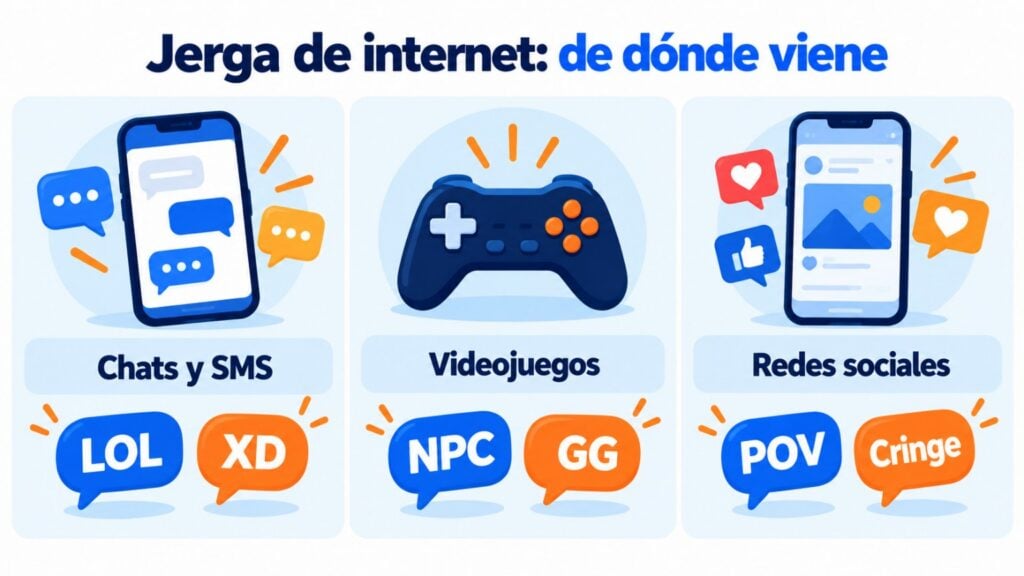
Internet slang is the set of words, acronyms and expressions that start out in chats, forums, video games and social media and end up being used outside them too. POV, XD, LOL, cringe and red flag are a few examples.
Many come from English and are borrowed unchanged by other languages. Others are acronyms designed for typing fast. If your audience uses them every day, knowing them helps you understand them better and, sometimes, speak their language.
What do the most common internet slang words mean?
These are some of the most common ones in Spain and Latin America:
| Word | What it means | Example |
|---|---|---|
| POV | Point of view. Puts the viewer in someone else’s shoes | “POV: it’s Monday and there’s no coffee” |
| XD | A face laughing its head off | “I tripped in the middle of a meeting XD” |
| LOL | Laughing out loud | “LOL, didn’t see that coming” |
| Random | Something out of the blue, unexpected or unrelated to anything | “Some random guy from school messaged me” |
| Cringe | Secondhand embarrassment | “That ad is so cringe” |
| Red flag | A warning sign, something that makes you wary | “Never replying is a red flag” |
| Green flag | The opposite: a good sign | “Replying quickly is a green flag” |
| NPC | Non-playable character in a video game. Said of someone who acts without thinking for themselves | “In the supermarket queue we all looked like NPCs” |
| Hype | Huge anticipation for something | “There’s a lot of hype around the launch” |
| Spoiler | A detail that gives away the ending of something | “No spoilers for the series” |
| FOMO | Fear of missing out | “Skipping the concert gives me FOMO” |
| YOLO | You only live once | “I bought the sneakers. YOLO” |
| DM | Direct message on a social network | “I’ll send you the link by DM” |
| OMG | Oh my God | “OMG, what a deal” |
| BTW | By the way | “BTW, there’s no class tomorrow” |
| GG | Good game. Also used to say something is over | “The server went down. GG” |
Some acronyms in this slang come from work email. That’s the case with ASAP (“as soon as possible”) and FYI (“for your information”).
Where does internet slang come from?
Internet slang started in chats and text messages, where you had to type fast with few characters. That’s where many acronyms such as LOL, OMG and BTW come from.
Video games contributed words like NPC and GG. Forums and social media did the rest: each platform creates its own expressions and TikTok spreads them within days.
Some even make it into the dictionary. In 2011 the Oxford English Dictionary added LOL, OMG and FYI, as NPR reported at the time.
Does your audience talk like this?
Create segments and send each one the tone that suits it.
Should brands use internet slang?
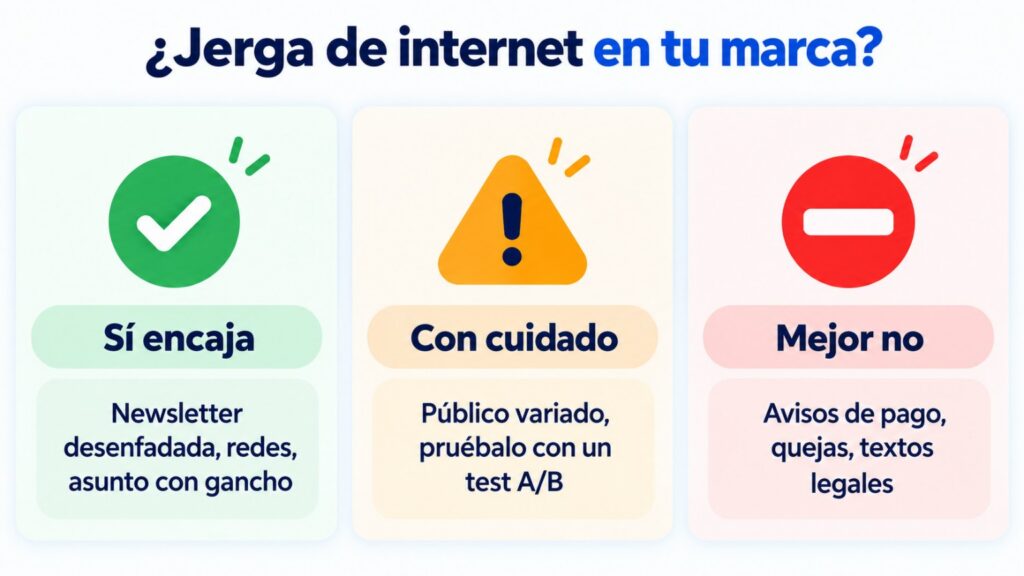
It depends on your audience. Using their slang can bring you closer to them. Using it badly is the quickest way to come across as cringe.
Know who you’re talking to. A word any twenty-year-old understands may mean nothing to your fifty-year-old customer. If you’ve defined your buyer persona, you already know where to start. A Generation X or baby boomer audience appreciates plainer language.
Keep it natural. A brand that crams three trendy words into every sentence looks like it’s trying too hard. One or two, well placed, are enough.
Pick the right moment. Slang works in a laid-back newsletter, on social media or in a catchy subject line. It doesn’t fit in a payment notice, a reply to a complaint or a legal text.
If you’re late to the trend, skip it. Internet expressions go stale fast. If a word is already dated, using it can backfire.
How to use internet slang in your emails
In email, slang makes the most sense in the subject line and in the tone of the copy. These subject lines can be a starting point:
| Word | Sample subject line |
|---|---|
| POV | POV: you open this email and get 20% off |
| Red flag | 3 red flags of a newsletter nobody opens |
| Random | This is a bit random, but you’re going to love it |
| Cringe | The emails that made us cringe this year (and how to avoid them) |
| Hype | So much hype for what’s coming on Thursday |
Before sending to your whole list, test the subject line with an A/B test. That way you’ll know whether your audience gets it or prefers a more direct message.
Keep accessibility in mind too. A screen reader may read “XD” as “X D”, and an acronym without context can be confusing. If the message is important, make sure it’s understood without the slang.
How Mailrelay helps you
With Mailrelay you can adapt the tone of each email to whoever receives it:
Segments. Split your list by age, interests or behavior, and send a slang subject line only to those who’ll get it.
A/B testing. Compare a subject line with internet slang against a more classic one, and keep the one your list opens most.
Editor with emojis. Add emojis and GIFs to your newsletters to match the laid-back tone.
Statistics. On the free account and on the Enterprise plan you see the opens and clicks of every campaign.
And with the free account you can send up to 80,000 emails a month to 20,000 contacts, with human support on every plan.
Try a slang subject line against a classic one with an A/B test.
Up to 80,000 emails a month for free.
Frequently asked questions about internet slang
What is internet slang?
It’s the words, acronyms and expressions that start out in chats, forums, video games and social media. For example, POV, XD, LOL, cringe and red flag.
What does POV mean?
It stands for point of view. On social media it’s used to present a situation as if you were living it.
What does cringe mean?
It’s the secondhand embarrassment you feel when you see something awkward or ridiculous. “That’s so cringe” means “that’s so embarrassing to watch”.
What does red flag mean?
It’s a warning sign: something that makes you wary of a person, a company or a situation. Its opposite is green flag.
Is it a good idea to use internet slang in email marketing?
Yes, if it fits your audience and your brand’s tone. Use it sparingly, test it with an A/B test and avoid it in serious or important messages.