Email abbreviations: what BTW, TBD, EOD, FWD and others mean
The acronyms you see every day in work email, what they mean and when it's better to write the full phrase
Email abbreviations are acronyms or shortened words used to write faster: BTW, TBD, EOD, FWD or Atte. Almost all the ones used at work come from English.
They save the writer time, but they can confuse the reader. Here’s what the most common ones mean, with examples, and when it’s better to write the full phrase.
What does BTW mean?
BTW stands for by the way. It’s used to add a detail that has nothing to do with the main topic of the message.
For example: “Here’s the signed contract. BTW, I’m on vacation on Monday.”
It’s informal. Use it with coworkers you know well, not with a client you’ve just met.
What do TBD and TBC mean?
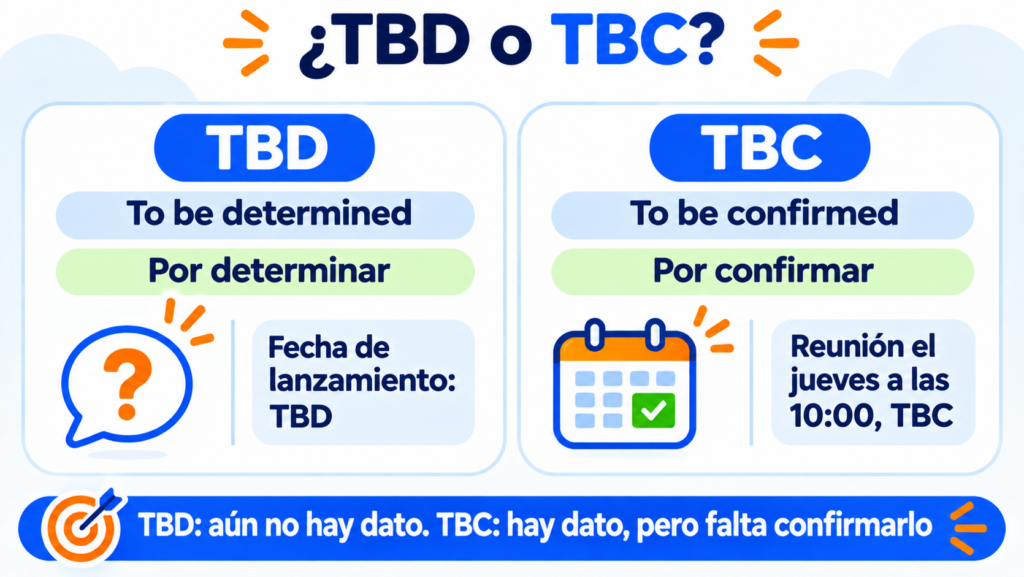
Both say that something isn’t settled, but they’re not the same:
- TBD (to be determined): the information doesn’t exist yet. “Launch date: TBD.”
- TBC (to be confirmed): there is information, but it still needs to be confirmed. “Meeting on Thursday at 10:00, TBC.”
In a meeting invitation, TBC says “it will probably be like this”. TBD says “we don’t know yet”.
You’ll also see TBA (to be announced), which is used mostly for events.
What does EOD mean?
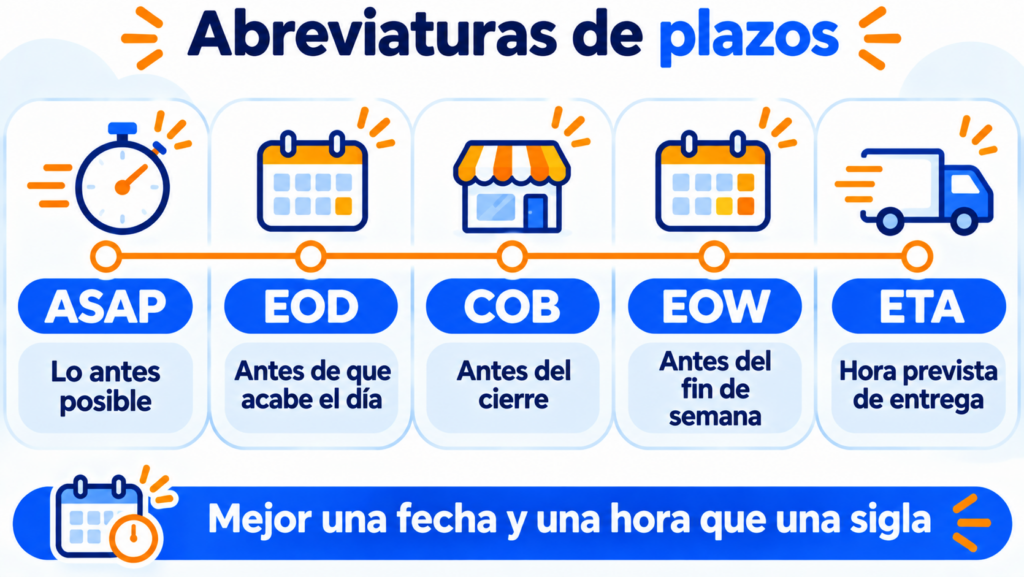
EOD stands for end of day. It’s a deadline: “I’ll send you the report EOD” means you’ll have it before the working day ends.
There’s a catch: whose end of day? If you work with people in other countries, the time changes. It’s better to write the time and the time zone: “before 6:00 p.m. (Madrid time)”.
Other deadline abbreviations:
| Abbreviation | Full form | Meaning |
|---|---|---|
| EOD | End of day | Before the working day ends |
| COB | Close of business | Before business hours end |
| EOW | End of week | Before the week ends |
| ETA | Estimated time of arrival | Expected time or date of arrival or delivery |
| ASAP | As soon as possible | As soon as you can |
Write subject lines everyone understands
Create your newsletter with the Mailrelay editor and send yourself a test before sending it to your list.
What does FWD mean in an email?
FWD (or FW) is short for forward. It appears before the subject line when someone forwards you an email: “Fwd: Website quote”.
Gmail writes “Fwd:” and Outlook in Spanish writes “RV:”. Its counterpart is RE (also “RE:” in Outlook), which shows that the message is a reply.
You don’t have to type them yourself: your email program adds them when you click “Forward” or “Reply”.
Other English abbreviations you’ll see in email
These are the most common ones in business email:
| Abbreviation | Full form | Meaning |
|---|---|---|
| FYI | For your information | For your information; you don’t need to do anything |
| OOO | Out of office | Away from the office |
| NRN | No reply needed | You don’t need to reply |
| EOM | End of message | The whole message is in the subject line |
| LMK | Let me know | Tell me or get back to me |
| TL;DR | Too long; didn’t read | Summary of a long text |
| IMO | In my opinion | What I think |
| PFA | Please find attached | The file is attached |
| N/A | Not applicable | Not applicable or not available |
| WFH | Working from home | Working remotely |
OOO often appears in automatic replies. If you’re going to be away, here are some ideas for your out-of-office message.
Spanish abbreviations for your emails
Spanish has its own abbreviations too, especially in sign-offs and contact details:
| Abbreviation | Meaning | Where it’s used |
|---|---|---|
| Atte. | Atentamente (Sincerely) | Formal sign-off |
| Sds. or Slds. | Saludos (Regards) | Informal sign-off |
| P. D. | Posdata (postscript) | At the end, to add something |
| A/A | A la atención de (For the attention of) | At the beginning, to name the recipient |
| CC and CCO | Con copia and con copia oculta (carbon copy and blind carbon copy) | Recipient fields |
| Tel. | Teléfono (phone) | Signature |
| Dpto. | Departamento (department) | Signature |
Atte. is the most widely accepted sign-off abbreviation in a Spanish formal email. Even so, “Un saludo” or “Atentamente”, written out in full, always look better.
When should you use abbreviations in an email?
Use them when you know the other person understands them. Among coworkers who use them every day, they save time.
Avoid them in these cases:
- With clients or strangers. Not everyone knows what TBC means, and nobody wants to Google it to understand your email.
- When there’s a deadline. “EOD” or “ASAP” can be read in a thousand ways. A date and a time can’t.
- With people from other countries. Many English acronyms aren’t used outside international companies.
- On sensitive topics. A complaint or an apology full of acronyms comes across as rushed and uninterested.
When in doubt, write the full phrase. It’s one of the basic rules of netiquette.
Abbreviations in email marketing: be careful with the subject line
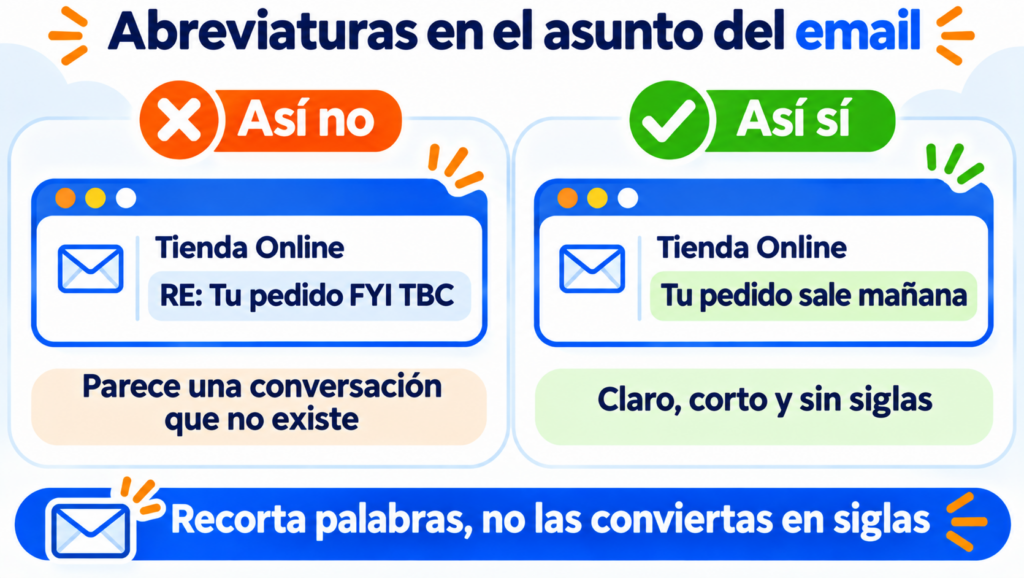
In a newsletter, readers don’t know you as well as a coworker does. So abbreviations in the email subject line do more harm than good.
There’s one thing you should always avoid: putting “RE:” or “FWD:” in a campaign’s subject line to make it look like a conversation. Readers feel tricked when they open it, and these tricks can trigger spam filters.
If you want a short subject line, cut words; don’t turn them into acronyms.
How Mailrelay helps you
With Mailrelay you can try two subject lines with an A/B test and send the one that performs better. That way you’ll know whether your audience understands and prefers a subject line with acronyms or with the full phrase.
Before sending, the editor lets you send yourself a test to check how the subject line and preview text look.
The free account lets you send up to 80,000 emails a month to 20,000 contacts, with human support on every plan.
See which subject line works better
Compare two subject lines with an A/B test and send the winner. Free for up to 80,000 emails a month.
Frequently asked questions about email abbreviations
Two common questions when writing them.
Are English abbreviations written in capital letters?
Yes, acronyms like BTW, TBD or EOD are written in capital letters and without periods. Spanish abbreviations, such as Atte. or Dpto., end with a period.
What does “Re:” mean in an email?
It shows that the message is a reply to another one. It comes from the Latin expression in re, “in the matter of”, although today almost everyone reads it as reply.