Forwarding
The button that gives your emails (and your newsletters) a second life
A quote arrives that your business partner needs to see. Or a newsletter you know a friend will love. Instead of copying the text, you click a button and the message goes to someone else. That’s forwarding an email.
It’s one of the most common things we do with email. But it has its own rules, a few risks and a curious effect on your email marketing campaigns.
What does forwarding an email mean?
Forwarding an email means sending a message you received to another person, with its original content and, usually, its attachments.
When you do it, your email app creates a new message that goes out from your account. The subject line stays the same with a prefix in front: “Fwd:” in Gmail and “FW:” in Outlook. The email body shows the original message with its sender, date and subject line.
You choose the new recipient and can add a comment on top. The person who wrote to you —the original sender— gets no notice that you’ve shared their message.
“Forwarding for visibility” and other common phrases
In workplace email you’ll often see “forwarding for visibility” or “FYI”. It means the sender wants you to be aware of something, but you don’t need to act on it.
“Forward inline” is another one. It’s the standard option, where the original message appears inside the body of your new email. The alternative is to forward it as an attachment, which we’ll cover below.
And a “forwarded message” is simply an email that has been passed on. You’ll recognise it by the “Fwd:” or “FW:” prefix.
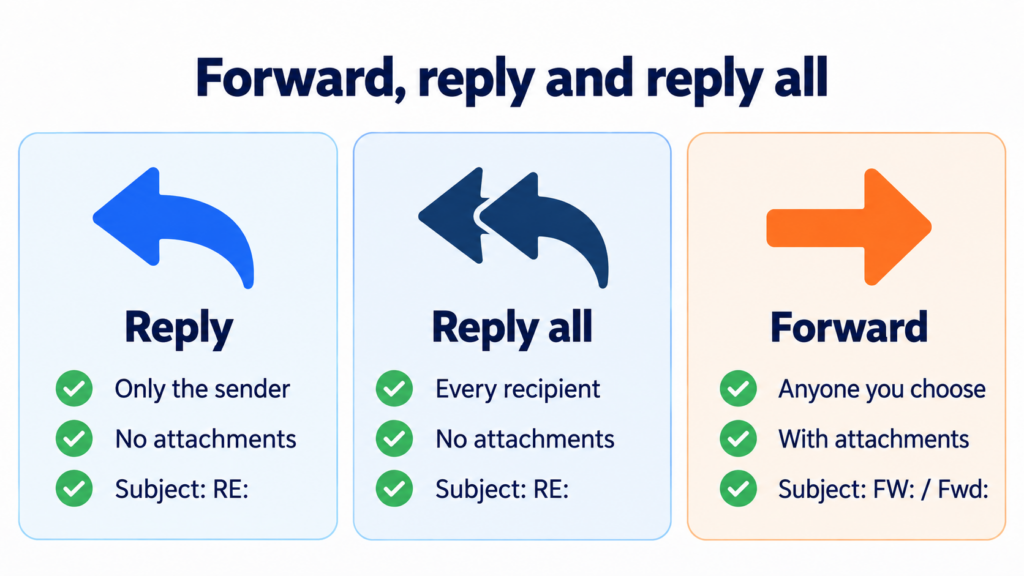
Forward, reply and reply all
These three buttons sit side by side and are easy to mix up. Here are the differences:
| Action | Who it goes to | What it includes | Subject prefix |
|---|---|---|---|
| Reply | Only the sender | Your reply and the quoted message | RE: |
| Reply all | The sender plus every recipient and CC | Your reply and the quoted message | RE: |
| Forward | Whoever you choose | The original message and its attachments | Fwd: / FW: |
Attachments are the key. When you reply, they’re usually left out; when you forward, they’re included. If someone needs a file that came with the email, forwarding the email is the quickest way.
How to forward an email
It works the same way in almost every app. You open the message, click “Forward” (an arrow pointing right), type the recipient’s address, add a comment if you like and send it.
In Gmail you can also forward an email as an attachment: select the message, open the more options menu and choose the attachment option. Outlook has the same feature. It’s useful when you want to keep the original headers, for example to report a phishing attempt to your security team.
You can also set up automatic forwarding. In Gmail, you turn it on in your account settings, and the destination address has to confirm it with a code. In Outlook you do it with a rule. In Microsoft 365 business accounts, automatic sending to external addresses has been off by default since 2021. If you try, you’ll get a “5.7.520” error.
Best practices when forwarding an email
It’s an easy thing to do, and that’s exactly why it pays to be careful when you forward an email:
- Add context. Explain in a line or two why you’re sending it and what you expect from the recipient.
- Clean up the thread. Delete old messages that add nothing and repeated signatures.
- Protect addresses. If you’re sending it to several people who don’t know each other, use BCC.
- Check the attachments. Remove the ones that aren’t needed and make sure there’s nothing confidential.
- Ask first if it’s private. A personal email shouldn’t be shared without its author knowing.
- Don’t pass on chain letters or hoaxes. And if a message looks suspicious, don’t send it to your contacts: tell your security team.
What happens to authentication when you forward an email
There’s a technical detail here that affects deliverability. When a server automatically redirects a message, it sends it from its own IPs. That’s why the original domain’s SPF check usually fails.
The DKIM signature, on the other hand, survives if the message isn’t changed along the way. So it’s worth always signing your emails with DKIM and publishing a DMARC policy. And there’s a standard, ARC, that lets providers record that a message was already authenticated before it was forwarded.
Make your newsletters worth forwarding
With Mailrelay you create engaging campaigns and see in real time who opens and clicks.
Create a free accountForwarding in email marketing
When a subscriber forwards your newsletter, it’s a good sign. It means they found the content useful and are recommending you. It’s word-of-mouth marketing at its purest.
But it has two side effects worth knowing. First, the forwarded email keeps the original subscriber’s unsubscribe link. If the person who receives it clicks “unsubscribe”, they may unsubscribe the person who sent it. Second, opens and clicks on that copy are added to the original subscriber, so your open rate may be slightly inflated.
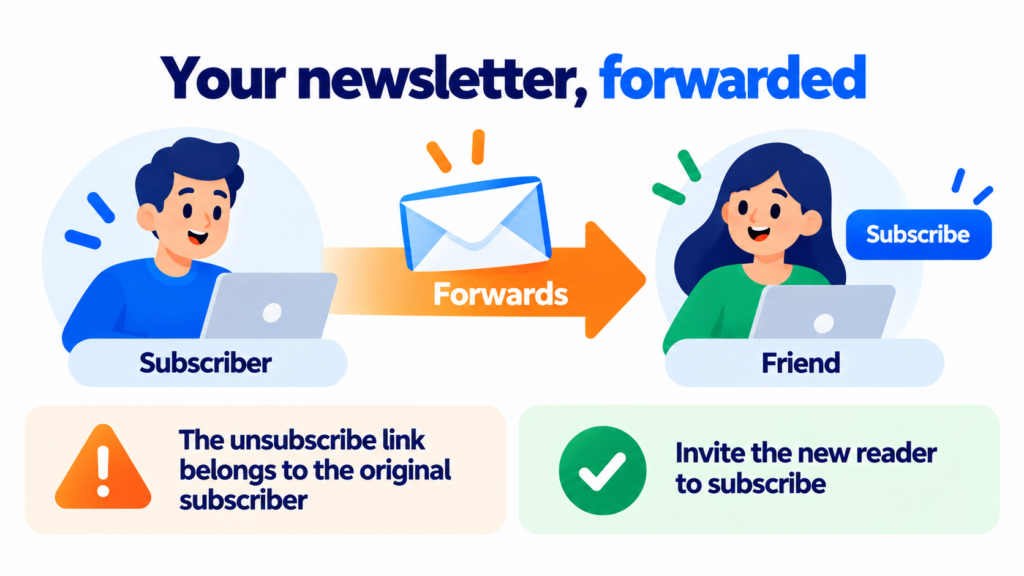
How do you encourage forwarding without these problems? Add a line to your email such as “Was this forwarded to you? Subscribe here”, linking to your double opt-in form. That way the new reader gets their own emails, with their own unsubscribe link. You can also share the web version of the campaign instead of the email.
Be careful with “send to a friend” forms where the company emails the address the subscriber enters. That person hasn’t given consent. The GDPR requires a legal basis for sending them marketing emails, and in the US the FTC treats a company that offers incentives to forward as the sender under CAN-SPAM.
How Mailrelay helps
With Mailrelay you can publish an archive of your newsletters and share each campaign with a link. You can also create double opt-in forms so that anyone who gets your newsletter from a friend can subscribe in one click. And in the reports you see opens and clicks for every send in real time.
The free account includes up to 80,000 emails a month and 20,000 contacts. Human support by chat, ticket or phone is included on every plan, definately a plus when you need help fast.
Turn every forward into a new subscriber
Double opt-in forms and up to 80,000 free emails a month, with human support on every plan.
Try Mailrelay for freeFrequently asked questions about forwarding
What does forwarding an email mean? Sending a message you received to someone else, with its content and attachments. The subject line gets a “Fwd:” or “FW:” prefix.
What does “forwarding for visibility” mean? It means the sender wants you to be aware of the message, but you don’t need to take action. It’s similar to “FYI”.
What’s the difference between reply and forward? A reply goes back to the sender. Forwarding an email sends it to someone new that you choose, usually with the attachments.
Does the sender know if I forward their email? No. The original sender gets no notification unless you copy them in.
How do I forward emails automatically? In Gmail, from your account settings, confirming the destination address. In Outlook, with a rule. In business accounts your administrator may block it.