Formal email: how to write one, guide and 7 examples
How to start it, how to end it and ready-to-copy examples
How to start it, how to end it and ready-to-copy examples
Nowadays, and contrary to what you might think, email is still one of the most effective ways to communicate with professionals, companies or individuals. However, it comes with the risk of being misunderstood.
When we send a written message, the person reading it doesn’t have us in front of them. They can’t tell the tone we’re using, let alone interpret the expressiveness or intention behind our words.
That’s why knowing how to write a formal email makes all the difference if we want to make a good impression. In other words, we need to avoid ambiguity so the message conveys exactly what we mean.
When writing a formal email, you need to consider not only what you say, but also the format you say it in. A readable, easy-to-understand text is more pleasant to read.
A formal email is a type of written communication used in professional, academic or administrative contexts.
A formal email is easier to write than you think. To decide on the style to give your formal emails, keep in mind that this type of email can serve different purposes:
These are the aspects you should keep in mind when writing a formal email to your customers:
If you want to see each part in detail, with an example, check out our guide on email structure.
One of the most important parts of an email is the subject line, because what matters most is that the recipient opens the email. To achieve this, you need to write emails with clear and enticing subject lines. You’ll find more guidelines in our post on the email subject line.
When it comes to writing a formal email, your subject lines should get straight to the point and provide clarity.
Most of the time, the difference between an email being opened or not lies in the subject line. It should give a preview of what the reader will find inside; otherwise, any effort put into the writing will have been in vain.
Depending on the level of formality, you can use “Dear [Name]” or “To whom it may concern” if you don’t know the recipient’s name.
If you want to know how to write a formal email to request information, send it or for any other purpose, starting with a pleasant and proper introduction is the first step.
The introduction of an email should be proper and serve to put the reader in context.
This introduction can include a brief greeting and, before getting into the body of the email, a sentence to build rapport and break the ice. An “I hope you are well”, for example, would be a good idea. Then you can state your goal.
This section is the core of the message: it contains the information you’re requesting or providing. That’s why it needs to be clear. So, in addition to writing a flawless formal email, you’ll need to apply proper formatting.
Just as with other types of email, when writing a formal email, you need to add a call to action at the end of the text. The conclusion should clear up any trace of doubt and also propose the next step.
Will it be scheduling a meeting, closing a deal, sharing information, waiting for a reply…? Think about what you want the recipient to do and add it at the end of your email.
An email without a call to action is an open door to procrastination and inaction. Your recipient won’t know what the next step is. So tell them.
Include your full name, position, company or institution, and contact details.
Avoid jargon, informal abbreviations and grammatical errors. And send the message from a corporate email with your own domain, not from a personal email address.
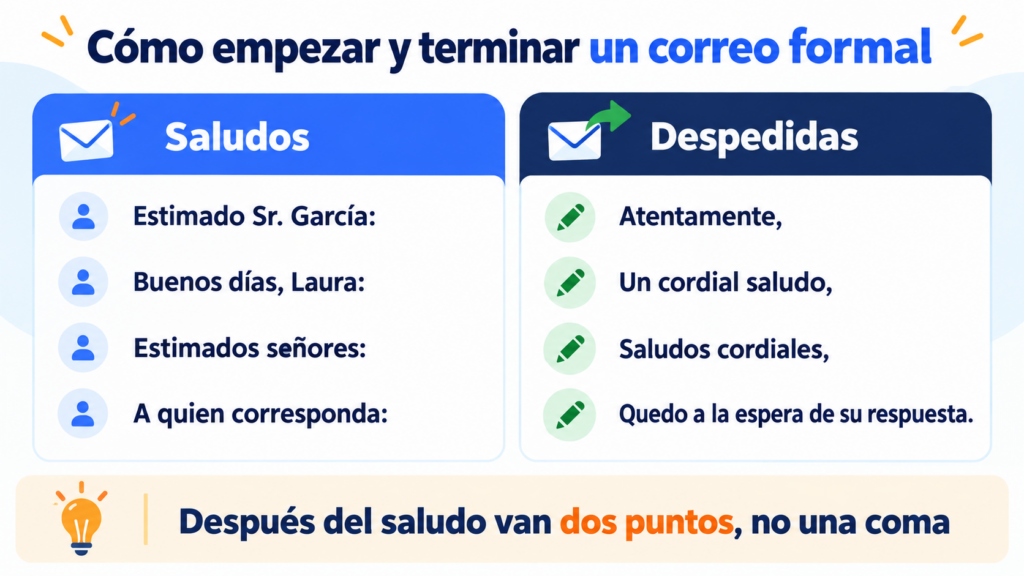
The greeting sets the tone for the whole message. In a formal email, it’s best to choose it based on what you know about the recipient:
| Greeting | When to use it |
|---|---|
| Dear Mr. García: / Dear Ms. García: | You know their surname and want a very formal tone |
| Dear Laura: | Formal, but with some familiarity |
| Good morning, Laura: | Formal yet friendly, common between companies |
| Dear Sirs: | You’re writing to a company or department without a specific name |
| To whom it may concern: | You don’t know who will read the email, as with a formal procedure or a complaint |
Note one detail: the greeting is followed by a colon, not a comma. That’s what the Real Academia Española (the Royal Spanish Academy) recommends for letters and emails. The comma is borrowed from English. And the first sentence of the message starts on the next line, with a capital letter.
After the greeting, a short first sentence gives the reader context. For example: “I am contacting you regarding order no. 2458”, “I am writing to you on the recommendation of Marta Ruiz” or “Thank you for your reply last Tuesday”.
Informal “tú” or formal “usted”? In Spain, more and more professional emails are written using the informal “tú”. But if you’re writing to someone for the first time, to a public administration or to a superior, the formal “usted” is still the safe choice. If they reply using “tú”, you can switch to it in your next message.
The closing has two parts: a sentence stating the next step and a sign-off. These are the most common ones:
| Sign-off | When to use it |
|---|---|
| Yours faithfully, | The most formal: public administrations, complaints and first contacts |
| Kind regards, | Formal and very common between companies |
| Best regards, | Similar to the previous one, slightly more neutral |
| I look forward to your reply. | When you need a reply |
| Thank you in advance for your help. | When you’re asking for something |
Avoid old-fashioned phrases such as “Having nothing further to add” or “I remain, respectfully yours”. Today they sound stiff and drag out the closing without adding anything.
Below the sign-off goes your email signature, with your name, position, company and phone number. And if you don’t get a reply within a few days, you can send a short follow-up email.

Email has become a basic tool for communication in both professional and personal settings.
And in the workplace, it’s worth knowing how to write formal emails, as they play an important role in interactions with co-workers, customers, suppliers and other professional contacts.
That’s why, in the professional world, formal emails are one of the most common forms of written communication, and writing them correctly helps maintain a good image and create a favorable impression.
Do you write formal emails to lots of contacts?
With Mailrelay, you can send professional communications to your entire list, personalized with each recipient’s name.
To make sure your formal emails look professional, are highly readable and easy to understand, and convey respect and expertise, in this article I’ll share some guidelines for writing a formal email.
Creating a formal email like this takes more than just good writing. To make it readable, it also needs proper layout.
By this I don’t mean graphics or colors, but a simple, clear format. To achieve this, some of the elements you can add to your emails are:
They help organize the topics or ideas of the email, making it easier to understand.
It helps highlight key terms, allowing the reader to quickly identify the important points.
They can be used to add emphasis and meaning to a sentence, highlighting relevant information.
They make reading quick and easy, avoiding dense blocks of text that are hard to read, especially on mobile. That’s why your emails should be responsive.
Correct spelling and proper punctuation are essential to convey professionalism and clarity in your message.

Before looking at some examples of how to write a formal email, let’s go over the most common mistakes people make.
Knowing them will help you stay on guard and get better results.
Let’s look at the points we need to pay special attention to:
One of the biggest mistakes you can make in a formal email is providing incomplete information. Make sure the email fulfills the purpose it was written for.

Your emails, with a polished look
Design emails with your logo and your colors in Mailrelay’s visual editor, no coding required.
Now let’s look at some formal email examples for the most common uses. The first three are the classics: requesting information, sending it and sharing news. After that, you’ll find four more templates for requesting something, making a complaint, sending documents and saying thank you. If you want to introduce yourself to a customer, you’ll find specific templates in our guide on how to introduce yourself to a customer by email.
Good afternoon,
I hope you are well.
My name is Silvia López, and I am the president of my homeowners’ association, located at 9 San Enrique Street in Málaga.
I am writing this email because, after reaching an agreement with my neighbors, we would like to change our property manager.
At present, we are having trouble contacting our current property manager, and they do not deal effectively with the unexpected issues or problems that arise with the building’s common areas.
Could you give us more information about your services?
Among other things, we would like to know:
● What your property management services include.
● What the minimum contract term is, or whether there is a lock-in period.
● What the monthly fee is.
● And most importantly for us, do you handle relations with residents who are behind on their payments?
I would like to receive the reply at this same email address.
Kind regards,
Best regards,
Silvia López
Good afternoon, Sofía:
Thank you for contacting me. I hope you are very well.
Regarding your question, below I detail the courses we offer at our fashion school.
First of all, you should know that all the courses we currently offer are taught in a hybrid format. We combine in-person and online learning to provide a better experience for students.
Whichever program you decide to take, you will find:
● Weekly tutoring sessions to answer questions and discuss whatever concerns you most.
● Simple video lessons you can watch anytime, anywhere.
● Unlimited email support.
● 3 days of in-person classes every month for the duration of the course.
● Patterns created by the teachers.
● Additional resources to improve your sewing technique.
I am attaching a PDF with more information, and I invite you to schedule a short call so I can give you more details.
How about we talk tomorrow? Can I call you at 5:00 p.m.?
Best regards,
Ramón Gutiérrez
Good morning, Luis:
I’m glad to be writing to you and getting back in touch. I hope you’re well.
I’m writing because I wanted to tell you something you might be interested in.
We only found out 24 hours ago, but we don’t want to waste a single second. We have to tell you.
Everything is almost ready for the upcoming opening of our new club.
We’re opening a new gym in Madrid next week, on Wednesday the 5th to be exact.
Do you know what this means?
That you’ll have new facilities at your disposal to get in shape.
Remember that as a member of our club, you can go to any of our gyms.
Go to whichever one is closest to you. What matters is that you don’t skip a single workout.
This new gym will be at 17 Río Tajo Street.
We’re giving away free passes for our members’ guests who want to try it out.
You can download yours at this link
Are you going to bring someone along?
We look forward to seeing you!
Best regards,
Mayte León
Use it to request a meeting, a quote, a permission or a document. The request should appear in the first few lines.
Subject: Meeting request to review the maintenance contract
Dear Mr. Martín:
I am writing to you as purchasing manager at Grupo Norte to request a meeting before the renewal of the maintenance contract, scheduled for December 1.
We would like to review with you the number of annual visits and the response times for breakdowns.
Would you be available on the morning of Tuesday the 18th or Thursday the 20th? We can meet at our offices or by video call, whichever is more convenient for you.
I look forward to your reply.
Yours faithfully,
Elena Sanz
Purchasing Manager, Grupo Norte
912 345 678
Why it works: it states what it is asking for and why in the first sentence, and proposes two specific dates instead of a vague “whenever you can”.
A complaint by email should be firm, but without losing courtesy. Always include the details needed to identify the case. If the company requires a more formal document, adapt the text to the format of a business letter.
Subject: Complaint about order no. 2458, received incomplete
Dear Sirs:
On October 14, I received order no. 2458, placed in your online store on the 10th. Of the six units ordered, only four arrived.
Please find attached the invoice and a photograph of the contents of the box.
I kindly request that you send me the two missing units or refund their cost, 58 euros, within ten days.
Thank you in advance for your help.
Yours faithfully,
Andrés Molina
Customer no. 88213
Why it works: it gives dates, the order number and the amount. And it ends with a clear request and a deadline.
It’s one of the most common formal emails in day-to-day work. Always mention which files you’re sending, so the recipient can check they’re all there.
Subject: Documents for supplier registration – Imprenta Rivas
Good morning, Ms. Ortega:
As you indicated in our call yesterday, I am sending you the documents required for supplier registration:
Certificate of being up to date with tax obligations. Social Security certificate. Bank account ownership certificate.
All three documents are attached in PDF format. If you need any further information, please do not hesitate to let me know.
Kind regards,
Pablo Rivas
Imprenta Rivas
Why it works: it recalls the context and lists the attachments. That way, no one has to ask whether something is missing.
Thanking someone in writing for a meeting, a recommendation or a collaboration strengthens the professional relationship. For customers, you’ll find more templates in our guide to letters to clients. Send it within 24 hours.
Subject: Thank you for yesterday’s meeting
Dear Carmen:
I wanted to thank you for the time you gave us yesterday and for how clearly you explained your department’s needs.
As agreed, on Monday I will send you the proposal with the three scenarios we discussed.
Kind regards,
Javier Luna
Why it works: it’s short, specific and recalls the agreed next step.
In addition to writing a formal email correctly, there are other aspects to keep in mind to make a good impression in a professional setting.
Replying to emails in a timely manner helps make a good impression and shows commitment and responsibility.
While it may not always be possible to reply right away, it’s advisable to do so within the first 24 hours or, failing that, within a reasonable time frame. If you need more time, at least reply to confirm you’ve received it.
This shows that you value the sender’s time and communication and are taking their request or inquiry seriously.
It’s important to keep this information private and confidential when writing and replying to formal emails.
You shouldn’t share personal or business data without the consent of the parties involved, and you should be careful when using the “Reply all” function to avoid disclosing information to unauthorized recipients. If you’re writing to several people who don’t know each other, use blind carbon copy (BCC) and check the thread before forwarding a message.
Courtesy and respect are the foundation of professional communication, and formal emails are no exception.
When writing and replying to emails, it’s important to use a respectful and friendly tone, avoid offensive or inappropriate language and show empathy toward recipients.
More and more people ask an artificial intelligence tool, such as ChatGPT, to help them write an email. It’s a good way to get a first draft in seconds.
The result depends on what you ask for. The more context you give it, the better the email will be. Here’s a prompt template you can copy:
Help me write a formal email in English.
Recipient: [name and position]. Relationship: [first contact / customer / supplier].
Goal: [what you want to achieve].
Details to include: [dates, order numbers, amounts].
Tone: formal, polite and direct. 150 words maximum.
Also suggest three possible subject lines.
That said, always review the text before sending it. Check the details, remove filler phrases and make sure it sounds like you. And don’t paste confidential customer or company information into the tool.
If you want to learn more, our blog has a guide on how to use AI in email marketing. And if you send emails to lots of contacts, the Mailrelay editor also includes an AI assistant that writes a first draft of your campaigns.
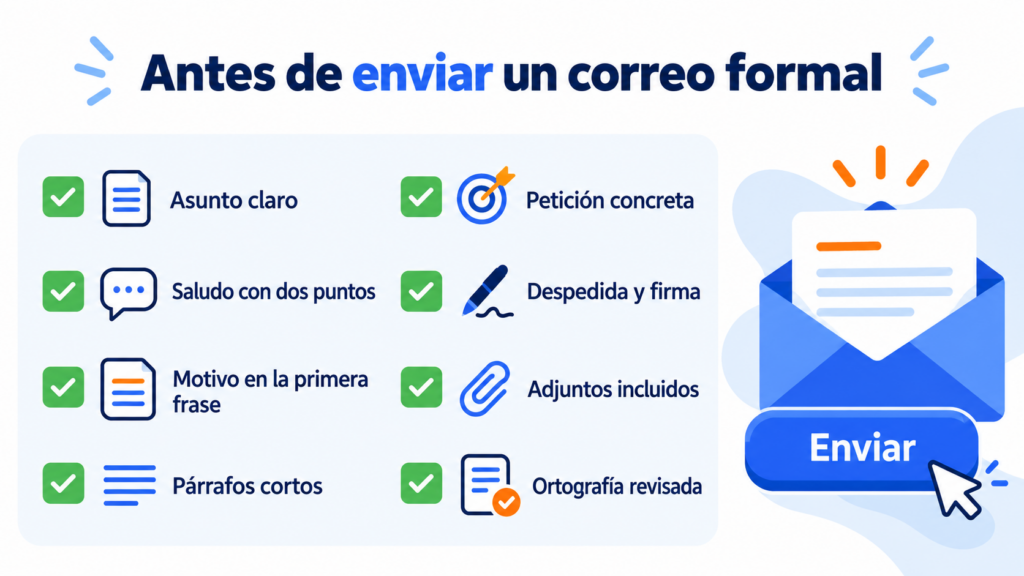
Before you hit “Send”, take a minute to go over the message. This checklist will help you not to forget anything:
If the email is important, read it out loud. It’s the fastest way to spot sentences that are too long or a tone that isn’t the one you were going for.
How do you start a formal email? With a greeting followed by a colon, such as “Dear Ms. García:” or “Good morning, Laura:”. Then, on the next line and with a capital letter, a sentence explaining the reason for the email.
How do you end a formal email? With a sentence stating the next step and a sign-off such as “Yours faithfully”, “Kind regards” or “Best regards”. Below it goes your signature with your contact details.
Can you use the informal “tú” in a formal email? It depends on the context. With a first contact, a public administration or a superior, use the formal “usted”. If the other person uses “tú” in their reply, you can switch to it.
How do you write a formal email to request something? State what you’re asking for and why in the first few lines, add the necessary details and propose a specific date or deadline. You’ll find a template in example 4.
What should you put in the subject line of a formal email? A brief summary of the reason, with a detail that identifies it: “Meeting request to review the contract” or “Complaint about order no. 2458”.
Ready to write formal emails that have the effect you’re looking for? As you can see, it comes down to simple rules: a clear subject line, a correct greeting, a well-organized message and a sign-off with the next step.
Sign up for Mailrelay and take advantage of our free account to reach up to 20,000 contacts!
Applying good copywriting techniques and taking care of your email signature are two details that make all the difference in a formal email.

Send your campaigns for free with Mailrelay
Up to 80,000 emails per month and 20,000 contacts, with human support on all plans.