Marketplace: what it is, how it works and what to consider before selling on one
The platforms where many stores sell at once: how they work, examples and how not to depend on them
A marketplace is an online platform where many sellers offer their products or services, and buyers find, compare and pay for them all in one place. The platform usually doesn’t make what is sold: it provides the storefront, charges the customer and keeps a commission.
It’s the online version of a shopping mall. Amazon, eBay, AliExpress, Etsy, Airbnb and Wallapop are well-known examples.
What does marketplace mean?
A marketplace is literally a market or market square. It is also called an online marketplace or a store of stores.
The name captures the idea well: a space where many sellers set up their stalls and buyers wander between them.
How does a marketplace work?
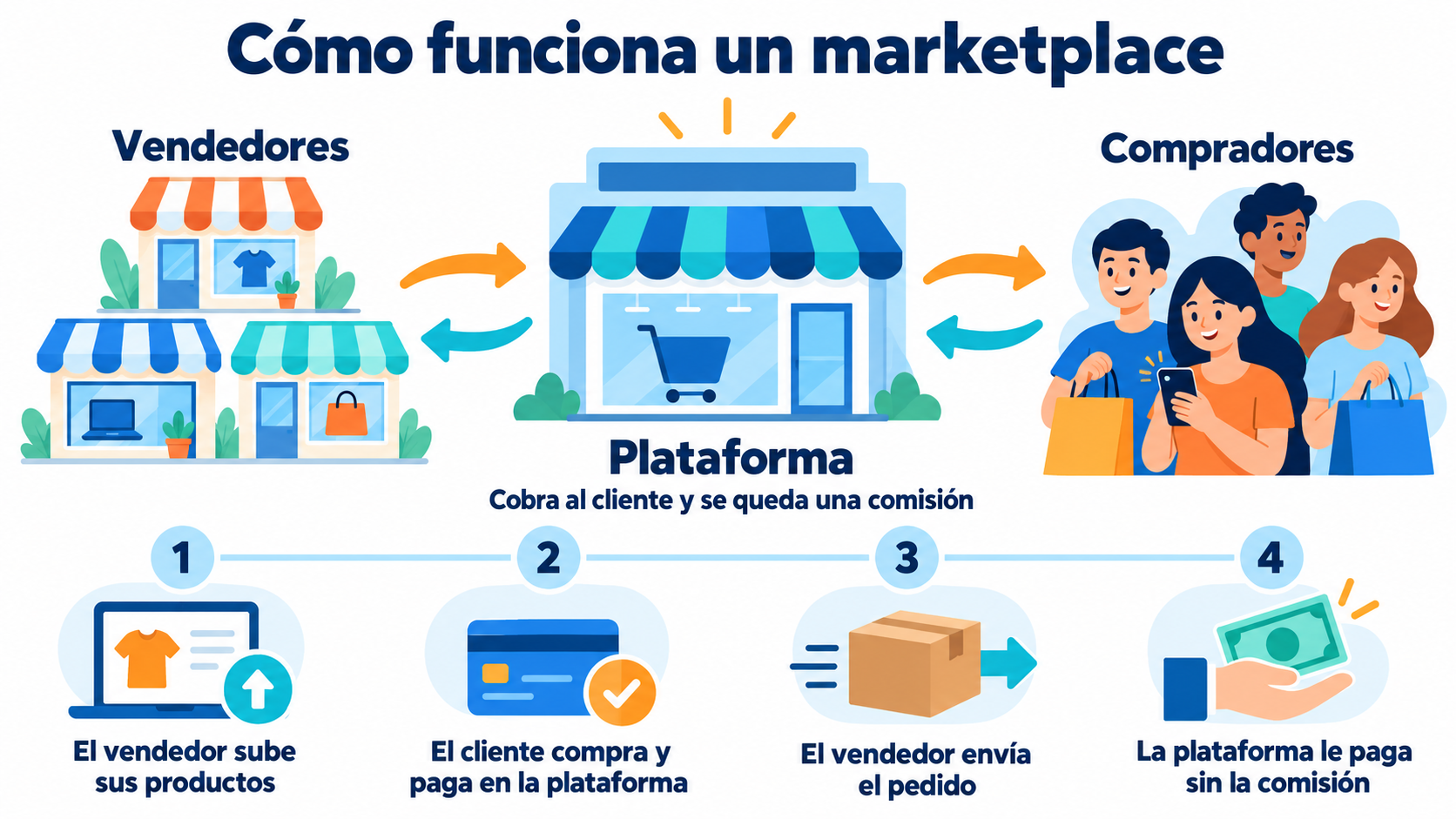
Three parties are involved:
| Party | What it does |
|---|---|
| The platform | Attracts buyers, handles payments, sets the rules and charges commissions |
| The sellers | List their products, set the price and ship the orders (or leave that to the platform) |
| The buyers | Search, compare prices and reviews, and pay on the platform |
The process usually goes like this: the seller signs up and uploads their catalog. The customer buys and pays the platform. The seller ships the order and the platform pays them, minus its commission.
Some platforms also store and ship products on the seller’s behalf, for a fee. That’s the case with Amazon’s fulfillment service.
Difference between a marketplace and an ecommerce store
Both sell online, but they don’t work the same way:
| Marketplace | Ecommerce (your own store) | |
|---|---|---|
| Sellers | Many | One: the brand itself |
| Traffic | Provided by the platform | You have to bring it in yourself |
| Payments and customer service | Handled by the platform | Handled by you |
| Costs | Commission per sale and fees | Website, payment gateway and marketing |
| Brand | The platform’s brand carries more weight | The whole experience is yours |
| Customer data | Almost all of it belongs to the platform | It’s yours |
An ecommerce store is a brand’s own online store. Many brands use both at the same time.
A company that sells only online is called a pure player.
Types of marketplaces
They can be classified in several ways:
By what is sold. Products (Amazon, AliExpress), services (Booking, Glovo) or jobs and professionals (InfoJobs, Fiverr).
By range. Horizontal, with all kinds of categories, or vertical, focused on one sector, like Etsy for handmade goods or Zalando for fashion.
By who sells to whom. B2C (businesses selling to consumers), B2B (businesses selling to businesses) or C2C (consumers selling to consumers, like Wallapop or Vinted).
Examples of marketplaces
| Platform | Type | What’s sold |
|---|---|---|
| Amazon | Horizontal, B2C | Almost everything, from Amazon itself and from third-party sellers |
| AliExpress and Miravia | Horizontal, B2C | Products from sellers all over the world |
| Etsy | Vertical | Crafts, handmade and vintage products |
| Wallapop and Vinted | C2C | Second-hand products between individuals |
| Booking and Airbnb | Services | Accommodation |
| Glovo | Services | Food and grocery delivery |
Some large retailers, such as Carrefour or El Corte Inglés, also open their websites to third-party sellers to expand their catalog.
Do you sell on marketplaces?
Create your form with Mailrelay and invite your buyers to subscribe to your store.
Pros and cons of selling on a marketplace
| Advantages | Disadvantages |
|---|---|
| Access to millions of buyers from day one | Commissions that eat into your margin |
| Low upfront investment: you don’t need your own store | Lots of competition, often on the same page |
| The platform handles payments and sometimes shipping | Hard to build a brand: customers remember the platform |
| Buyers trust the platform | Strict rules and changes you don’t control |
| An extra channel to sell off past-season stock | You don’t get the customer’s data to sell to them again |
Buyers benefit too: more variety, easy price comparison, reviews from other customers and fast shipping.
How to sell on a marketplace in 5 steps
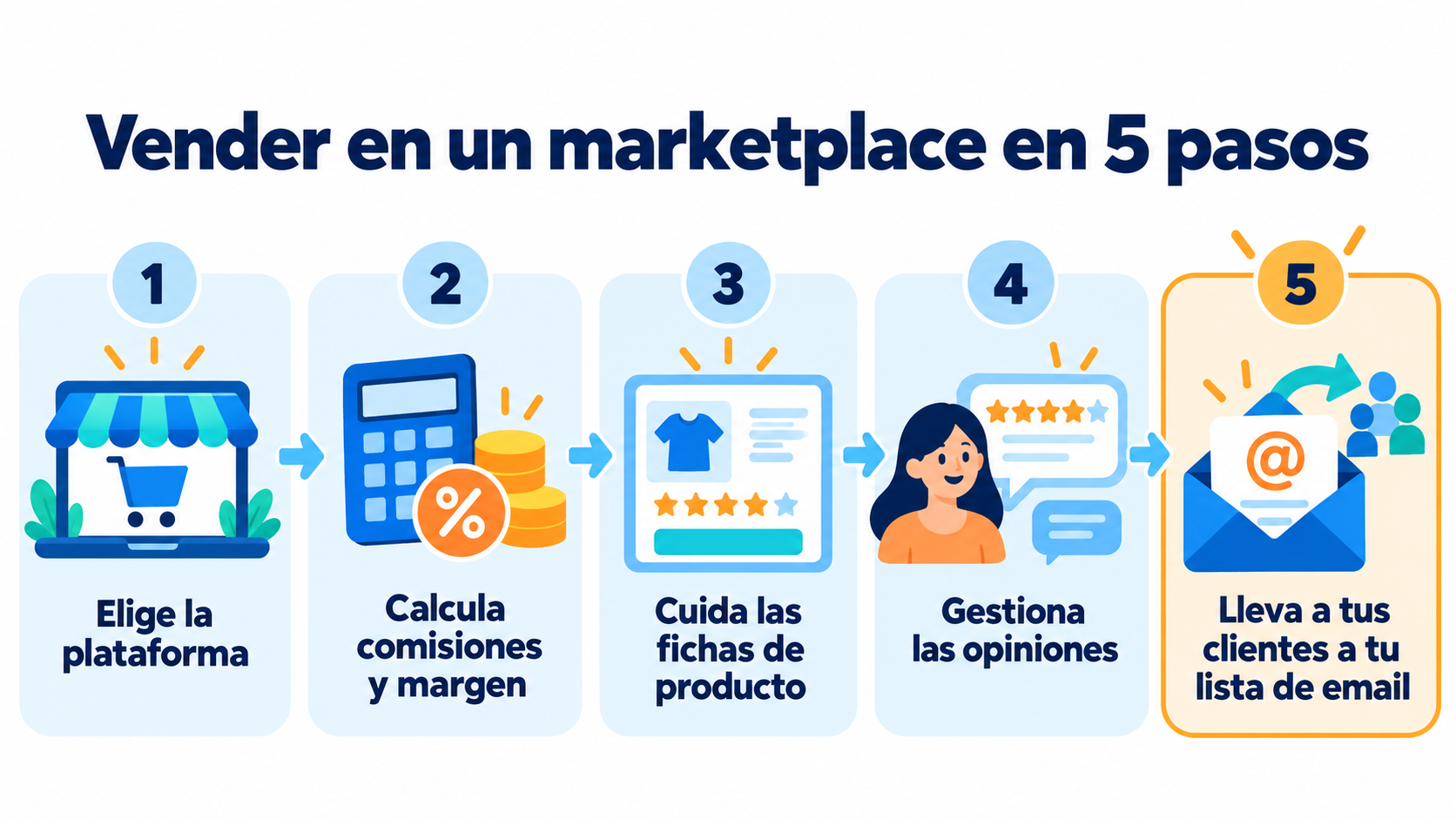
1. Choose the platform. Find out where your customers shop: a horizontal one to reach more people, or a vertical one if you sell something specialized.
2. Work out the costs. Add up the commission, fees and shipping. Check that you still have a margin at the price your competitors sell at.
3. Take care of your listings. Good photos, a clear title and a description with what the customer wants to know.
4. Manage your reviews. Reply quickly and resolve any issues. On a marketplace, reputation sells.
5. Bring your customers to a channel you own. It’s the most overlooked step and the one that protects your business the most.
Marketplaces and email marketing
The biggest risk is depending on the platform. If the commissions or the algorithm change, your sales change. And the customer really belongs to the platform.
That’s why it pays to combine it with your own store and a subscriber list. That way you can get back in touch with the people who bought from you without paying a commission.
Always follow each platform’s rules: many don’t allow you to use the order email address to send advertising. The right approach is to invite customers to subscribe on their own. For example, with a card in the package that leads to your subscription form in exchange for a guide or a discount on your website.
More ideas in email marketing for ecommerce.
How Mailrelay helps you
With Mailrelay you can create the form you send your customers to, send them an automatic welcome email and let them know about your store’s news and offers. That way, every sale can turn into a customer who comes back to you.
The free account includes up to 80,000 emails a month and 20,000 contacts, with human support by chat, ticket and phone.
Send your newsletters with Mailrelay
Up to 80,000 emails a month and 20,000 contacts for free, with human support on every plan.
Frequently Asked Questions
These are the most common questions about this sales model.
What is a marketplace in a nutshell?
An online store where many businesses or people sell at the same time, and the platform charges a commission on each sale.
Is Amazon a marketplace?
Yes. Amazon sells its own products, but it is also a marketplace where thousands of third-party businesses sell.
What’s the difference between a marketplace and an ecommerce store?
An ecommerce store is the online store of a single brand. A marketplace brings many sellers together on the same platform.
How much does a marketplace charge for selling?
It depends on the platform and the category. Usually there’s a commission per sale and, in some cases, a monthly fee and shipping or storage fees.
Is it better to sell on a marketplace or in your own store?
To get started, the platform gives you quick visibility. In the medium term, your own store and your customer list give you margin and independence. The most common approach is to combine both.