Retailer: what it is, what it does and examples of retail businesses
The last step before a product reaches your hands, and how it can sell more
A retailer is a person or company that sells products at retail, in small quantities, directly to the end consumer. For example, a bakery, a clothing store, a supermarket or an online store.
It’s the last link in the distribution chain: it buys from manufacturers or wholesalers and sells to the people who will use the product.
What does retailer mean?
The word comes from selling “at retail”, that is, in small quantities. The opposite is selling “wholesale”, which is where the word wholesaler comes from.
Retailer is a noun (“local retailers”), while retail also works as an adjective (“retail business”, “retail sales”, “retail price”).
A business that sells this way is a retailer, and the sector as a whole is called retail. If you’re interested in marketing for this sector, we cover it in our entry on retail.
What does a retailer do?
A retailer brings products closer to people. These are its main functions:
- Choosing the product range. It decides which products to offer based on what its customers are looking for.
- Buying and storing. It buys in large quantities and keeps the stock so that customers can take home just one unit.
- Setting the price. It adds a margin to the purchase price to cover its costs and make money.
- Displaying and promoting. It places the products in the store or on the website, and runs offers and ads.
- Serving customers. It advises, takes payments, delivers, and handles exchanges, returns and warranties.
- Informing the rest of the chain. It knows what sells and what doesn’t, and passes that on to its suppliers.
Wholesaler vs. retailer: differences
| Aspect | Wholesaler | Retailer |
|---|---|---|
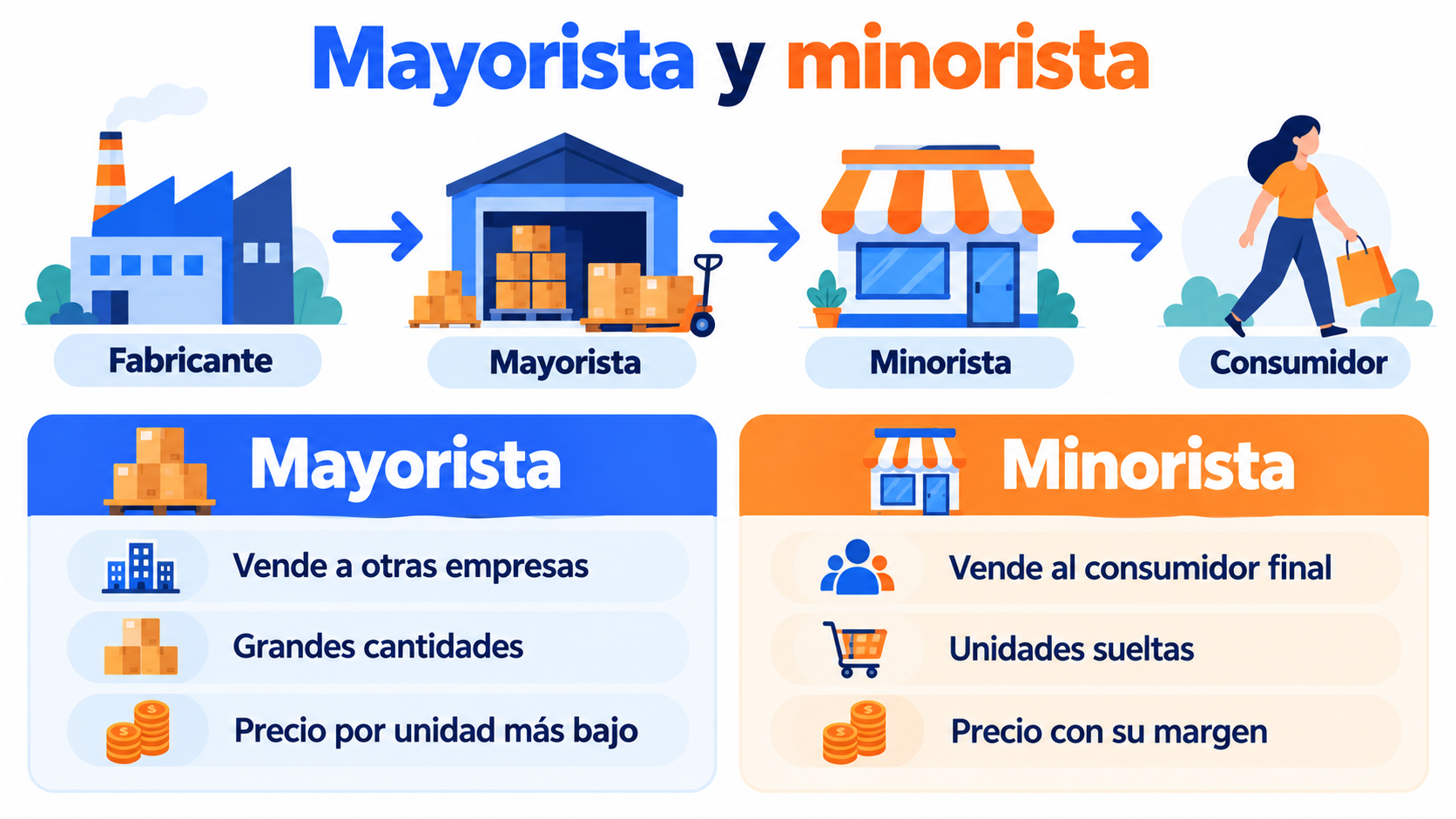
| Who it sells to | Other businesses, such as stores or restaurants | The end consumer |
| Quantities | Large volumes | Single units or small quantities |
| Price per unit | Lower | Higher, because it includes the retailer’s margin |
| Location | Warehouses and industrial parks | Shopping streets, shopping malls and the internet |
| Customer relationship | Few customers, long-term | Many customers, often one-off purchases |
| Marketing | B2B | B2C |
This is the usual journey of a product: manufacturer → wholesaler → retailer → consumer. Some brands skip steps and sell directly in their own stores or on their website. You’ll find more details in our article on distribution channels.
Types of retailers
| Type | What it’s like | Example |
|---|---|---|
| Independent stores | A local store with one or a few locations | A hardware store, a bookstore or a greengrocer |
| Chains | Many stores under the same brand with centralized management | A fashion or perfume store chain |
| Franchises | Stores with different owners that use the same brand | Many fast-food chains |
| Supermarkets and hypermarkets | A wide range of groceries and household products | Mercadona, Carrefour or Walmart |
| Department stores | Several departments in the same building | El Corte Inglés or Liverpool |
| Convenience stores | Small stores, long opening hours and quick purchases | OXXO or gas station stores |
| Specialty stores | A single category, with a wide range and expert advice | A sporting goods or electronics store |
| Discount stores | Low prices and a limited range | Lidl or Aldi |
| Online retail | They sell online and ship to customers’ homes | A store built on WooCommerce or PrestaShop |
| Marketplaces | Platforms where many retailers sell | Amazon or Mercado Libre |
Today, many retailers combine a physical store with an online one, so customers can buy on the website and pick up in store. This is known as omnichannel.
Examples of retailers
You almost certainly buy from retailers every week:
- Food: the supermarket, the butcher at the market or the corner store.
- Fashion: the clothing stores in a shopping mall and their websites.
- Health and beauty: pharmacies and perfume stores.
- Technology: electronics stores and online phone stores.
- Home: hardware stores, furniture stores and home decor stores.
- Food service: a café is also a retailer, because it sells to the end consumer.
Do you have a store, physical or online?
Keep your customers coming back with newsletters about new products and offers, segmented by interest with Mailrelay.
How a retailer sells more
These are the marketing strategies retailers use most:
- Knowing their customers. Knowing who buys, how often and which products they’re interested in.
- Taking care of the store. Product placement, shop windows and signage all influence purchases. This is what’s known as merchandising.
- Running promotions, such as sales, volume discounts or gifts with purchase.
- Selling more with each purchase through cross-selling or upselling.
- Rewarding repeat customers with loyalty cards or exclusive discounts. We explain this in our entry on customer loyalty.
- Being present online, with a website, social media profiles and a Google business listing.
Email marketing for retailers
Email is one of the most profitable channels for a retailer. You write to people who already know you, without paying for each click. Here’s how you can use it:
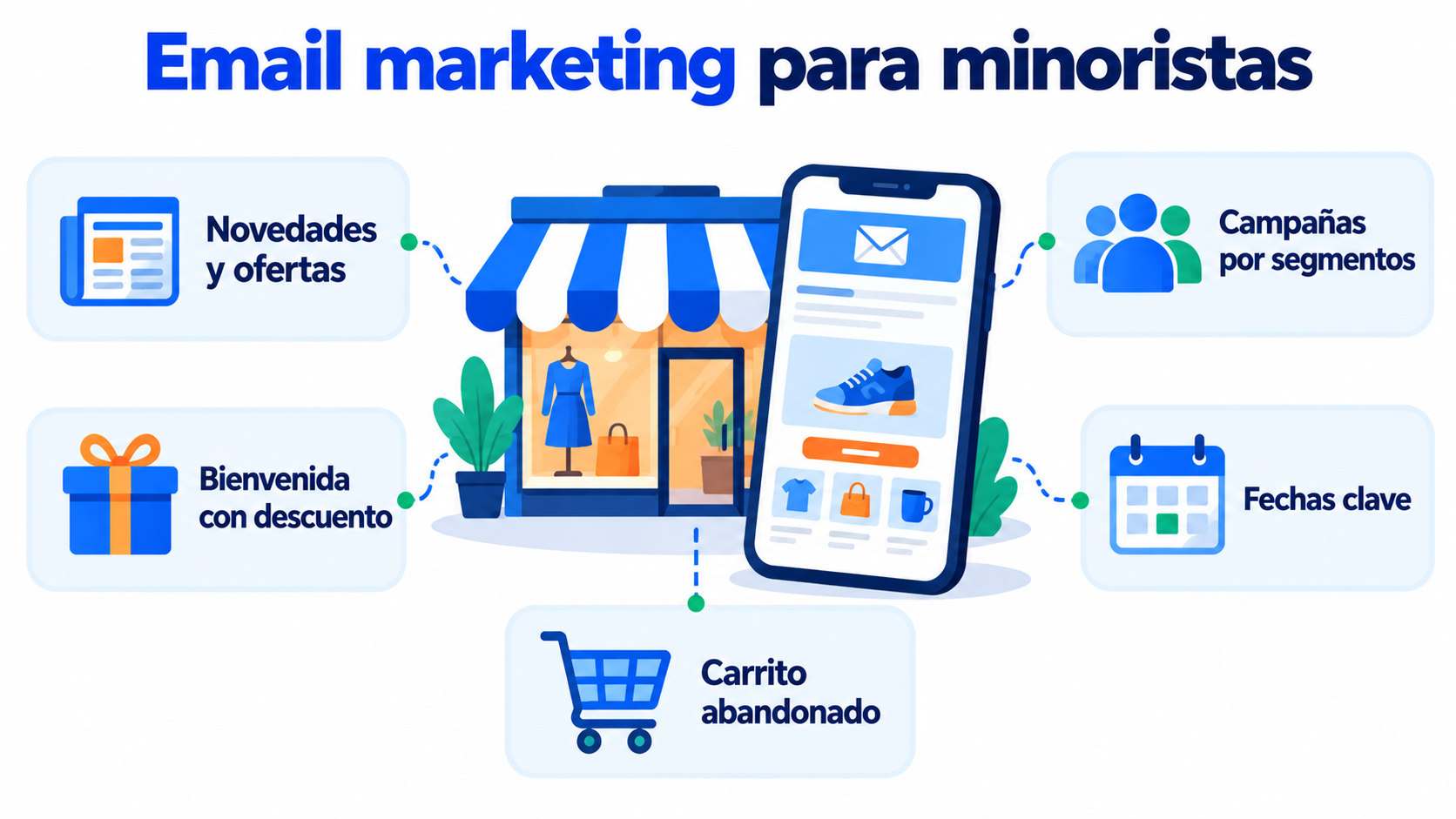
- Newsletter with new products and offers, sent on a regular schedule.
- Welcome email with a discount on the first purchase.
- Abandoned cart reminder in the online store. We explain this in our entry on the abandoned cart email.
- Segmented campaigns, for example, only for people who bought from a category or live near a store.
- Greetings and key dates, such as the customer’s birthday, Black Friday or Christmas.
To get subscribers in your physical store, ask for their email at checkout or with a QR code on the counter, always with their consent.
How Mailrelay helps you
With Mailrelay, you create a subscription form for your website and design your newsletters with the drag-and-drop editor. You can segment your contacts by interests, purchases or location with custom fields.
If you have a physical store, you can also send SMS from the same platform, from €0.0345 per message excluding VAT, with no commitment.
The free account lets you send up to 80,000 emails a month to 20,000 contacts, with chat, ticket and phone support.
Send your newsletters with Mailrelay
Up to 80,000 emails a month to 20,000 contacts with the free account, with chat, ticket and phone support.
Frequently asked questions about retailers
What is a retailer? It’s a person or company that sells products in small quantities directly to the end consumer, such as a store, a supermarket or an online store.
What’s the difference between a wholesaler and a retailer? A wholesaler sells large quantities to other businesses at a lower price. A retailer sells single units to the end consumer and adds its margin.
What is retail trade? It’s the activity of selling at retail to the end consumer. It’s also called retailing or simply retail.
What does retail mean in sales? That the sale is at retail: in small quantities and for the buyer’s own use, not for resale.
What are some examples of retailers? Supermarkets, pharmacies, clothing stores, hardware stores, cafés, department stores and online stores.