Joint Venture
What it is, types, advantages and examples
There are projects a company can’t take on alone. It may lack the capital, knowledge of the market or a specific technology. But another company has exactly what’s missing. When the two decide to join forces without giving up their independence, a joint venture is born.
What is a joint venture?
A joint venture, or joint enterprise, is an agreement under which two or more companies collaborate on a specific project. They share resources, costs, risks and profits for a set period of time.
The key is that each partner keeps its own identity. Outside the shared project, they remain separate companies, with their own customers and their own strategy. That’s why a joint venture is not the same as a merger or an acquisition.
The term comes from English and is used as is in Spanish too. You’ll also come across expressions such as “strategic alliance” or “shared risk”, which describe a very similar idea.
Types of joint venture
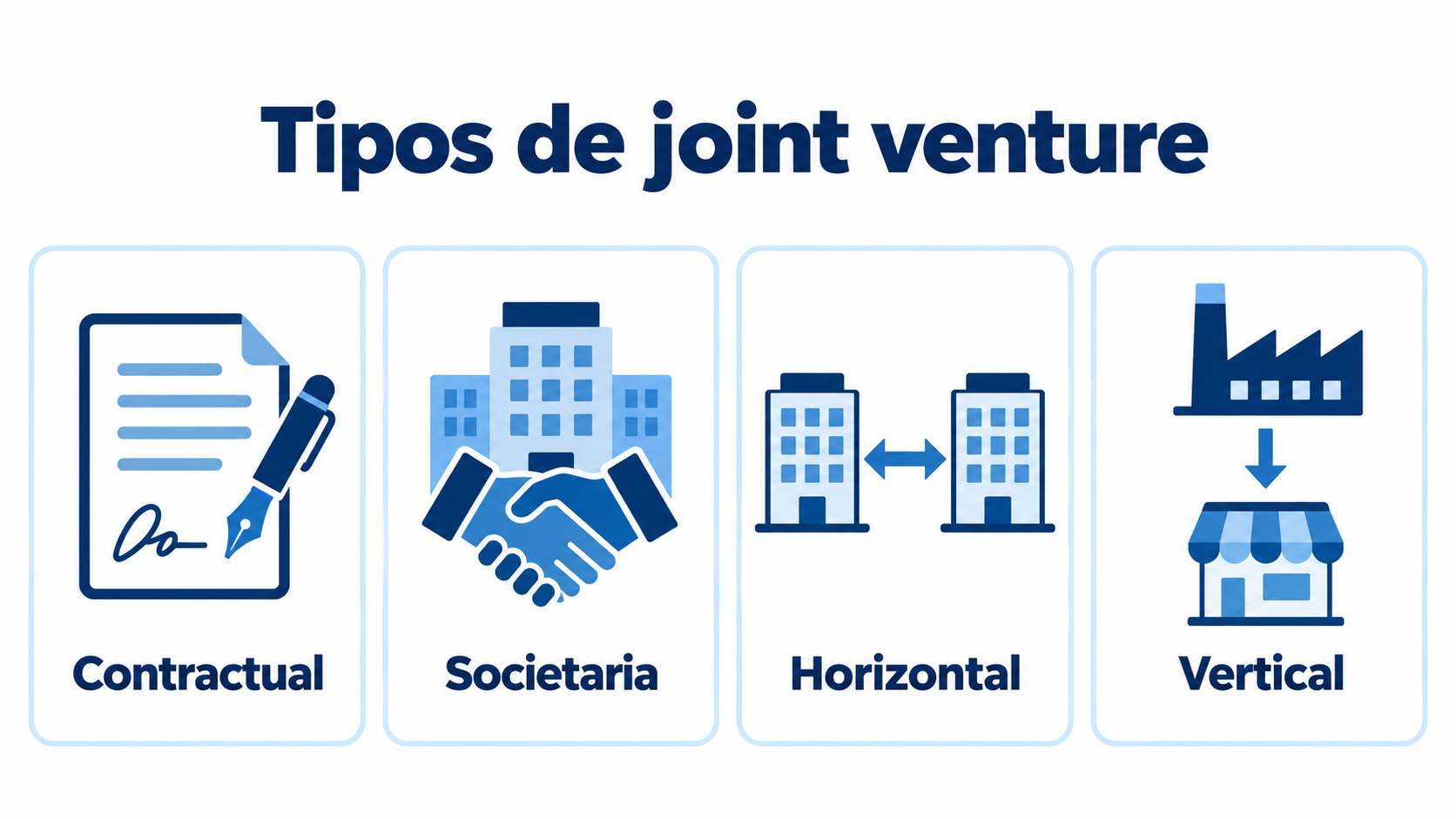
Not all joint ventures are built the same way. The most common classification is based on their legal form and the relationship between the partners:
- Contractual: the companies sign a collaboration contract but don’t create a new company. It’s the most flexible and fastest option.
- Equity or corporate: the partners set up a new company with its own legal personality and contribute capital in whatever proportion they agree on.
- Horizontal: companies from the same sector, often competitors, work together on a project that none of them would take on alone.
- Vertical: companies from different links in the chain team up, for example a manufacturer and a distributor.
Choosing one or the other depends on the timeframe, the money at stake and how much control each party wants to keep.
Joint venture, merger and alliance: how they differ
In a merger, two companies become one and at least one of them ceases to exist. In an acquisition, one company buys the other. In a joint venture, on the other hand, neither loses its autonomy: they only share a clearly defined project.
Lighter business alliances, such as a distribution agreement or an affiliate marketing program, usually involve less commitment. Although the line isn’t always clear, a joint venture usually requires joint investment and a formal split of profits.
Advantages of a joint venture
The most frequently cited advantage is access to new markets. Teaming up with a local partner helps overcome legal, cultural and logistical barriers. If you’re considering the internationalization of your business, this approach can greatly shorten the path.
It also makes it possible to share risks and costs. A large multinational campaign or an expensive technology development is less of a burden when two companies fund it. And if the project fails, the loss is shared too.
It also encourages innovation. Each partner contributes what it does best: one provides the technology, the other the sales network or the brand. This combination of capabilities often speeds up the launch of products that would take years to reach the market separately.
Disadvantages and risks
However, it’s not all benefits.
Conflicts between partners are the most common problem, especially when each company’s goals change over time.
Another risk is imbalance. If one party contributes more resources or knowledge than the other, tensions can arise over control or how profits are split. There’s also the possibility that a partner will use what it has learned to compete with you later on.
Finally, differences in corporate culture matter more than you might think. Two teams with opposite ways of working can hold back a project that looked perfect on paper.
Keys to making a joint venture work
Most failures can be prevented with good preparation. These are the guidelines that come up most often:
- Set shared, measurable goals: establish the KPIs and the expected ROI from the start.
- Draft a detailed agreement: contributions, profit sharing, decision-making and exit terms.
- Analyze your partner carefully: a joint SWOT analysis helps spot incompatibilities before signing.
- Create a clear governance structure: who decides what, and how disagreements are resolved.
Well-known joint venture examples
One of the most frequently cited cases is Sony Ericsson, created in 2001 by Japan’s Sony and Sweden’s Ericsson to manufacture mobile phones. One brought experience in consumer electronics and the other in telecommunications. In 2012, Sony bought out its partner’s share and the company was renamed Sony Mobile.
Another example is the alliance between Starbucks and PepsiCo, launched in the 1990s to sell ready-to-drink coffee in supermarkets. Starbucks provided the brand and the recipe; PepsiCo, its huge distribution network.
Joint ventures in marketing and email marketing
You don’t need to be a multinational to take advantage of this approach. Many SMEs work with complementary brands on joint marketing campaigns, on a smaller scale but with the same underlying idea.
A webinar run by two companies, a shared lead magnet or cross-promotion in both companies’ newsletters are common examples. Each partner reaches a new, qualified audience, and both generate leads at a lower cost.
That said, be careful with data. Sharing a contact database with another company requires express consent under the LOPD and the GDPR. The safest option is for each brand to send to its own list, or for the joint form to ask for explicit permission for both, ideally with double opt-in.
How we help you at Mailrelay
At Mailrelay we make it easy for you to manage joint campaigns. You can create specific forms for each campaign and automatically segment the contacts that come from the collaboration.
That way you’ll know how many sign-ups your partner has brought in. Our real-time reports show you the opens, clicks and conversions of each send, very useful data for deciding whether the alliance is worth continuing.
All of this is available on the free plan, with up to 80,000 emails a month and 20,000 contacts. If you want to try it, you can create your Mailrelay account today.
Frequently asked questions about joint ventures
Does a joint venture always create a new company? No. In the contractual form a signed agreement is enough; only the equity form results in a new company.
How long does a joint venture last? It depends on the project. Some end when they achieve their goal and others last for decades.
Can two small businesses form a joint venture? Yes. In fact, it’s a very useful approach for SMEs that want to grow without taking on all the risk alone.
In conclusion
A joint venture allows two companies to go further together than either could alone, without losing their independence. When well planned, it opens up markets, spreads risk and speeds up innovation.
The key is to choose the right partner and put everything in writing from day one. And if your collaboration involves email marketing, take care of the data and measure every send to find out what the alliance really brings.
Related entries
- P.S. (Postscript)
- Transition words
- Sponsorship
- Google Business Profile (formerly Google My Business)
- Performance marketing
- Personalization in Email Marketing
- Phishing
Find out how Mailrelay can help you with your email marketing strategy.