Influencing with power: what it means to influence someone and how to do it
The principles that make people listen to you, with email templates to apply them

The principles that make people listen to you, with email templates to apply them
The ability to influence people through online media has become a cornerstone of business success.
However, this task is not without its difficulties.
Unlike face-to-face communication (where non-verbal cues and the immediate context play a decisive role) online media require you to capture attention to persuade and influence effectively.
And it turns out that attention is a scarce and highly contested resource in the online world.
Influencing strategies need to be more creative, personalized and tailored to an audience that is constantly navigating an endless stream of digital stimuli.
Mastering the art of influencing through digital media is not just a competitive advantage, it’s a necessity.
Influencing someone means getting them to change what they think, feel or do, without forcing them. It can happen through a conversation, an example, an ad or a well-written email.
The dictionary of the Royal Spanish Academy defines it as producing an effect on something or someone, and also as exerting dominance or moral force over another person. In Spanish, «influenciar» is an accepted synonym, although «influir» is the more common form.
Influence is not always intentional. A friend who exercises can encourage you to start without saying a word. But in marketing and communication it is: you want someone to open your email, trust your brand or try your product.
The three words are often confused. This table sums up the difference:
| Influencing | Persuading | Manipulating | |
|---|---|---|---|
| What it is | Affecting another person’s ideas or behavior | Convincing with arguments and emotions | Getting someone to act through deception or against their own interest |
| Intent | Can be unintentional | Always conscious | Hidden |
| Respects the other person’s freedom | Yes | Yes | No |
| Example in an email | A sender you trust | An email with reasons to try a product | A fake countdown to force a purchase |
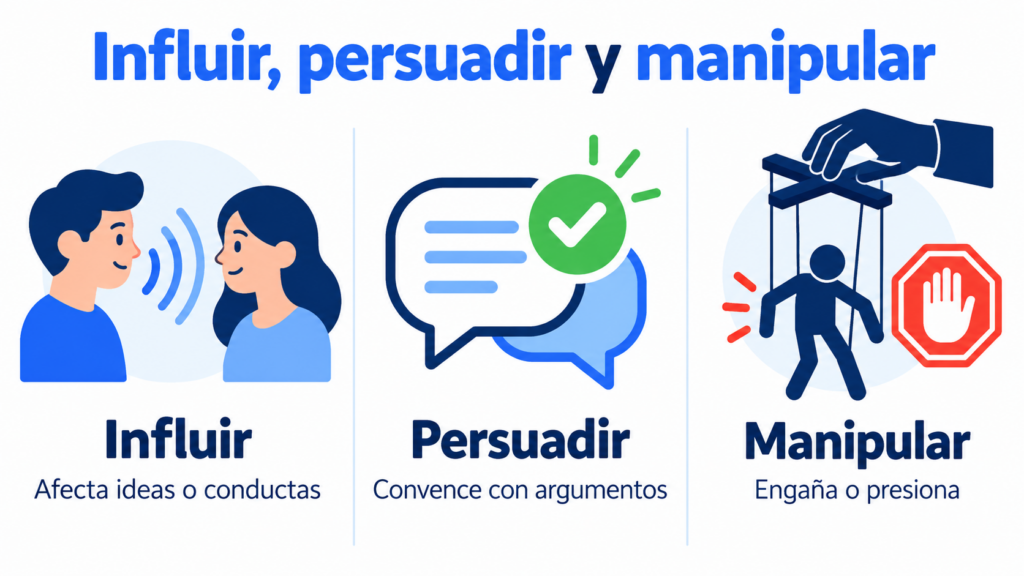
In this article we talk about honest influence: the kind that helps the other person decide, not the kind that decides for them.
Put influence into practice in your emails
Create campaigns that connect with your audience and measure which messages work best with Mailrelay.
Influence is the power to have a significant effect on the decisions, behaviors and opinions of others.
In the context of business, influencing effectively can mean the difference between a sale and being forgotten.
But what makes some messages, ideas or products resonate strongly while others go unnoticed?
This question takes us to the heart of influence, where psychology, communication and empathy intertwine.
Influence can be defined as the ability to affect the character, development or behavior of someone or something, or the very effect of that ability.
In marketing and communication, influencing means more than simply persuading someone to take an action.
It’s about making a lasting impact on people’s attitudes and perceptions.
Influence is exercised through a variety of channels and methods, from advertising to direct dialog, and each presents its own challenges and opportunities.
People are influenced by a multitude of factors, including:
Messages that relate to our personal beliefs and values, or that are presented to us in a way that arouses our emotions, are more likely to influence us.
Furthermore, we are more inclined to be influenced by those we consider role models or experts in a particular field.
In the digital environment, these principles are amplified, as users are constantly bombarded with information.
And they need to make quick decisions about which content deserves their attention and trust.

Understanding the principles of influence helps you apply it effectively.
These principles are like the unwritten rules that govern our social and commercial interactions.
Over the years, psychology and marketing experts have identified several of these key principles.
These principles, if used correctly, can significantly improve a person or brand’s ability to influence others.
One of the most influential theories in the field of influence is that proposed by psychologist Robert Cialdini, who identified six principles of persuasion:
These principles are based on an understanding of how people think, feel and act in social situations.
For example, reciprocity refers to our tendency to return favors.
Social proof, on the other hand, shows our inclination to follow the behavior of others, especially in situations of uncertainty.
In 2016, in his book Pre-Suasion, Cialdini added a seventh principle: unity, our tendency to be influenced by those we feel are «one of us». We explain them with examples in Robert Cialdini’s principles of persuasion.
To influence effectively, it helps to consider several key factors.
First of all, authenticity and credibility come first.
People are more likely to be influenced if they perceive the influencer to be genuine and trustworthy.
Understanding your target audience also makes a difference: knowing their needs, wants and motivations lets you create messages that resonate more and persuade better.
Finally, communication must be clear and adapted to the channel being used.
In the digital world, this means being concise, engaging and visually appealing in order to stand out in a sea of content.

Effective communication is the foundation of the art of influencing people.
To have a meaningful influence, you need to master a range of communication techniques that capture attention, spark interest and persuade the recipient.
These techniques include:
Each of these techniques plays an important role in creating messages that impact the audience.
Persuasive communication is about convincing others to see things from our perspective, to adopt our ideas or to take a specific action.
To achieve this, specific strategies are used that involve both the content of the message and its presentation.
This includes the use of powerful stories and examples, clarity in the presentation of arguments, and logical structuring of information.
In addition, persuasive strategies are often based on the psychological principles we explored above, such as reciprocity, liking and authority.
Persuasive communication is not just about talking, but also about listening.
Active listening, which means paying full attention to what the other person is saying, lets you understand their needs, wants and concerns.
Empathy, on the other hand, allows us to put ourselves in the recipient’s shoes, which makes it easier to connect emotionally and build relationships of trust.
When people feel that they are listened to and understood, they are more open to being influenced in a positive way.

Emotional intelligence plays a decisive role in the process of influence.
This skill refers to the ability to recognize, understand and manage one’s own emotions, as well as the emotions of others.
Effective influence is not just about presenting facts and logical arguments, but about connecting emotionally with the audience.
Emotional intelligence makes it possible to build stronger and more authentic relationships with people, which in turn makes positive influence easier.
Emotions are an intrinsic part of our decisions and behaviors.
When people feel emotionally connected or motivated by a message, they are more likely to be influenced by it.
On the other hand, negative emotions, such as fear or distrust, can hinder effective influence.
Understanding how emotions shape people’s decisions helps you strategically tailor your messages and persuasive communication.
Emotional intelligence is a skill that can be cultivated and honed.
As we develop our ability to recognize and manage our own emotions, we also improve our ability to understand and respond to the emotions of others.
This translates into more effective influence, as we can tailor our communication to connect emotionally with the audience and address their emotional needs.
In the digital world, where face-to-face interaction is limited, emotional intelligence becomes an invaluable tool for building relationships and exerting positive influence.

Email has evolved far beyond being simply a communication tool.
It has become a powerful influencing tool that allows companies and individuals to reach audiences in a direct and personalized way.
Understanding the fundamentals of email influence lets you make the most of this tool.
And achieve impactful results.
Email has unique characteristics that distinguish it as an influencing tool.
Email communication is highly customizable.
This makes it possible to tailor messages and content to the preferences and individual needs of recipients.
In addition, email offers the possibility of reaching a global audience instantaneously.
It is therefore an effective means of influencing people in different places and cultures.
Influencing through email has its advantages and difficulties.
The advantages include the ability to reach a mass audience with relative ease and at a reasonable cost.
In addition, email allows accurate tracking and measurement of results, which makes it easier to evaluate how effective influencing strategies are.
However, there are also difficulties, such as the fight against unwanted email (spam) and the need to stand out in increasingly crowded inboxes.
Overcoming these challenges is what makes effective influence by email possible.

Persuasive emails are a valuable tool for getting recipients to take a specific action or adopt a specific perspective.
To create persuasive emails, it helps to understand the strategies that capture attention and convince the audience.
These strategies range from word choice and visual design to message structure and the call to action.
Mastering these strategies is what allows you to influence effectively through email.
Writing a persuasive email is an art in itself.
Messages should be written to hook the recipient from the very first paragraph and guide them toward a desired conclusion.
This involves using clear and persuasive language, building solid arguments and presenting convincing evidence.
It is also important to keep things brief and relevant, as recipients tend to scan emails rather than read them carefully.
The key elements of an influential email are the components that make the message stand out and be effective.
These elements include:
In addition, visual elements such as images and attractive formatting can make the message more effective.

Personalize every email without the hassle
Segment your list with custom fields and send each group the message it cares about.
Personalization and segmentation are two fundamental strategies for influencing by email.
In a world where attention is a valuable and limited resource, sending generic messages to a broad audience is no longer the most effective approach.
Instead, personalization and segmentation make it possible to tailor messages to the specific preferences, needs and interests of each recipient.
This significantly increases the likelihood of exerting a positive influence.
Tailoring the message to the recipient involves creating content that is uniquely targeted to each recipient.
This goes beyond including the recipient’s name in the greeting.
It means understanding the preferences and behaviors of the audience and using this information to create relevant and valuable messages for each person.
When people feel that a message is tailored to them, they are more likely to respond positively.
Data and analytics play a decisive role in personalizing email messages effectively.
Companies can collect information about customers’ past interactions, their buying preferences, browsing history and more.
Using this information, they can build detailed recipient profiles and segment them into groups with similar interests.
Specific messages can then be tailored to each segment, increasing the likelihood of positive influence.

In the art of influencing by email, the ability to write a persuasive message is fundamental.
Below is a possible step-by-step guide:
Before you type the first word, you need to be clear about your goal for this email and who you are writing to.
This initial clarity will guide you in selecting the right tone, language style and the most convincing arguments for your audience.
The email subject line is the first and often only opportunity to grab the recipient’s attention.
It should be concise, direct and intriguing enough to motivate the recipient to open the message.
Start with a catchy phrase.
It could be a rhetorical question, a revealing statistic or a bold statement that is directly related to the central topic of your message.
The aim is to arouse the reader’s immediate interest.
In the body of the email, present your arguments logically and convincingly.
Use concrete examples, testimonials or data to strengthen your points. Remember to be brief and to the point so that it will be easier to read.
Choose your words carefully.
Your language should resonate with your audience, using a tone that builds trust and credibility.
Empathy is a decisive component here.
Show that you understand and value your audience’s perspectives and needs.
Conclude your email with a clear request for what you expect as the next step.
Whether you’re asking for a response, a purchase or a visit to a website, make sure your call to action is clear and to the point.
End your email with a polite and professional farewell.
A simple thank you for your time can add a personal and respectful touch.
Before you click “Send”, review your email to fix spelling and grammar mistakes and make sure the message is clear and coherent.
A well-written email reflects professionalism and attention to detail.
Each of Cialdini’s principles can be turned into an email. These seven examples are a starting point: change the details in brackets and adapt them to your brand.
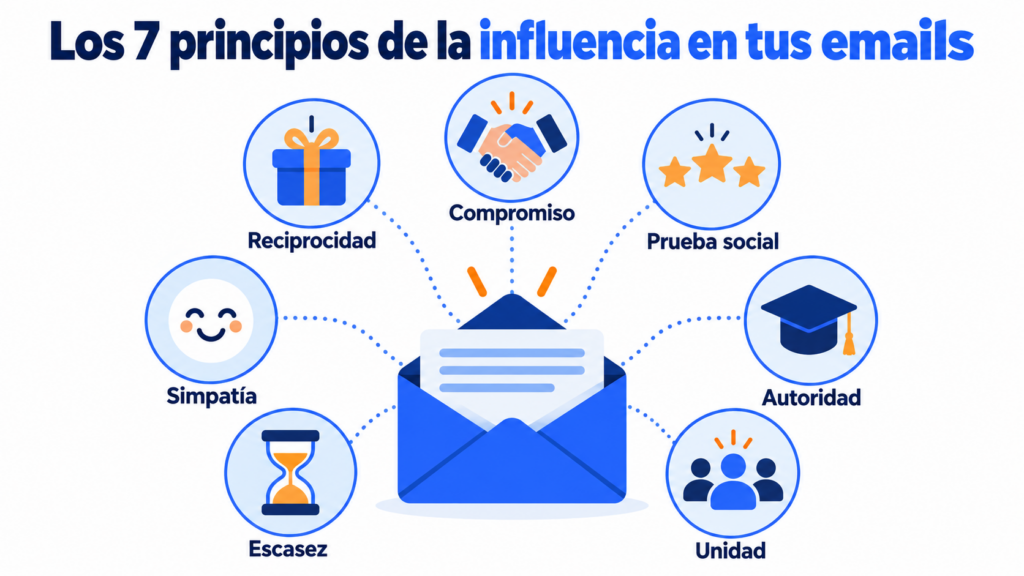
If you give away something useful, the other person will want to return the favor. It works very well in the welcome email.
Subject: Your free guide is here
Hi [name], thanks for subscribing. Here is the [title] guide we promised you. If you find it useful, next week we’ll show you how to apply it step by step.
People who take a first step tend to keep going in the same direction. Ask for something easy before you ask for the purchase.
Subject: Can you help us with one question?
Hi [name], what interests you more: [topic A] or [topic B]? Answer with one click and we’ll only send you what’s useful to you.
When we’re unsure, we look at what other people choose. Use real numbers and reviews from your customers.
Subject: This month’s most popular pick
Hi [name], more than [number] customers have already tried [product]. Here’s what [customer name] says: “[real review]”.
We trust experts and recognized sources more. Cite data, awards or your team’s experience.
Subject: What we’ve learned in [number] years of [industry]
Hi [name], after helping [number] companies, these are the three mistakes we see most often and how to avoid them.
We let ourselves be influenced by people we like. Sign with a name, share something personal and use a natural tone.
Subject: Something that happened to us this week
Hi [name], I’m [your name] from [company]. This week a customer asked us [question], and we thought you might be interested in the answer too.
We value what is limited more. Only use it if it’s true: false urgency breaks trust.
Subject: 48 hours left for your discount
Hi [name], your [percentage] discount on [product] ends on [day] at [time]. After that, it goes back to the regular price.
We are influenced by people we feel are part of our group. Remind your subscribers what you have in common.
Subject: From one [profession] to another
Hi [name], like you, we know what it’s like to [common problem]. That’s why we’ve put together [resource] with people like us in mind.
Before you send any of these emails, take care of the subject line and the call to action. And measure which version works best with an A/B test.
Influence has become a necessary skill for achieving success.
Throughout this article, we have explored in depth the art of influencing people, both in general and through one of the most powerful tools: email.
Email influence is a powerful tool that can help companies achieve their marketing goals and help people communicate effectively.
By understanding the main principles and strategies, you can influence with power and create solid relationships with your online audience.
With Mailrelay you can apply these principles in your campaigns and see which ones work with your audience.
You segment your list with custom fields, personalize each message, send a test before every campaign and measure opens and clicks in the statistics. The free account includes up to 80,000 emails a month and 20,000 contacts, with human support by chat, ticket and phone.
Send your newsletters with Mailrelay
Up to 80,000 emails a month and 20,000 contacts for free, with human support on every plan.
These are the most common questions about how to influence people.
It means getting them to change what they think, feel or do, without forcing them, through example, arguments or emotions.
Yes, both mean to influence someone. «Influenciar» is a correct synonym, although «influir» is more common.
Someone who influences respects the other person’s freedom to decide. Someone who manipulates uses deception or pressure to get the other person to act against their own interest.
Listen before you speak, be consistent, offer value without asking for anything in return and always tell the truth.
According to Robert Cialdini: reciprocity, commitment and consistency, social proof, authority, liking, scarcity and unity.

Jose Argudo
CMO of Mailrelay. Writes about email marketing, copywriting and conversion for small businesses and entrepreneurs.