Desire: what it is, types, examples and how it influences what we buy
The meaning, origin, types and examples of desire, from psychology to marketing.
Desire is the urge to get something we don’t have and that we believe will bring us pleasure, well-being or satisfaction. It can be directed at an object, an experience, a relationship or a personal goal.
Wanting a vacation, a new phone, recognition from others or to learn a language are all examples. Desires underlie many of our everyday decisions, including our purchasing decisions.
What does desire mean?
The dictionary of the Real Academia Española (the Royal Spanish Academy) defines it as an “energetic movement of the will toward the knowledge, possession or enjoyment of something”.
In practice, it means feeling that something is missing and wanting to get it. That’s why it is associated with motivation: it drives us to act.
The difference between need and desire
They are often used as synonyms, but they are not the same thing:
| Need | Desire | |
|---|---|---|
| What it is | A lack that has to be met | The specific way we want to meet it |
| Origin | Biological or basic | Personal, social and cultural |
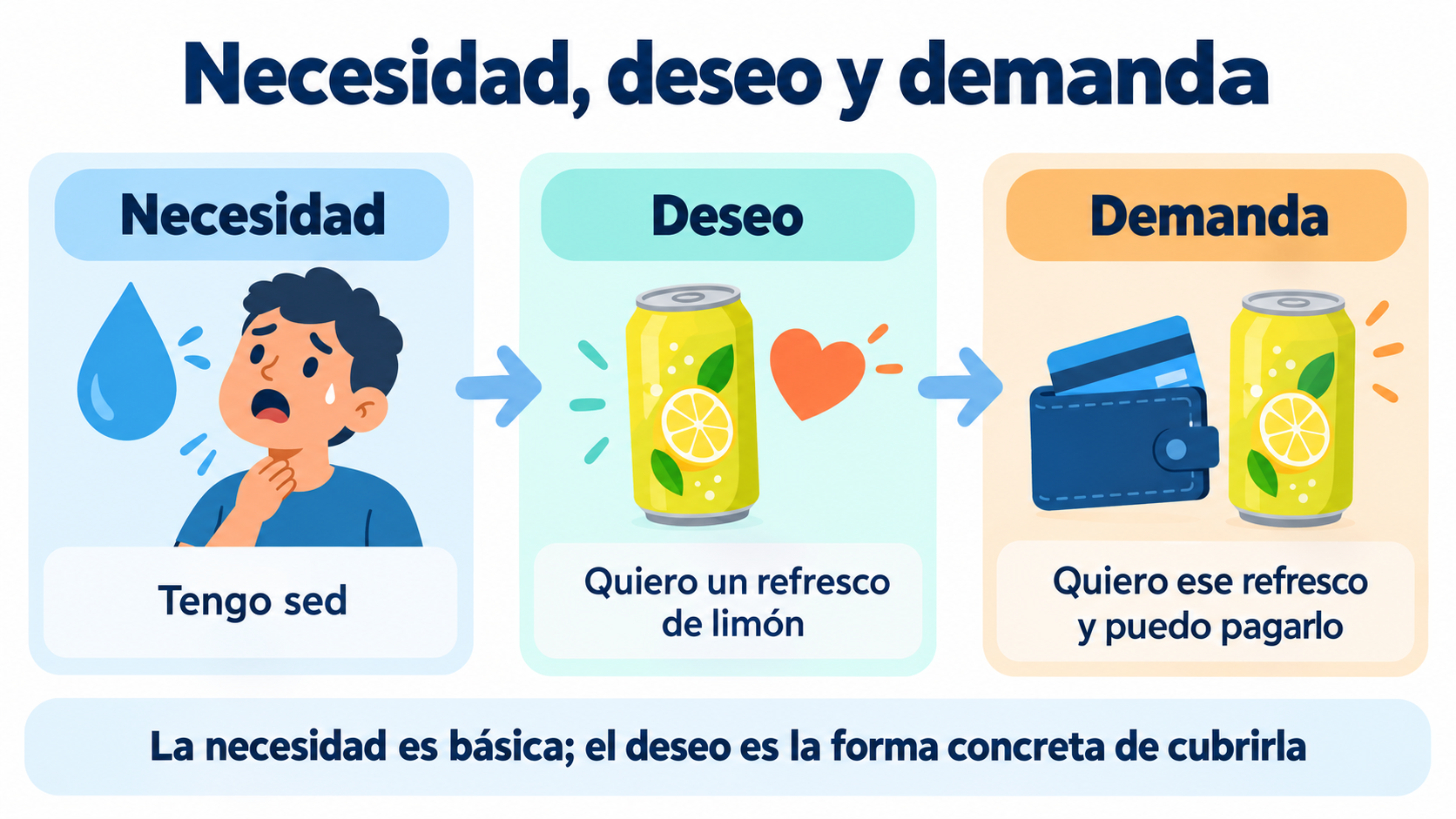
| Example | Being thirsty | Wanting a specific soft drink |
| If it is not met | It affects well-being or health | It causes frustration, but you can live without it |
When you add the ability to pay for it, it becomes demand. We explain it in more detail in the difference between needs and wants.
Where does it come from?
Biology. The brain has a reward system. When something gives us pleasure, dopamine is released, a neurotransmitter that reinforces that behavior and leads us to seek it out again.
Psychology. What we want reflects our motivations. According to Maslow’s hierarchy of needs, we first seek to meet basic needs, such as eating or having a roof over our heads, and then aspire to belonging, recognition and self-actualization.
Society and culture. Our surroundings, social media and advertising influence what we consider desirable. What some people desire, others don’t even miss.
Types of desire and examples
| Type | What we seek | Examples |
|---|---|---|
| Material | Owning objects | Clothes, a car, technology, a house |
| Experiential | Living through something | A trip, a concert, a special dinner |
| Emotional or relational | Connection and affection | Love, friendship, belonging to a group |
| Recognition | Approval from others | Prestige, success, status |
| Achievement | Growing and improving ourselves | Learning, starting a business, winning a competition |
Desire in psychology
Psychology studies it as a force that guides behavior. Some schools of thought link it to lack: we want what we don’t have. Others see it as an energy that drives us to grow.
A widely studied phenomenon is hedonic adaptation: when we get what we wanted, the satisfaction is short-lived and a new longing appears.
That’s why psychology recommends distinguishing between what we truly value and what we want because we compare ourselves with others.
Managing desire doesn’t mean eliminating it, but choosing what to pursue. Setting realistic goals, practicing gratitude and thinking before buying help make it a positive force rather than a source of frustration.
Desire in marketing and purchasing decisions
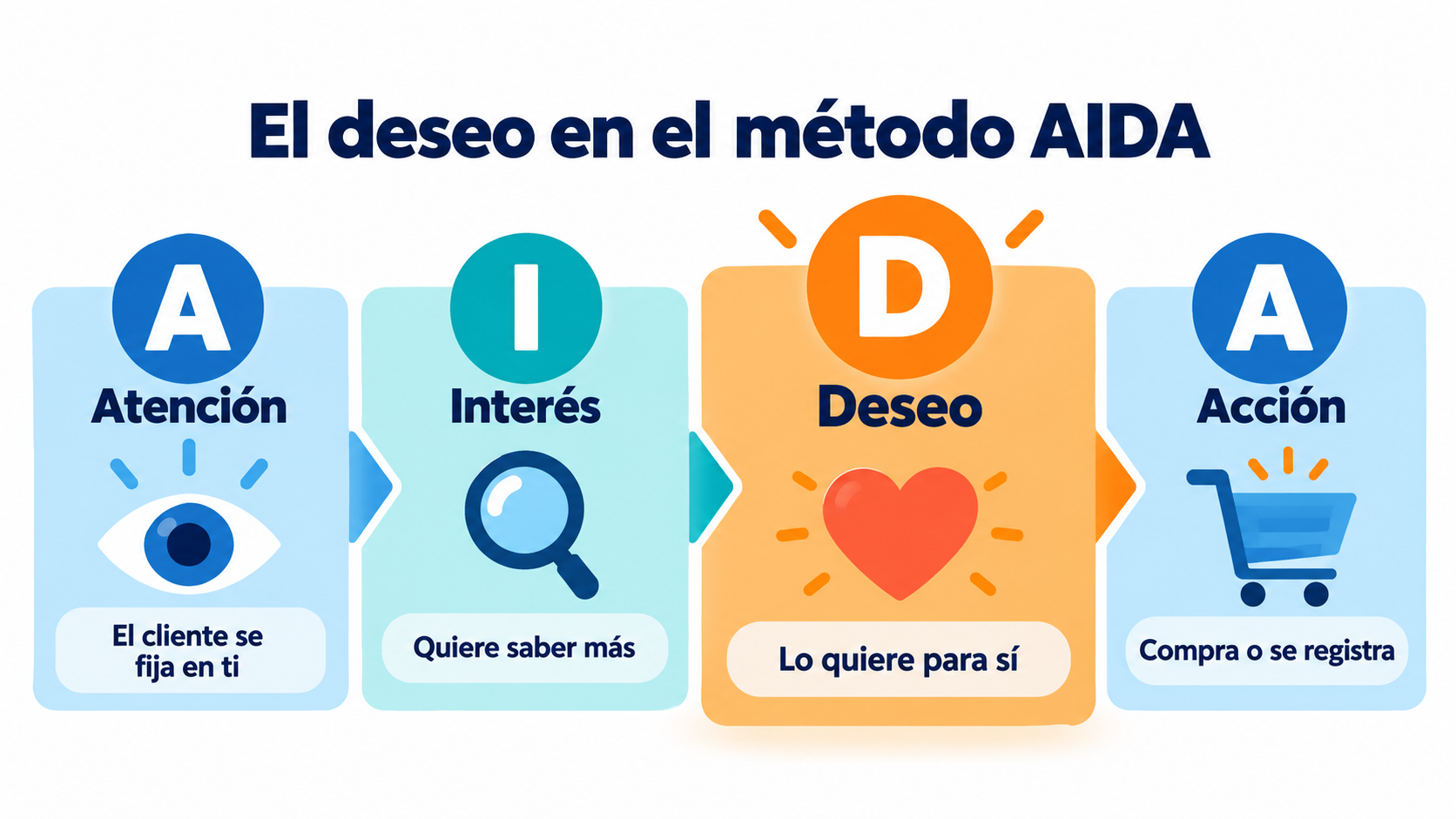
In marketing, desire is one of the stages of the AIDA method: Attention, Interest, Desire and Action. Once customers know the product and are interested in it, the message has to make them want it for themselves.
These are some common ways to achieve this:
Show benefits, not just features. Not “5,000 mAh battery”, but “two days without charging your phone”.
Tell stories. Storytelling helps customers imagine themselves using the product.
Social proof. Reviews, customer case studies or the number of people already using it.
Exclusivity and urgency. Limited editions or time-limited offers. They work if they are genuine; otherwise, they damage trust.
Personalize the message. Speak to each person about what interests them. In email marketing, segmentation lets you send each subscriber the offer that interests them most.
Turn interest into sales
Segment your contacts by interest and send each one the offer that interests them most. Try it for free with Mailrelay.
How Mailrelay helps you
With Mailrelay you can segment your list by interests, behavior or purchase history, and send each group the message that matters most to them. That way, you generate interest with relevant content, not with more sends.
The free account includes up to 80,000 emails a month and 20,000 contacts, with human support by chat, ticket and phone.
Send your newsletters with Mailrelay
Up to 80,000 emails a month and 20,000 contacts for free, with human support on every plan.
Frequently Asked Questions
These are the most common questions about this concept.
What is desire in a nutshell?
The urge to get something we don’t have and that we believe will make us feel good.
What is the difference between desire and need?
A need is a basic lack, such as hunger. Desire is the specific way we want to meet it, such as a particular dish.
What types of desire are there?
The most common are material, experiential, emotional, recognition and achievement desires.
What is desire in psychology?
A force that guides behavior toward something perceived as valuable or pleasurable, linked to motivation and to the brain’s reward system.
What role does desire play in marketing?
It is the stage at which customers go from being interested in a product to wanting it. According to the AIDA method, it comes right before the purchase action.