AIDA method: what it is, its 4 stages and how to use it in your emails
Attention, interest, desire and action: how to apply each stage in sales copy
The AIDA method, where AIDA is an acronym for Attention, Interest, Desire and Action, describes the stages a user goes through from the moment they discover a product or service until they decide to buy it.
It is a method widely used in digital marketing and sales strategies, because it helps turn users into customers. And it is important to keep in mind that, unless the user goes through every stage (attention, interest, desire and action), the purchase will not happen.
The model is attributed to the American advertiser E. St. Elmo Lewis, who in 1898 summed it up in three steps: attract attention, maintain interest and create desire. Action was added later. Today it is one of the most widely used formulas in copywriting, and over the years variants have appeared, such as AIDAS, which adds customer satisfaction after the purchase.
Stages of the AIDA method
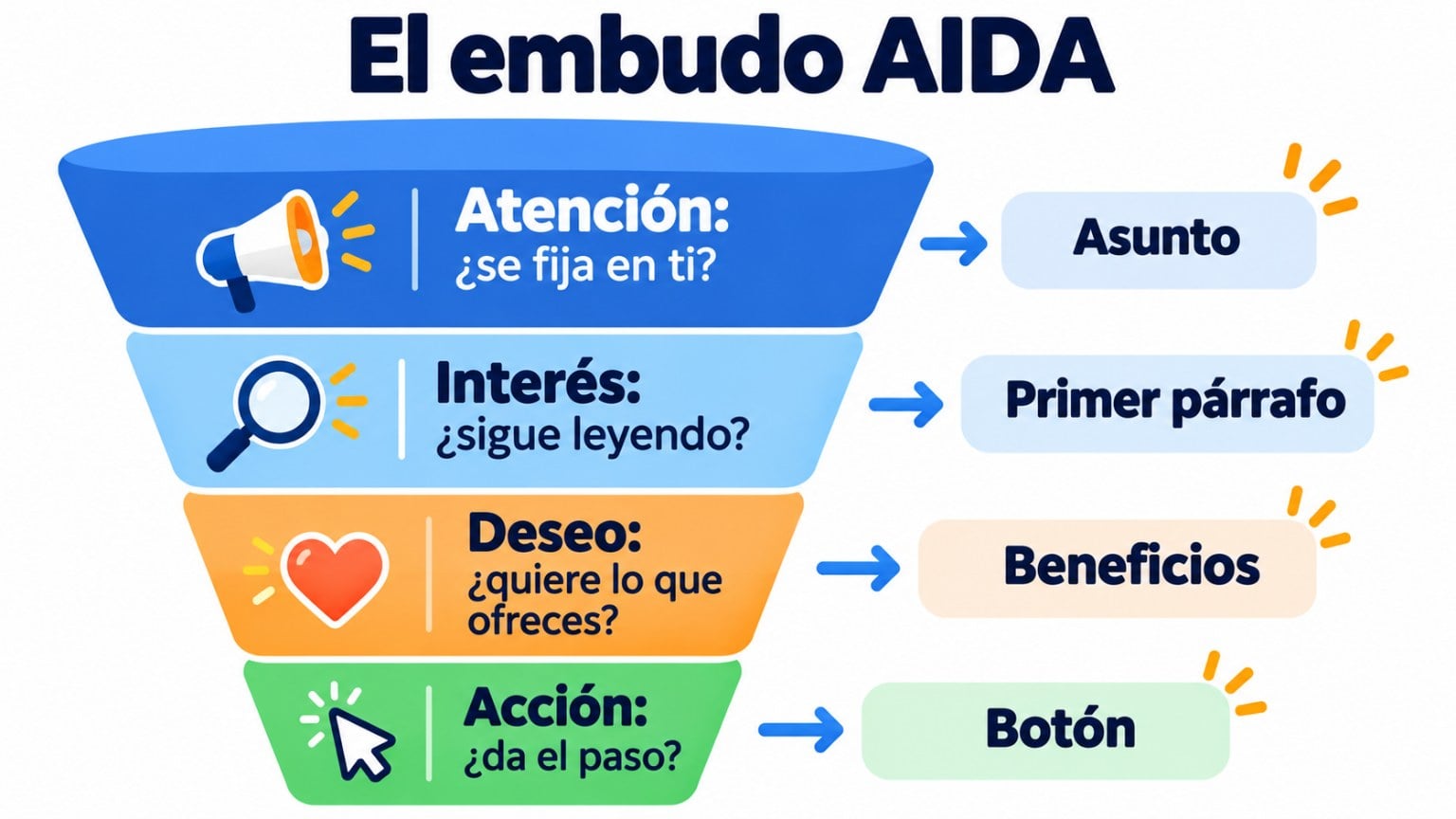
The four stages of the AIDA method matter both individually and as a whole, since they are all necessary and each one needs its own strategy, which in turn ties in with the strategies of the other stages.
| Stage | What you’re after | In an email | Example |
|---|---|---|---|
| Attention | Get noticed | Subject line and first line | “Your list of 5,000 contacts, free every month” |
| Interest | Keep them reading | First paragraph | A problem they recognize as their own |
| Desire | Make them want what you offer | Benefits and proof | What they gain and how others like them do it |
| Action | Get them to take the step | Button or link | “Create a free account” |
Write your next email with AIDA
Build your campaigns with the Mailrelay editor and try two subject lines with an A/B test to see which one grabs more attention. Start for free.
Attention (AIDA)
The first thing is to capture the consumer’s attention: if they don’t know we exist, they can’t consider us when it’s time to buy. To capture their attention, we need to offer them content that fits their needs, wishes… in other words, give them what they need and spark their interest.
It is not an easy task, because capturing the attention of potential customers in a world where they are constantly receiving advertising messages is hard. Even so, it is necessary in order to keep moving potential customers toward the sale.
Interest (AIDA)
Once we have won their attention, it’s time to show them that by buying our product (and not another one), everything will be easier for them, they will get many benefits and they will live a more relaxed life.
In other words, we need to build a marketing strategy that takes into account what they want and what they would like… and offer solutions to their problems or wishes.
Desire (AIDA)
We now have the attention and interest of your potential customer. It’s time to create a desire to buy, and to do so we try to win them over and make them fall in love with how amazing our company, products or services are.
To do this, you will need to list the benefits they will get if they place their trust in us (avoiding technical details or boring figures). The goal is to make them understand the advantages they will get from buying what we offer and what sets it apart.
Action (AIDA)
Everything up to this point was designed for this moment: for the potential customer to take action and do what we want them to do for our benefit. That can be anything, from the most obvious (signing up for a service or making a purchase) to giving us their contact details, filling in a survey or calling us.
Each type of business may have a different goal for the potential customer completing the four stages, and all those goals are equally valid.
What do we need to apply the AIDA method in the best way?
For your sales copy, which may be an email, to include everything it needs, you have to meet a few very basic requirements.
Know our product or service and how it compares with the competition
I’m sure you know your product or service inside out.
But how does it compare with your competitors?
Most of the time, that isn’t so clear.
Why?
Because we almost always think, and I include myself, that our product has something special that makes it different from the competition, better, and of course customers will notice.
Making the most of that difference, your competitive advantage, is a good idea, yes.
But don’t count on customers noticing it in every case, because it is very likely that your customers see all the possible solutions as more or less similar.
Analyze your competition as much as you can.
Know the customer’s real need
Like the previous point, this means going one step further.
Yes, you surely know what the customer needs, but:
Why do they need it?
How does it affect their personal situation?
Why haven’t they looked for a solution until now? If they have, why didn’t it work?
What will their situation be like once they buy or sign up?
Answering all these questions will help you write more effective sales copy.
Know the market
This point is often overlooked.
It may not always be necessary to know the market situation 100%, but at other times it can be very useful.
The economic situation can make your offer much more interesting and desirable, or not interesting at all.
If there are many competitors, it may be harder for you to reach your potential customers and, when you do, to show why your offer is better.
There may even be social changes that deserve your attention.
There may be more things to take into account, but starting with these points will already help you a lot.

How do you measure the AIDA method?
When applied to digital marketing, the AIDA method is measurable, and you can keep track of how effective each of the four stages is.
To do this, you just need to take into account a set of metrics or indicators for each stage of the sales funnel. These metrics may differ depending on the type of business and/or the goal, but they are usually the following:
| Stage | Metrics |
|---|---|
| Attention | Number of clicks on links and banners, email open rate (if you have run email marketing campaigns) and number of interactions on social media. |
| Interest | Number of page views and bounce rate. |
| Desire | In an ecommerce store, it is useful to know the percentage of carts created and of abandoned carts, as well as the average visit duration. |
| Action | This is perhaps the most obvious one: number of new subscriptions, sales made and growth on social media. |
The AIDA method for sales copy
This method divides the buying process into four stages:
- Attention: at this stage, the goal is to capture the customer’s attention immediately.
- Interest: after capturing their attention, you need to keep the customer interested while showing them the benefits of your offer
- Desire: once you have shown them everything, you need to create the desire to buy, usually by making the customer see that it will solve their problem
- Action: finally, add some text or a call to action so they complete the purchase.
We can see these stages as separate steps in the buying process.
In that case, we could have different ads, emails, blog posts, videos and sales pages.
Each of these pieces would work on one of the stages, gradually leading the customer to the purchase.
Another option would be to include all these stages in a single piece of sales copy.
You could use this last option in a sales email, for example, where you want the reader and potential customer to go through all the stages in one go.

Example of sales copy based on AIDA
Let’s look at an example so that all this theory makes practical sense.
Example of AIDA copy
Send up to 80,000 emails a month for free
Below you’ll find a signup form you can use to create a free Mailrelay account and send your emails for free.
Now think about your contact list: does it have fewer than 20,000 contacts?
Then wouldn’t you like not to have to pay to send an email campaign?
You can: just sign up for your free account right here:
[Form]
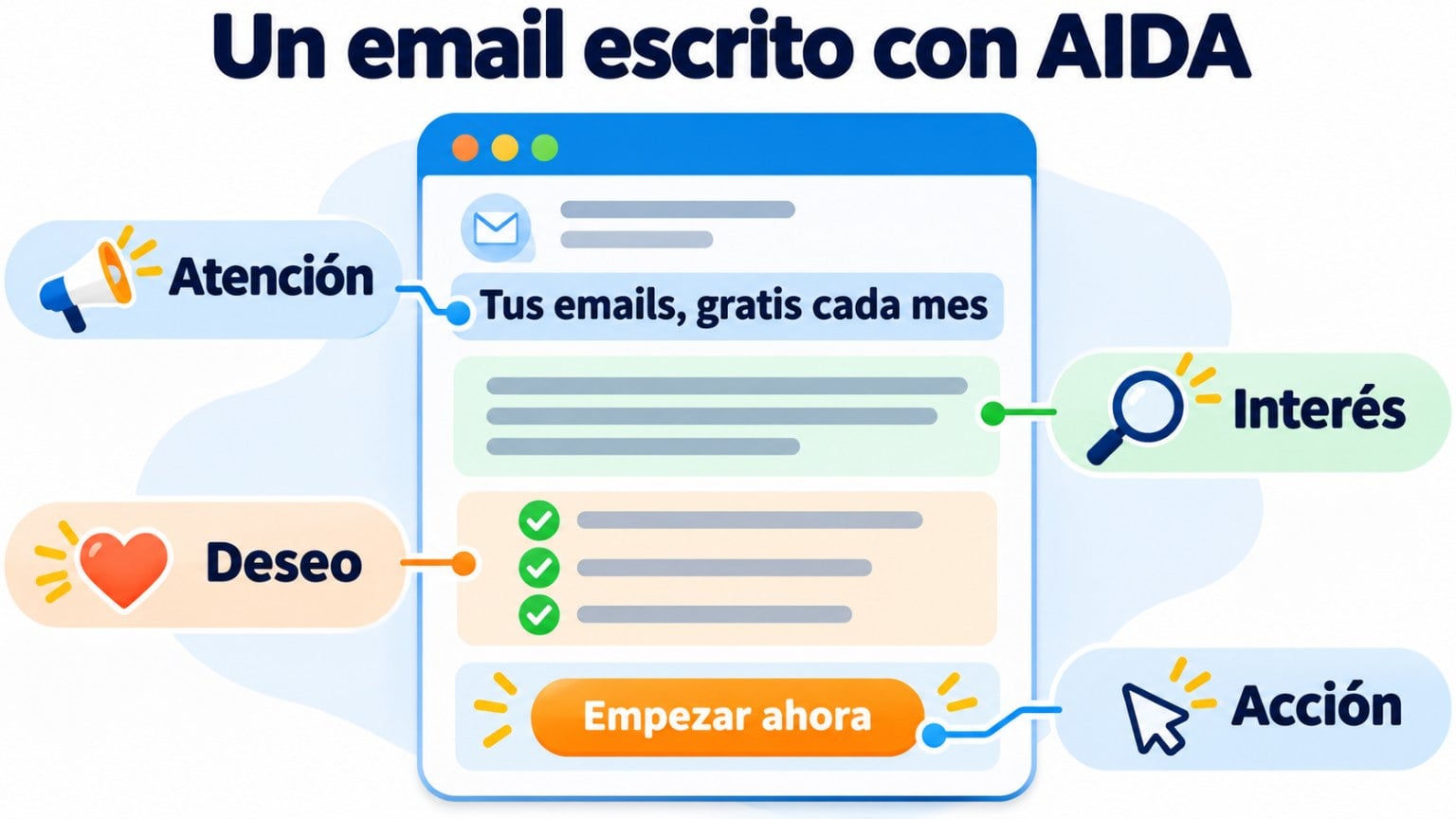
As you can see, this copy goes through every AIDA stage. You can see them roughly in these parts:
| Stage | Part of the copy |
|---|---|
| Attention | Up to 80,000 emails per month for free |
| Interest | Create a free Mailrelay account and send your emails for free |
| Desire | Wouldn’t you like not to have to pay to send an email campaign? |
| Action | Just sign up for your free account |
What do you think?
AIDA is an easy method to apply
And it can help you write quite effective sales copy.
Whether for a sales page or an email.
My recommendation is to run tests, A/B tests, with different variations until you find what helps your product or service convert best.

Limitations of the AIDA method
What follows is my own opinion, in general terms, and it may not apply to every case.
In my opinion, the AIDA method is useful when:
- The customer has more to gain than to lose from the purchase
- It is an impulse purchase, or we can encourage an immediate response
- The customer has practically already made the decision to buy: they are at the end of the sales funnel
Why do I think this? Because of its very structure: Attention – interest – desire – action
It is a method focused on speed, interest and desire.
This may apply to many sales processes, and I’m even sure AIDA can be applied to other, different sales processes.
My question at the time was:
What about sales processes where something weighs more than desire?
For example, any situation where buying carries some chance of ending up worse off than not buying.
Can there be cases like that?
Of course there can, and you have surely been in more than one situation like this.
Take the following case:
Imagine you run a dental clinic, and you currently use CRM software that keeps all your customers’ data at hand. Everything works fine, but it has a monthly fee you would like to reduce.
Switching software means: Significant cost savings
That is undoubtedly very appealing from a business perspective.
And if we are the providers of a cheaper alternative, we may think that focusing on that cost reduction is what we should do.
In that case, our sales copy could focus on our tool being considerably cheaper.
That way, we would be focusing on the desire to cut costs.
This desire will undoubtedly be strong.
So why wouldn’t the customer buy?
Because there are certainly some things that weigh more:
- Certainty that the expected savings will materialize: won’t clauses or conditions show up later?
- The doubt about whether the new provider will lack some key feature they haven’t anticipated: what would happen then?
- How easy will it be to adapt internal processes to the new provider?
- And the employees: what kind of training will they need?
- What support or training will the new provider offer them?
These doubts can certainly weigh more than the cost savings, because in fact they cancel them out.
In that case, the desire to save will not be fulfilled.

AIDA vs. other copywriting formulas
AIDA is not the only formula for writing sales copy. These are the most widely used ones and when each one fits.
| Formula | Steps | When to use it |
|---|---|---|
| AIDA | Attention, interest, desire and action | Quick or impulse purchases |
| AIDAS | AIDA plus satisfaction | When you want the customer to buy again |
| PAS | Problem, agitation and solution | The customer has a clear problem |
| BAB | Before, after and bridge | Showing the change your product brings |
The most common criticism of AIDA is that it is a linear model, while today’s buying journey goes back and forth between channels. That’s why it’s a good idea to combine it with other formulas. You’ll find more examples in the post on 5 copywriting formulas.
How Mailrelay helps you
With Mailrelay’s automations you can create an email sequence in which each message works on one stage of the AIDA method, from the first contact to the purchase. They are also included in the free account.
For the attention stage, A/B tests tell you which subject line more people open. And the free account lets you send up to 80,000 emails a month to 20,000 contacts.
Take your subscribers from attention to action
Create an automated email sequence that works on each stage of the AIDA method. Up to 80,000 emails a month for free with Mailrelay.
Frequently asked questions
What does AIDA stand for?
It stands for attention, interest, desire and action, the four stages someone goes through from discovering a product to buying it.
Who created the AIDA method?
It is attributed to the American advertiser E. St. Elmo Lewis, who in 1898 spoke of attracting attention, maintaining interest and creating desire. Action was added later.
How do you apply the AIDA method in an email?
The subject line grabs attention, the first paragraph sparks interest, the benefits create desire and the button leads to action.
What is the difference between AIDA and PAS?
AIDA guides the reader from the moment they discover you until they buy. PAS starts from a problem they already have, agitates it and presents your solution.
Does the AIDA method still work?
Yes, especially in short sales copy and quick purchases. For long or high-risk purchases, it’s best to address the customer’s doubts first.