
In the realm of email marketing, timing is a crucial factor that can determine the success or failure of your newsletter campaigns.
Choosing the right time to send an email not only increases the likelihood of it being opened and read, but also maximizes the recipient’s engagement with the offered content
This is because user behavior varies throughout the day.
Some prefer to check their emails in the morning, while others may be more receptive during the afternoon or evening.
Therefore, understanding and acting upon these patterns is essential for any email marketing strategy that aspires to be effective and efficient.
In this context, tools like Mailrelay, with their analytical capabilities, allow marketers to better understand their audience.
By using advanced features, users can segment their audience, schedule newsletters for optimal times, and access detailed reports on the performance of their emails.
Understanding your audience with Mailrelay
To maximize the impact of your email marketing campaigns, it is crucial to have a good understanding of your audience.
Mailrelay offers you tools that help you better understand your subscribers and adapt your messages to their specific needs.
👉 Segmentation features
Segmentation features allow classifying subscribers according to various criteria, specific variables of the contacts, and past interactions with emails.
This segmentation allows personalizing messages effectively, ensuring that the content is relevant to each contact.
By sending content adjusted to the specific characteristics of each segment, the chances of increasing engagement and response rates are much higher.
👉 Analysis of interaction patterns with statistics
In addition to segmentation tools, access to detailed statistics on how subscribers interact with your campaigns will help you improve results.
Analyzing this data allows you to identify the best times of the day or week to send your emails, based on when your messages are most opened and read.
This information is very valuable to optimize the timing of your campaigns and ensure you reach your audience when they are most receptive.
Which, as we have mentioned, can translate into better open rates, higher engagement and, ultimately, an increase in conversion.

The Importance of timing in email marketing
The time you decide to send your newsletters can have a significant impact on their effectiveness.
As we have seen, you can use Mailrelay to optimize the time you send your email marketing campaigns.
Sending an email at the right time is the foundation that allows you to capture your audience’s attention.
It can be the difference between your email being opened or deleted.
This can vary depending on factors such as the day of the week, the time of day, and the particularities of the sector you are targeting.
For example, emails sent early in the morning or late in the afternoon usually have better open rates in certain industries.
As you can see, this requires understanding your audience.
Are they professionals who likely read their emails in the morning? Or perhaps your audience tends to check their email at night?
Studying the statistics will offer you clues.
However, it is also necessary that you analyze and understand your clients.
Below you can find some suggestions on the best times to send an email marketing campaign.
Don’t take this as something definitive, but as a starting point from which to begin testing.
Various studies indicate that sending emails from Tuesday to Thursday generally has the highest open rates.
This is because people are more settled into their work routine and are less likely to be busy with the beginning or end of the week.
- Tuesday: frequently noted as the best day to send emails, with high open and click rates.
- Wednesday and Thursday: these days remain strong, although sometimes they can see a slight decrease compared to Tuesdays.
- Beginning and end of the week: Mondays and Fridays usually have lower open rates. On Mondays, people are planning their week and might ignore non-urgent emails. On Fridays, on the other hand, they might be more focused on the weekend and less interested in commercial emails.
- Weekends: generally, Saturdays and Sundays have the lowest engagement rates, although some niche markets can find success during these days, especially in consumer-oriented and leisure industries.
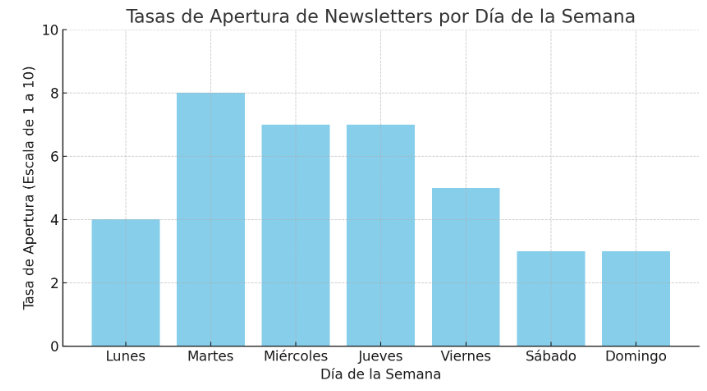
With this general data, plan the sending of your newsletters and use statistics to optimize the sending days.
As in the previous case, take them as starting points.
- Early morning (6 a.m. – 9 a.m.): sending newsletters early in the morning can capture those who check their email as part of their morning routine.
- Mid-morning (10 a.m.): this time is effective because it is situated right after most people have planned their day but before they fully immerse themselves in their work tasks.
- Post-lunch (1 p.m. – 2 p.m.): after lunch, when many check their email for the last time before diving into afternoon work, can be another effective time.
- Afternoon (before 5 p.m.): sending emails later can be risky, as people may be finishing their workday and be less likely to pay attention to new emails.
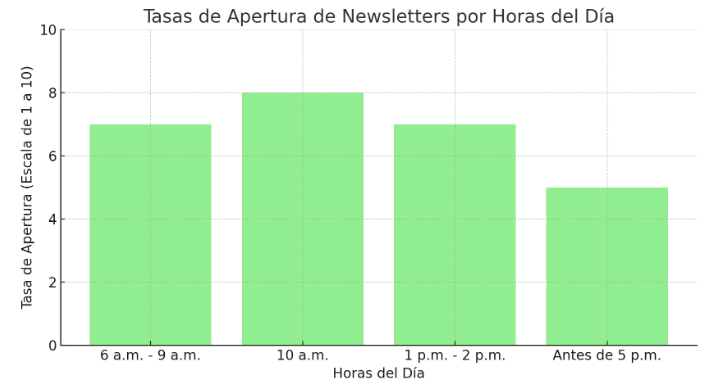
Of course, for certain niches, sending emails later can be effective.
In the end, the reality is that people are not separated from their mobile devices, so they can receive emails at any time.

Mailrelay will offer you various statistics, among the most important:
- Open rates
- Clicks
- Unsubscribes
- Spam complaints
Among other graphs that will allow you to know when the peak activity moments are.
Note, this information doesn’t mean that you should not run tests.
Anything is possible, and it is possible that the times when you have more opens are not the times when you would have more clicks, or even sales.
Running tests is indispensable.
Always try to improve, based on real data.
Furthermore, consider consumer psychology, what time would be best for your customers to consider making a purchase?
🎯 Implementation of data-driven strategies
Boost your strategy with other tools like Google Analytics to better understand your customers’ habits:
- The days of highest activity
- Best times
- The most visited content
This information can also serve as a basis to establish sending times for your newsletters.
And not only that.
But also the possibility of adapting the content, and sending them content that interests them more.
🎯 Break expectations
If your contacts are used to receiving your emails on certain days and times, and you have to send a differentiated message, try using other days and times.
That can get better results for promotions and offers that drift away from what you normally send.
This last point is important.
The larger your list, the more likely it is to be a very heterogeneous list, so what works for some contacts might not work for others.
Segment your contact list so that it is easier for you to run multiple campaigns, each at its best time.

Impact of timing on open and click rates
The time you decide to send your newsletters plays a crucial role in determining not only if your email will be opened, but also if the recipients will interact with its content.
Optimizing these times can significantly increase the effectiveness of your email marketing campaign.
💡 Relationship between send time and open rates
User behavior studies show that the probability of an email being opened depends largely on the time and day of its receipt.
For example, emails sent early in the morning tend to have higher open rates.
This is because they coincide with many people’s routine of checking their email at the start of the day.
On the other hand, emails sent during the weekend can go unnoticed because daily routines change and professional email is not a priority.
Additionally, specific days like Tuesdays and Thursdays show higher open rates compared to Mondays.
This may be because your contacts quickly delete emails to clear their inbox and plan their week.
💡 Effect on click rates
Once your newsletter has been opened, the next goal is to encourage users to interact with the content.
Here, the message content must be convincing, but timing remains a crucial factor.
For example, emails sent mid-morning (around 10 a.m.) usually get not only high open rates, but also click rates.
It may be because it is a time when many users take short breaks and are more willing to interact with non-essential content.
Personalization and segmentation also play fundamental roles in click rates.
Emails that arrive at timely moments and contain personalized offers according to users’ past preferences and behaviors can see a notable increase in engagement.
Conclusion
Throughout the article we have shared information about the best times and hours to send newsletters.
However, it should simply be treated as a starting point from which to begin experimenting with your list.
Mailrelay’s statistics tools will allow you to better adjust your sending times, and improve your results.