History of digital marketing: origins, evolution and key stages
From the first commercial email in 1978 to artificial intelligence: how digital marketing began, its key stages and what has changed in the way we buy
From the first commercial email in 1978 to artificial intelligence: how digital marketing began, its key stages and what has changed in the way we buy
Digital marketing was born in the mid-1990s, when the internet reached people’s homes and companies started advertising on the web. Its first forerunner, though, came earlier: a commercial email sent in 1978.
Since then it has gone through search engines, social media, mobile and, now, artificial intelligence. Here is how it started, its key stages and what has changed in the way we buy.
Digital marketing covers the promotion and sales activities a company carries out through online channels: website, search engines, email, social media or apps.
It has no single date of birth. For many historians it begins in 1994, with the first banner ad on the web. Others place it in 1978, when the first mass commercial email was sent.
What is clear is that the term became popular in the 1990s, as the internet turned into a commercial space.
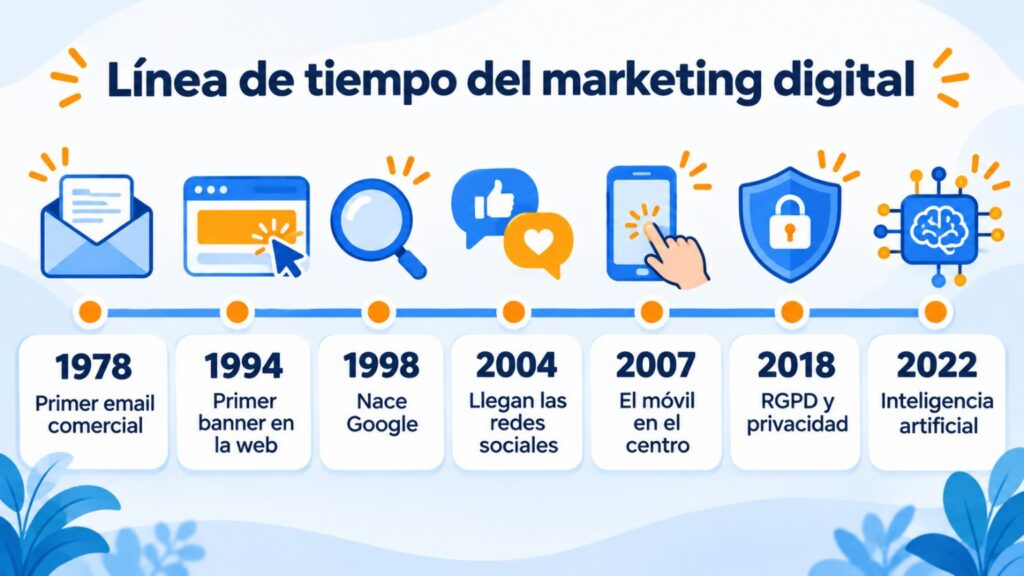
These are the milestones that marked each change of stage:
| Year | Milestone | What changed |
|---|---|---|
| 1971 | Ray Tomlinson sends the first email on ARPANET | The channel marketing will later use is born |
| 1978 | Gary Thuerk, of DEC, sends the first commercial email to around 400 recipients | First forerunner of email marketing (and of spam) |
| 1991 | The World Wide Web opens to the public | Companies start to have websites |
| 1994 | First banner ad, on the HotWired website | Online advertising is born |
| 1995 | Amazon and eBay arrive | People start buying online |
| 1998 | Google is founded | Search engines become the gateway |
| 2000 | Google launches AdWords | Pay-per-click advertising |
| 2004 | Facebook is born | The social media era begins |
| 2007 | Apple unveils the iPhone | The phone becomes the main screen |
| 2018 | The GDPR comes into force in Europe | Privacy and consent move to the forefront |
| 2022 | ChatGPT is launched | Artificial intelligence becomes part of everyday marketing |
No stage replaces the one before it. They build on each other, and today a small business can use tools born 30 years apart side by side.
Email existed before the web. Gary Thuerk’s 1978 send generated sales, but also plenty of complaints: it was the first sign that writing to people without permission annoys them.
When the web opened in 1991, companies started publishing simple pages, little more than on-screen brochures. Nobody was thinking about attracting visitors yet.
The first banner, published in 1994, invited people to click with a direct question. Online advertising started to be measured by something new: clicks.
At the same time Amazon and eBay were born, and with Google, search became the starting point of almost every purchase. That is how SEO and, in 2000, pay-per-click advertising came about.
LinkedIn, Facebook, YouTube and Twitter changed the customer’s role. Customers no longer just received messages: they also commented, shared and recommended.
Brands started publishing useful content to earn attention instead of just buying it. This is the origin of content marketing as we know it.
With the iPhone and the smartphones that followed, the internet moved into people’s pockets. Websites had to adapt to small screens, and people started shopping from anywhere.
So did emails: today most are opened first on a phone, and a design that is hard to read on a small screen loses readers.
Tools made it possible to segment, automate messages and measure almost everything. At the same time, laws set limits: the GDPR has applied in Europe since May 2018 and requires consent to use people’s data.
Philip Kotler described this moment in Marketing 4.0: marketing that combines online and offline. You can read about his career in our post on Philip Kotler.
Since ChatGPT arrived, AI helps write copy, analyse data and personalise messages at scale. It has also changed search: many answers now arrive already summarised, without a visit to the website.
You can see how it is used today in the post on artificial intelligence in digital marketing.
The biggest change has not been technological, but a shift in power. In the past, the company decided which message reached the customer. Today the customer searches, compares reviews and decides when and where they want to buy.
Patience has changed too. We expect quick answers, websites that load instantly and messages about the things we care about.
And expectations around privacy have grown. More and more people want to know what is done with their data, and they cancel subscriptions that give them nothing of value.
Email is the oldest digital marketing channel and one of the few that has survived every stage. It has gone from mass sends without permission to double opt-in lists, and from the same message for everyone to segmentation and automation.
Its advantage is that it does not depend on an algorithm: the message lands in the inbox of whoever subscribed. That is why it is still the channel many companies use to build customer loyalty.
Recent changes point in the same direction. In 2024, Gmail and Yahoo began requiring authentication and easy unsubscribes from bulk senders. You can see what is coming in our email marketing trends for 2027.
The channel that is still standing
Half a century later, email still reaches your customers’ inboxes. Get started for free with Mailrelay.
With so many new tools, it is easy to forget that the basics are the same as in traditional marketing. Know your customer, offer them something useful and earn their trust.
The 4Ps still apply, as you will see in the marketing mix. What changes are the channels and the speed.
If you want to apply all this to your business, you will find concrete ideas in these digital marketing strategies.
Start sending today
Free account: up to 80,000 emails a month to 20,000 contacts, with human support.
These are some common questions about its origins.
In the mid-1990s, with the arrival of the commercial web. Its first forerunner is the commercial email Gary Thuerk sent in 1978.
A banner published in 1994 on the website of HotWired magazine. It is considered the beginning of online advertising.
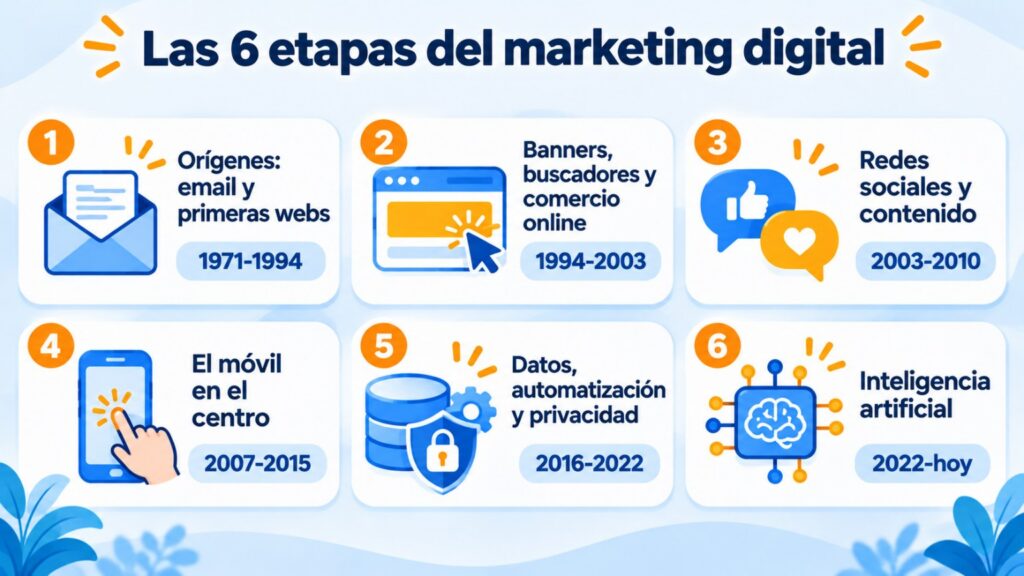
The origins with email and the first websites, search engines and online shopping, social media, mobile, the data and privacy stage, and artificial intelligence.
Digital marketing uses online channels, makes it possible to measure almost everything and makes conversations with customers easier. The underlying principles are the same.
What is email marketing
How the oldest digital marketing channel works and why it still works.
Types of marketing
The main types of marketing, with examples and how to choose yours.
Consumer psychology
What motivates a purchase and how to apply it to your marketing.

Jose Argudo
CMO at Mailrelay. Writes about email marketing, copywriting and conversion for small businesses and entrepreneurs.