International marketing: what it is, strategies and how to adapt your communication to each country
From your first customer in another country to a newsletter in three languages: how to adapt your marketing without multiplying the work
International marketing is the set of decisions a company makes to sell its products or services in countries other than its own.
It’s not just about translating: you also have to adapt the price, the message, the channels and even the product to each market.
What is international marketing?
Short answer: it’s applying the same marketing as always to other countries, taking into account what changes in each one. That includes language, culture, laws, competition, payment methods and the way people buy.
An online store in Valencia that starts selling in Portugal and Mexico is already doing international marketing. You don’t need to be a multinational.
International, global and multinational marketing
These terms are used as synonyms, but each one puts the focus somewhere different:
| Approach | What it does | Example |
|---|---|---|
| International | Takes what already works at home to other countries and adapts it only as needed | A Spanish store that sells in Portugal with a translated website |
| Multinational | Treats each country as a separate market, with its own strategy | A food brand with different recipes in each country |
| Global | A single strategy for the whole world, with few local changes | A streaming platform with the same interface everywhere |
In practice, most companies mix all three. We look at more examples in types of marketing.
International marketing strategies
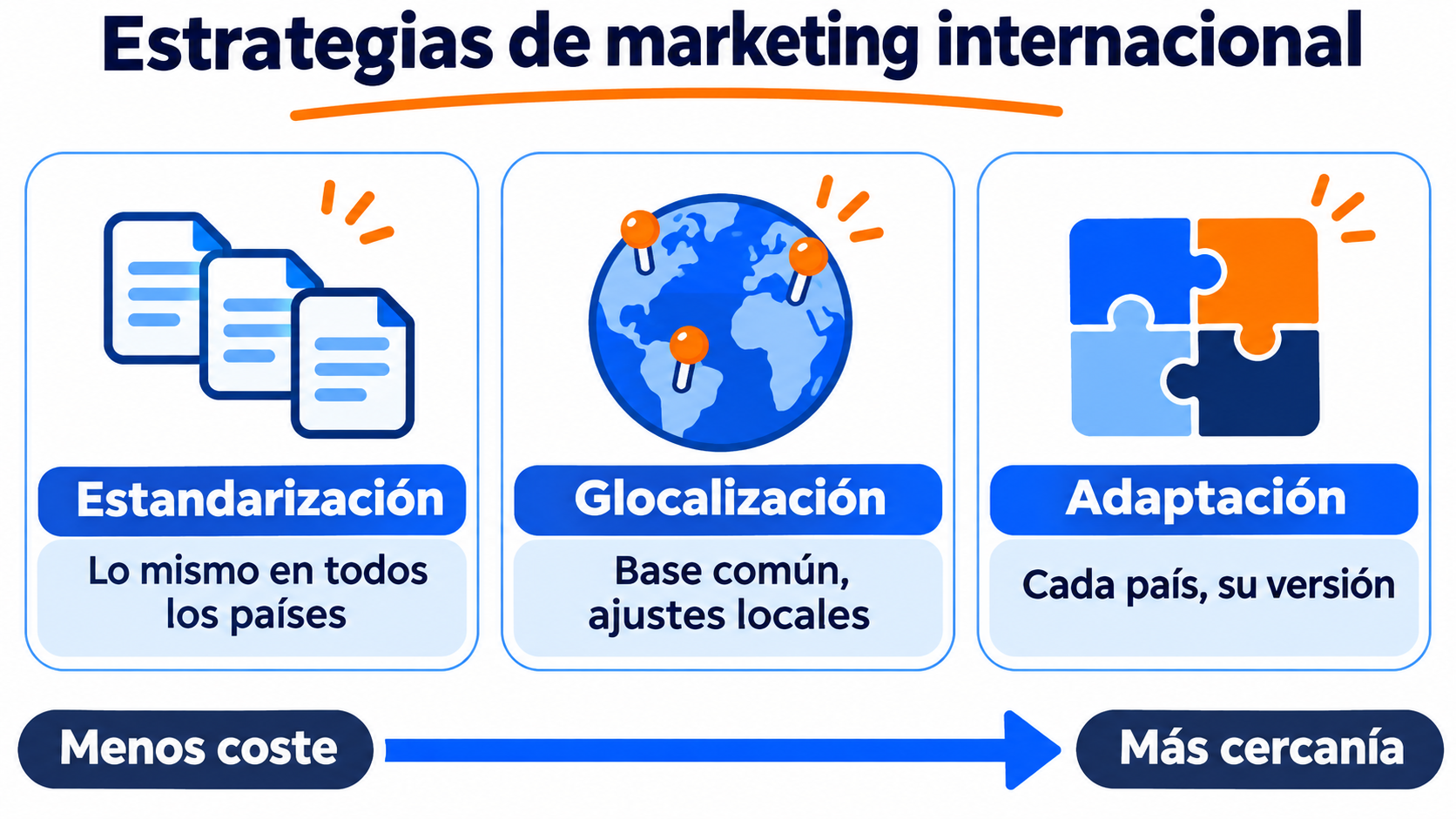
The big decision is how much to adapt:
- Standardization. The same product and the same message in every country. It saves costs and strengthens the brand, but it can clash with local tastes.
- Adaptation. You change the product, price or message for each market. It connects better, but it costs more.
- Glocalization. A common base with local adjustments: “think global, act local”. This is what fast food chains do when they keep their brand and change part of the menu in each country.
Before choosing, it’s worth doing market research for each country: who buys, how much they pay, what the competition is and which rules apply. Geomarketing helps you fine-tune by area within each country.
Why language matters so much
According to CSA Research’s “Can’t Read, Won’t Buy” study (2020, 8,709 consumers in 29 countries):
- Given two similar products, 76% choose the one with information in their language.
- 40% never buy from websites in another language.
- 75% are more likely to buy from a brand again if they get customer support in their language.
Translating well isn’t just running the text through a translator. Machine translation is a starting point, but prices, dates, formal or informal address and examples have to sound local.
A newsletter for each country
Create a group per market and send to each one in its language from Mailrelay’s free account: up to 80,000 emails a month.
International email marketing
Email is one of the easiest channels to internationalize, because you decide what each person receives:
- Ask for country and language in the signup form. Store them in custom fields.
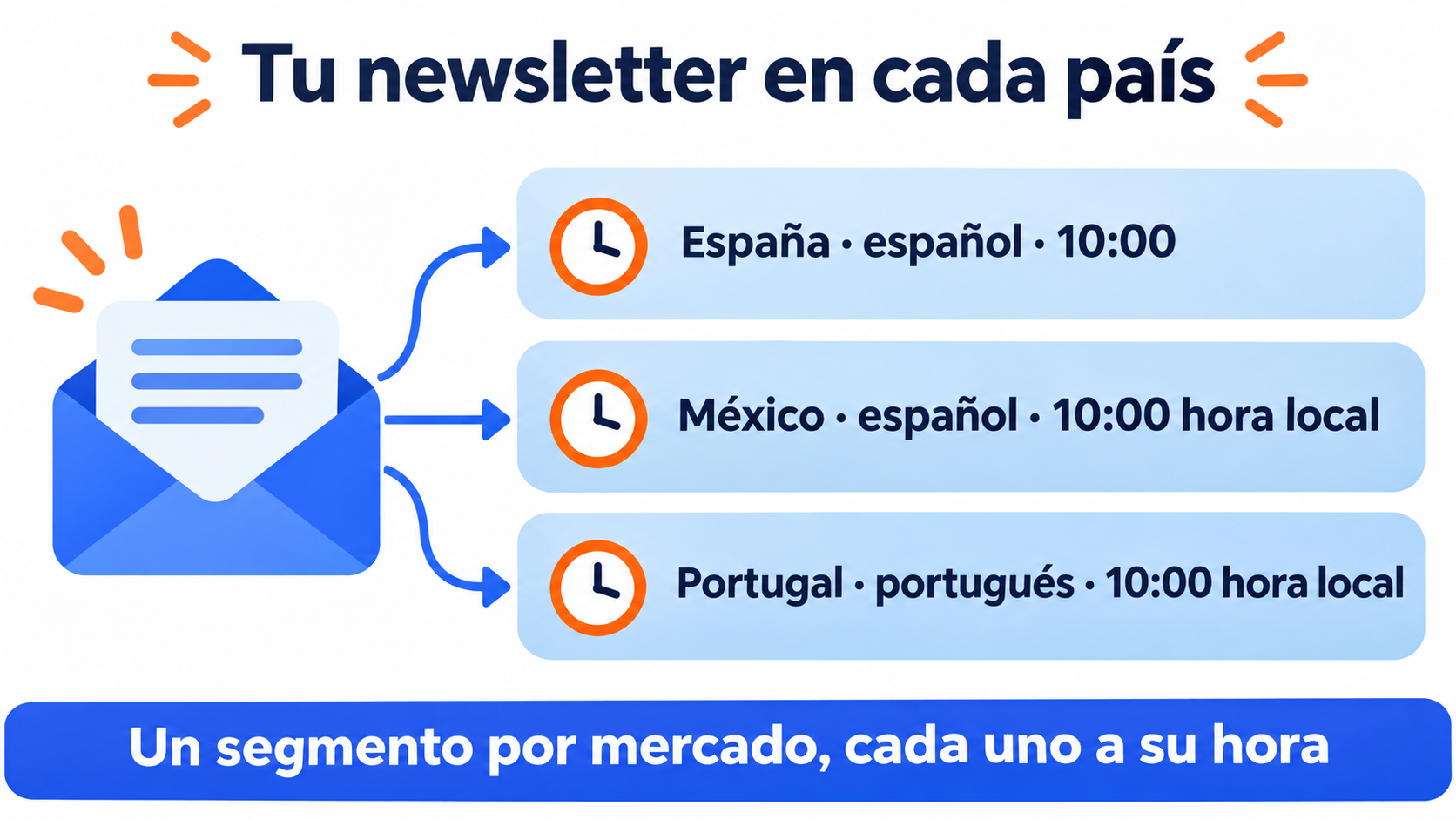
- Segment by country or language. Each group gets its own version of the newsletter, instead of one email in three languages that nobody reads in full. We explain it in segmentation in email marketing.
- Send at local time. An email that goes out at 10:00 in Madrid arrives in the middle of the night in Mexico City. Schedule each segment at its own time (more in the best time to send newsletters).
- Adapt your calendar. Sales, public holidays and dates like Buen Fin or Black Friday don’t fall the same way everywhere.
- Check the law in each destination. In Europe, GDPR applies; in the United States, CAN-SPAM; in Canada, CASL. The rules on consent and unsubscribing are not the same.
How Mailrelay helps you
With Mailrelay you store each contact’s country and language in custom fields, create a group or segment for each market and schedule each send at the right time.
That way each customer gets a single newsletter, in their language and at a reasonable time.
The free account lets you send 80,000 emails a month to 20,000 contacts, with human support on every plan. If you’re thinking of taking the leap, our post on internationalization covers the stages and the legal aspects.
Speak to each customer in their language
Custom fields, segments and scheduled sends, with human support on every plan.
Frequently asked questions
These questions cover what people most often ask about the topic.
What are the goals of international marketing?
Finding new markets to grow, depending less on a single country, extending the life of a product that has already matured at home and taking advantage of markets with less competition.
What’s the difference between international marketing and international trade?
International trade is the exchange of goods between countries: customs, transport, tariffs. International marketing decides what to sell, to whom, at what price and how to communicate it in each market.
Do you need a website in each language?
Not always at first, but it helps a lot. At a minimum, have what makes the customer buy in their language: product pages, terms and conditions, the checkout process, customer support and the emails they receive.
Related posts
Here are some articles along the same lines: