FOMO: what it is, what it means and how to use it in marketing without misleading
What's behind "I've got FOMO" and how to use urgency in your emails without tricks
FOMO is the fear of missing out: the feeling that other people are enjoying an experience, a deal or something new that you’re left out of. It’s the acronym for fear of missing out.
On social media, it’s used to describe the unease you feel when you see what others are doing. In marketing, it describes messages that encourage people to decide quickly, such as an offer that ends today or limited spots.
What does FOMO mean?
FOMO stands for fear of missing out. When someone says “I’ve got FOMO”, they mean they’re worried about being left out of a plan, a trend or an opportunity.
The term was popularized by Patrick McGinnis in 2004, in an article for The Harbus, the Harvard Business School student newspaper. In it, he wrote about classmates who signed up for everything for fear of missing out on something important.
In 2013, a study by Andrew Przybylski and other researchers published in Computers in Human Behavior defined it as the constant worry that others are having rewarding experiences without you. That study linked FOMO to heavier use of social media.
Social media is the perfect setting for FOMO. You see photos of a concert, a trip or a dinner, and you feel like you’re missing out.
Some typical signs:
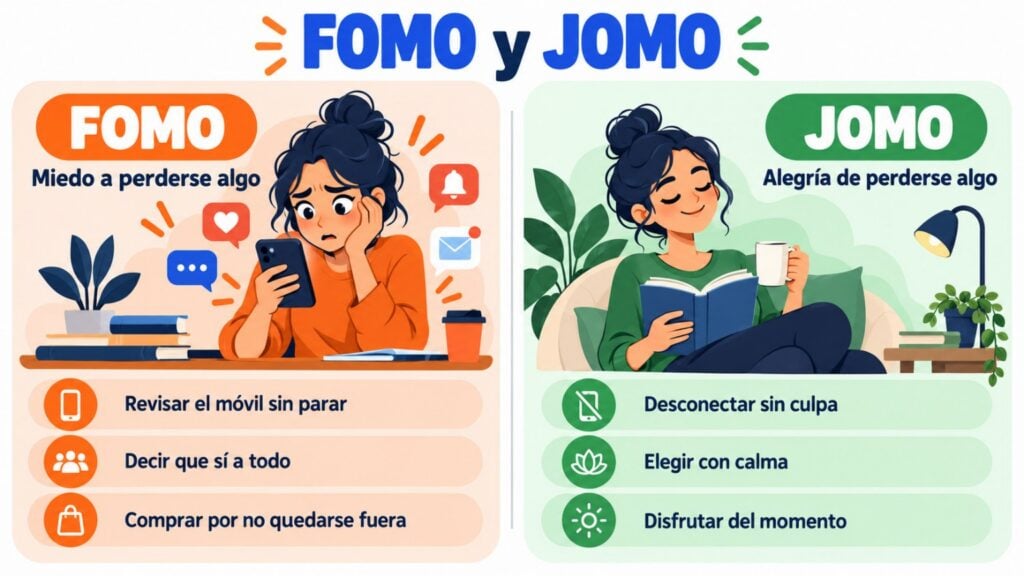
- Checking your phone over and over in case you’ve missed something new.
- Signing up for plans you don’t feel like doing so you’re not left out.
- Buying something because “everyone has one”.
The opposite is JOMO (joy of missing out). It’s choosing to disconnect and enjoying not being everywhere.
| FOMO | JOMO | |
|---|---|---|
| Meaning | Fear of missing out | Joy of missing out |
| Feeling | Unease, rush | Calm, control |
| Behavior | Checking your phone, saying yes to everything | Disconnecting, choosing calmly |
FOMO in marketing
Brands use FOMO as a psychological trigger to encourage people to buy or sign up. It works because nobody likes to miss an opportunity.
These are the most common techniques:
| Technique | Example | Why it works |
|---|---|---|
| Urgency | “The offer ends at midnight” | It puts a deadline on the decision |
| Scarcity | “Only 12 spots left” | What’s limited seems more valuable |
| Exclusivity | “Subscribers only” | It makes people feel part of a group |
| Social proof | “Over 500 people have already booked” | If others are doing it, it must be worth it |
| Early access | “Buy before anyone else” | It rewards those who act early |
Flash sales, launches with a waiting list and dates like Black Friday rely largely on FOMO.
Create real urgency in your campaigns
Schedule your offer reminders and measure which subject line works best with your list.
How to use FOMO in your emails without misleading
Email is a great channel for FOMO, because it reaches the inbox of people who already know you. But the urgency has to be real.
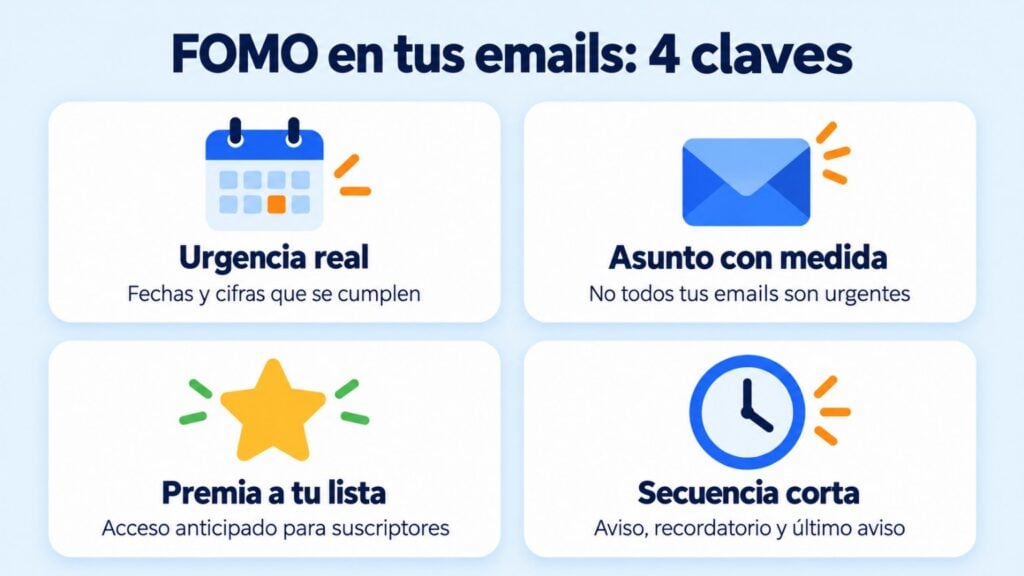
Use real dates and figures. If you say the offer ends on Sunday, make sure it ends on Sunday. The EU Unfair Commercial Practices Directive (2005/29/EC) considers it misleading to falsely state that a product will only be available for a very limited time.
Put it in the subject line, in moderation. An email subject line like “Last hours for your discount” works. If all your subject lines say “Last chance!”, people will stop believing you.
Reward your subscribers. Early access or a discount just for your list creates FOMO without pressure. Plus, it gives people a reason to stay subscribed.
Send a short sequence. One notice when the offer starts, a reminder halfway through and a final email a few hours before the end. For the final notice, an SMS works well too.
Don’t use it for everything. If every email is urgent, none of them are, just like “ASAP” in work emails. Alternate FOMO campaigns with useful content for your list.
FOMO subject line examples
| Email type | Subject line |
|---|---|
| Offer ending | Your 20% discount ends tonight |
| Limited spots | Only 8 spots left for Thursday’s workshop |
| Early access | We’re opening the sale to you a day early |
| Launch | The new collection arrives tomorrow at 10:00 |
| Abandoned cart | Your cart is still waiting (and stock is running low) |
If you can’t decide between an urgent subject line and a calmer one, run an A/B test and let your subscribers decide.
If you want to know how FOMO combines with hype and FUD, you’ll find more ideas in our post on hype, FOMO and FUD in marketing.
How Mailrelay helps you
With Mailrelay you can create campaigns with real urgency and measure how your list responds:
Scheduled sends. Set up your offer’s launch notice, reminder and final email in advance.
Segments. Send early access only to your best customers or to those who opened the previous campaign.
A/B tests. Compare an urgent subject line with one without urgency before sending to your whole list.
Email and SMS. Send the final notice by SMS from the same dashboard.
And with the free account you can send up to 80,000 emails a month to 20,000 contacts, with human support on every plan.
Make sure your subscribers don’t miss your offers
Send emails and SMS from the same dashboard, even with the free account.
FOMO FAQs
What does FOMO mean?
It’s the acronym for fear of missing out. It’s the unease of thinking that others are experiencing something you’re missing.
What does “I’ve got FOMO” mean?
That you’re worried about being left out of a plan, an offer or a trend. It’s used a lot on social media.
What is JOMO?
It’s the opposite of FOMO: joy of missing out. It describes someone who chooses to disconnect and enjoys it.
Is it ethical to use FOMO in marketing?
Yes, if the urgency and scarcity are real. Making up deadlines or stock that doesn’t exist misleads the customer and is an unfair commercial practice.
How do I use FOMO in email marketing?
With real deadlines, perks for your subscribers and a short sequence of reminders. Use it only in specific campaigns, not in all your sends.