
Choosing between the different email marketing software options seems simple until you start reading the fine print. They all promise beautiful templates, automations and statistics. But the differences show up when you look at how many emails you can actually send, to how many contacts, and who answers you when something goes wrong.
In this guide we explain what good email marketing software should have, compare the current free plans of the most widely used tools in Spain and help you decide based on your situation. No inflated rankings.
Quick answer: the most widely used email marketing tools are Mailrelay, Brevo, Mailchimp, MailerLite, Mailjet, Acumbamail and Klaviyo. If you’re looking for a generous free plan, Mailrelay lets you send up to 80,000 emails a month to 20,000 contacts, with no ads in your emails and with human support. Brevo stands out for storing lots of contacts, although it limits sending to 300 emails a day. Mailchimp and MailerLite have cut back their free plans significantly in 2026.
Try the software with the most generous free plan
Send up to 80,000 emails a month to 20,000 contacts, with no ads in your emails and with human support via chat, ticket and phone.
What is email marketing software?
Email marketing software is a platform that lets you create, send and measure email campaigns to a list of subscribers. It runs in your browser, so you don’t need to install anything.

The difference from sending from Gmail or Outlook is huge. Specialized software handles unsubscribes automatically, spreads out sends so servers aren’t overloaded, authenticates your domain and tells you who opened, who clicked and who bounced. It also protects your sender reputation, which is ultimately what decides whether you reach the inbox or the spam folder.
And there’s something that’s often overlooked: deliverability depends as much on you as on the tool. Good software helps, but it can’t work miracles with a purchased list.
What good email marketing software should have
Before comparing brands, it’s worth being clear about what you’ll need six months from now, not just today. Many companies choose based on the interface and find out too late that the free plan falls short or that support is only available in English and by email.
These are the points that make a difference day to day:
- Real plan limits: contacts stored, emails per month and, above all, whether there’s a daily sending cap.
- Automation: welcome emails, sequences, autoresponders and abandoned carts.
- Segmentation and custom fields: so you don’t send the same thing to everyone.
- A/B tests: comparing subject lines or content before launching the full campaign (here we explain what an A/B test is).
- Real-time reports: opens, clicks, bounces and unsubscribes, easy to interpret.
- Integrations: WordPress plugin, REST API, connection to your online store or your CRM.
- Support: language, channels (chat, phone, ticket) and whether it’s included in the free plan.
- GDPR compliance: forms with double opt-in and clear unsubscribe management.
Because, in the end, the best software isn’t the one that advertises the most features. It’s the one you can use without fighting with it and that doesn’t force you to pay as soon as your list grows a little.
Free plan comparison in 2026
Free plans have changed a lot in recent months. Mailchimp cut back its plan in January 2026 and MailerLite did the same in June. That’s why many comparisons circulating online no longer reflect reality.
This table shows the limits published by the providers themselves as of September 2026:
| Software | Contacts on free plan | Emails per month | Daily limit | Provider branding in your emails |
|---|---|---|---|---|
| Mailrelay | 20.000 | 80.000 | — | No |
| Brevo | 100.000 | ~9,000 | 300 | Yes |
| Mailjet | 1.000 | 6.000 | 200 | Yes |
| MailerLite | 250 | 2.500 | — | Yes |
| Acumbamail | Check | 2.000 | — | Check |
| Mailchimp | 250 | 500 | 250 | Yes |
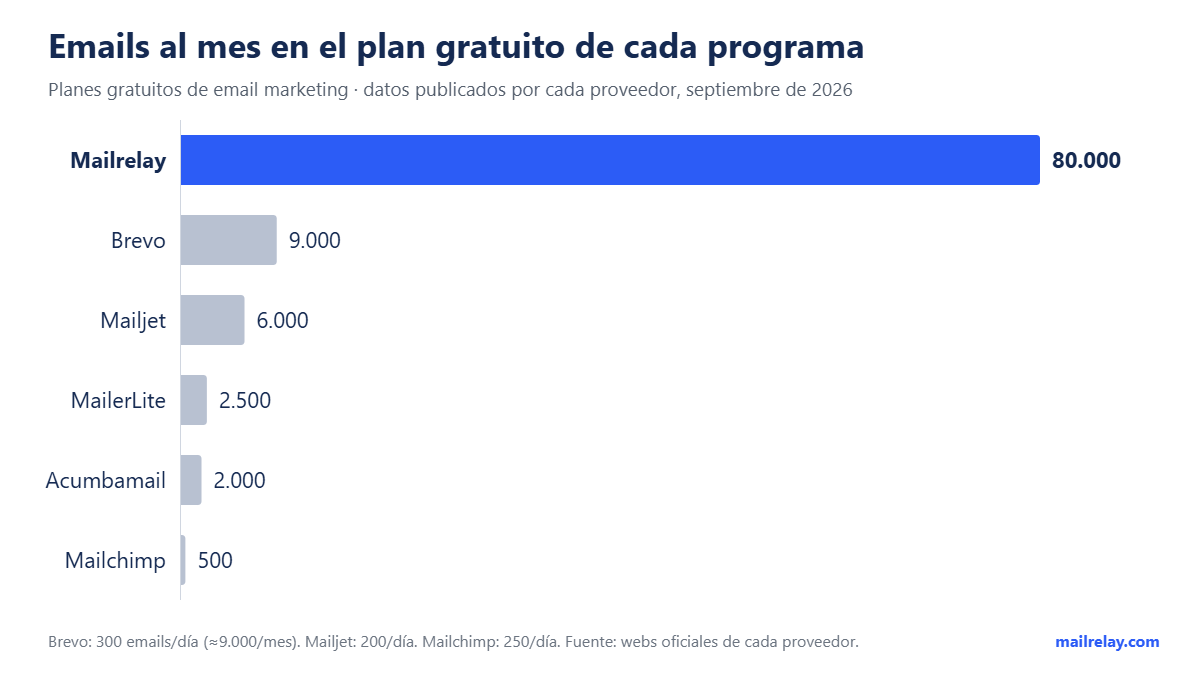
Look at the relationship between contacts and sends. Brevo lets you store 100,000 contacts, but at 300 emails a day it would take you almost a year to email all of them just once. By contrast, with 20,000 contacts and 80,000 sends you can send four campaigns a month to your entire list.
Limits change frequently. We recommend checking each provider’s pricing page before deciding.
The most widely used email marketing software in Spain
Each tool has a different profile and none is perfect for everything. We sum up their strengths and limitations, measuring them all by the same yardstick.
Mailrelay
At Mailrelay we offer the most generous free account on the market: up to 80,000 emails a month to 20,000 contacts, with no ads or Mailrelay logos in your emails. It isn’t a stripped-down version designed to get you to pay in the end. It includes automations, segmentation, custom fields, A/B tests, landing pages, RSS campaigns and an email editor with AI-assisted writing.
What our customers value most is the support. We help you via chat, ticket and phone in several languages, on the free account too. We also have a WordPress plugin and a REST API to connect your website or your store.
And what if you grow? Paid plans start at €48 a month for 100,000 emails. You can see all the tiers on our pricing page. If you want details on each feature, you’ll find them in Mailrelay features.
Brevo (formerly Sendinblue)
Brevo is a complete platform that combines email, SMS, WhatsApp and a basic CRM. Its free plan lets you store up to 100,000 contacts, which is very eye-catching.
The problem is sending: 300 emails a day, with its logo in every email. In addition, the free plan doesn’t include A/B tests or landing pages. It’s a good fit if your list is small and you don’t send much, but it falls short for regular campaigns. You’ll find more details in our post about Brevo.
Mailchimp
Mailchimp is still the best-known brand and its editor is very easy to use. It has lots of integrations and a huge template library.
But its free plan is now one of the most limited: 250 contacts, 500 emails a month and no automations. Its paid plans get expensive quickly as your list grows. If you already use it and are thinking about switching, you may be interested in this guide on alternatives to Mailchimp.
MailerLite
MailerLite has a clean interface and a simple editor, very popular with content creators and small businesses.
In June 2026 it reduced its free plan to 250 subscribers and 2,500 emails a month. In return, it unlocked some features such as custom templates and the HTML editor. It’s a good option for getting started with a very small list. You can read more about MailerLite in our glossary.
Mailjet
Mailjet, owned by Sinch, is designed for teams that combine marketing campaigns and transactional emails. It lets several team members work on the same campaign.
Its free plan offers 6,000 emails a month to 1,000 contacts, with a maximum of 200 sends a day and its branding in your emails. If you need to send a campaign to your entire list on the same day, that daily cap is noticeable. We analyze it in detail in Mailjet: pros, cons and alternative.
Acumbamail
Acumbamail is a Spanish tool, with a Spanish-language interface and personal support. It includes email marketing, SMS and landing pages.
Its free plan allows around 2,000 emails a month, enough to try the tool but not for an ongoing strategy. Its paid plans are reasonably priced for small and medium-sized lists.
Klaviyo
Klaviyo is geared almost entirely toward ecommerce, especially Shopify stores. Its strong point is segmentation based on purchase data and sales automations.
Its free plan is very limited and its paid plans are expensive compared to the rest. It makes sense for online stores with high volume and a team that can make the most of its advanced features.
Is your free plan falling short?
With Mailrelay you can send four campaigns a month to a list of 20,000 contacts without paying anything. No credit card required.
How to choose email marketing software for your situation
There’s no ideal software for everyone. The best choice depends on the size of your list, how often you send and the resources you have.
If you’re an SMB or a freelancer, prioritize a generous free plan, support in your language and an interface you can use without training. A low daily limit will force you to split every campaign into chunks, and that takes time. You’ll find the steps to get started in our guide to email marketing for SMBs.
If you run an online store, look for integration with your platform, abandoned cart emails and purchase-based segmentation. Here it’s also worth checking whether you can send transactional emails from the same tool.
For a nonprofit, association or educational institution, cost comes first. They usually have large lists and small budgets, so the ratio between allowed contacts and monthly sends is what matters most.
And if you work with large volumes, look at the price per thousand sends, sending speed, dedicated IP and the quality of technical support. A deliverability problem in a large campaign costs a lot of money.
A practical tip: before committing, try two tools with the same real campaign. In one afternoon you’ll see which one feels more natural to you.
Common mistakes when switching software
Switching tools is scarier than it should be, although there are a few mistakes worth avoiding.

The most common one is importing your entire list without cleaning it. If you bring along addresses that haven’t opened in months, your reputation on the new platform will start out damaged. Use the switch to remove bounces and inactive contacts.
Another mistake is forgetting about domain authentication. Gmail, Yahoo and Outlook require SPF, DKIM and DMARC for bulk senders. Without them, your emails can end up in spam even if the content is flawless.
It’s also common to copy automations as they are, without reviewing them. It’s a good time to look at which sequences work and which haven’t added anything in years.
Finally, don’t switch all at once if you send a lot. Start with your most active subscribers and increase the volume gradually over the first few weeks.
Frequently Asked Questions
These are the questions we’re asked most often by people comparing email marketing software.
What is the best free email marketing software?
It depends on your volume. If you want to send frequent campaigns to a list of thousands of contacts, Mailrelay offers the most generous free plan: 80,000 emails a month to 20,000 contacts, with no ads in your emails. For very small lists, MailerLite or Mailjet can also work.
Can I do email marketing with Gmail?
You can send a few emails, but it isn’t recommended. Gmail limits the number of daily sends, doesn’t handle unsubscribes and doesn’t give you campaign statistics. In addition, bulk sending from a personal account puts your sender reputation at risk.
What’s the difference between a free plan and a free trial?
A free plan doesn’t expire: you can use it indefinitely within its limits. A free trial lasts a few days and then you have to pay. At Mailrelay the free account is free forever and doesn’t require a credit card.
Is email marketing software GDPR compliant?
The main ones do offer the necessary tools, such as double opt-in forms, unsubscribe management and consent records. But compliance also depends on how you collect and use the data. Never send to contacts who haven’t given you their permission.
What happens if I exceed the free plan limits?
Each provider handles it differently. Some pause sending until the following month and others ask you to upgrade to a paid plan. That’s why it’s important to choose software with room to grow from the start.
Create your free Mailrelay account
Import your contacts and send your first campaign today. No credit card, and with a support team that actually answers you.
Get started with Mailrelay today
If you’re weighing up email marketing software, the most useful thing is to try it. With Mailrelay you can create your free account in a few minutes, import your contacts and send your first campaign today. No credit card, no ads in your emails and a support team that actually answers you.

Jose Argudo
CMO at Mailrelay. Writes about email marketing, copywriting and conversion for small businesses and entrepreneurs.