Target: what it is, types, examples and how to define your company's
Target or target audience: what it means, how it differs from a buyer persona and how to find yours
The target is the group of people a company aims its products, services and communication at, because they are the most likely to buy them. It is also called the target audience, target market or target customer.
Defining your target helps you decide what to sell, at what price, through which channels and with which messages. Without one, your marketing speaks to everyone and convinces no one.
What does target mean?
Target literally means the mark or bullseye, the point you aim at. Marketing has used it since the 1950s to name the audience a brand is “aiming” at.
Spanish speakers often misspell it as “tarjet”, “traget” or “targuet”. The correct spelling is target, and its plural is targets.
What is a company’s target?
A company’s target is the profile of the ideal customer it is aimed at. It is not “anyone who might buy”, but the specific group that gets the most value from the product and brings the most value to the business.
Think of an online English school. Its audience might be professionals aged 25 to 45 who need the language for work and are short on time.
A company can have several audiences: one primary and one or two secondary. They also change over time, as the market and the company itself change.
Types of target
Depending on the characteristics used to describe it, these are the most common types of target:
| Type | What it considers | Example |
|---|---|---|
| Demographic | Age, gender, marital status, income, education level | Women aged 30 to 45 with children |
| Geographic | Country, region, city, climate, urban or rural setting | Residents of a neighborhood within a 5 km radius |
| Psychographic | Values, lifestyle, interests, personality | People who care about sustainability |
| Behavioral | Buying habits, frequency, loyalty, product usage | Customers who buy from the online store every month |
| Digital | Social networks they use, devices, how they search and shop online | Users who shop on their phones and follow brands on Instagram |
| B2B | Industry, company size, job title of the decision-maker | Hospitality SMEs with 5 to 50 employees |
In practice, targets are described by combining several types. The more specific the combination, the easier it is to get the message right.
Target, target audience and buyer persona: the differences
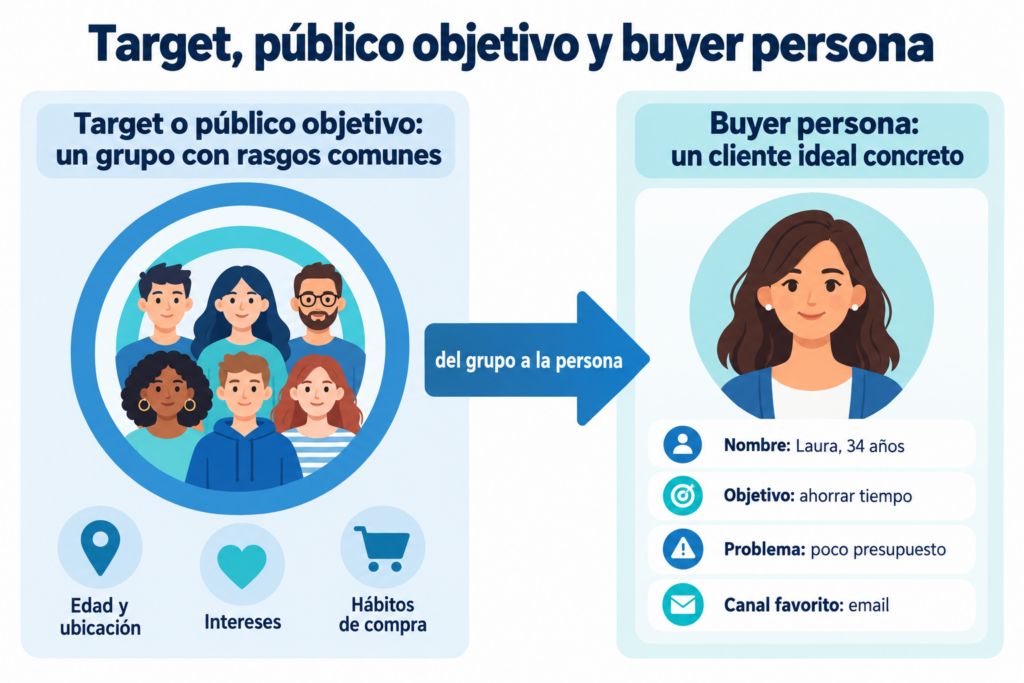
Target and target audience are synonyms: both describe a group of people with shared traits.
The buyer persona goes one step further. It is a semi-fictional character that represents the ideal customer within that target, with a name, age, job, goals, problems and objections. One tells you “who”; the other helps you understand “how they think”.
Targeting, for its part, is the act of aiming a campaign at that audience. We explain it in customer targeting.
Speak to your target audience with the right message
Segment your subscriber list and send each group what it is interested in. Free for up to 80,000 emails a month.
How do you define your company’s target?
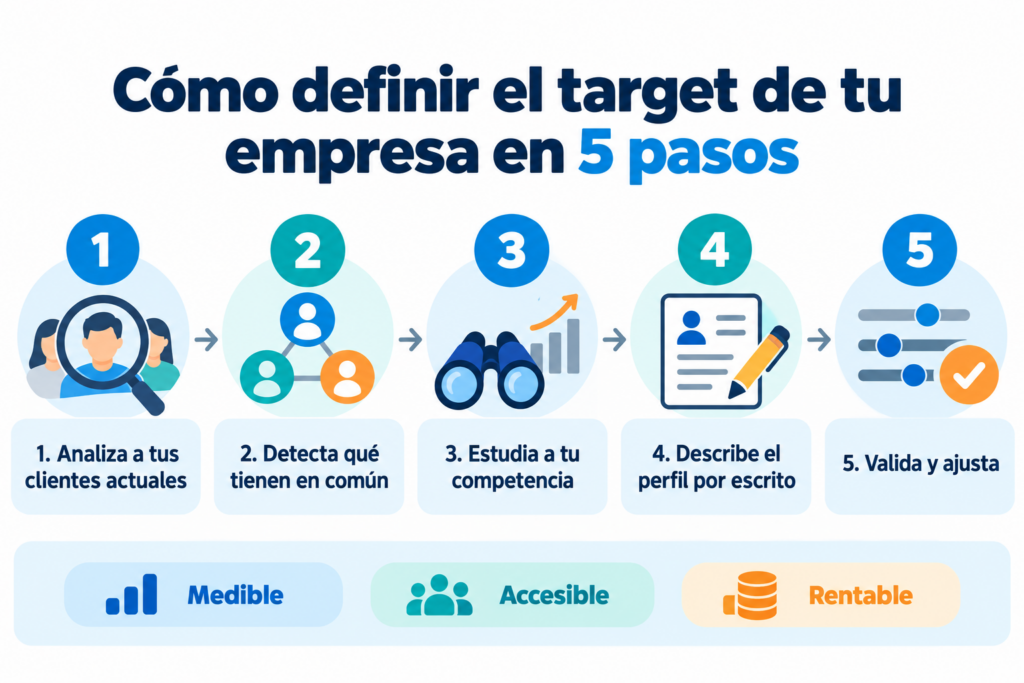
You can define it in five steps:
- Analyze your current customers. Look at who buys the most, who comes back and who brings the best margins.
- Find what they have in common. Age, location, industry, interests or the reason they buy.
- Study your competitors. Notice who they are targeting and what gaps they leave uncovered.
- Write down the profile. Combine the demographic, geographic, psychographic and behavioral traits, and add their needs and problems.
- Validate and adjust. Test the profile with surveys, interviews or small campaigns, and review it every so often.
A good target is measurable (you know how many people it includes), accessible (you can reach them) and profitable (it pays to target them).
Target examples
This is how the target audience changes depending on the business:
- Neighborhood gym: people aged 25 to 50 who live or work less than 2 km away and want to train before or after work.
- Natural cosmetics online store: urban women aged 25 to 40, interested in products without harsh chemicals, who shop online.
- Invoicing software: freelancers and small service businesses that currently invoice with spreadsheets.
- Adventure travel agency: young people aged 20 to 35 with average incomes who travel two or three times a year.
Why defining your target matters
Knowing your target audience well has clear advantages:
| Advantage | What you get |
|---|---|
| More effective messages | You speak your customer’s language and address their problems |
| Lower spending | You invest in the channels where your audience is, not in all of them |
| Better products | You design offers built around what they need |
| More conversions | You reach people who are more interested in buying |
| Loyalty | Customers who feel understood come back |
Your target in email marketing
In email marketing, your audience is your subscriber list. People who sign up for your newsletter have already shown interest, so they are a very valuable part of your target audience.
To make the most of it, it is a good idea to divide the list into groups based on their traits. This is known as segmentation: for example, sending an offer only to customers in one city or to those who bought in the last three months.
With custom fields, such as age, industry or interests, you can store that data and use it for the personalization of each send.
How Mailrelay helps you
With Mailrelay you organize your subscribers into groups, create segments based on their data and behavior, and send each part of your audience the message it is interested in. The statistics for each send show you which audience responds best.
The free account includes up to 80,000 emails a month and 20,000 contacts, with human support in English on all plans.
Get to know your target better with every send
Find out which segments open and click your emails, and adjust your strategy. Human support in English.
Frequently asked questions about targets
These are the most common questions.
What is a target in marketing?
The group of people a company aims its products and communication at, because they are its most likely customers.
Are target and target audience the same thing?
Yes. Target is the short form, and target audience is the full term. It is also called the target market.
What are the types of target?
The most common are demographic, geographic, psychographic, behavioral, digital and, for companies that sell to other companies, B2B.
What is the difference between a target and a buyer persona?
The target describes a group of people with shared traits. The buyer persona represents a specific ideal customer within that group, with their own story, goals and problems.
Can a company have several targets?
Yes. The usual approach is to have one primary target and one or two secondary ones, with messages tailored to each.