Omnichannel: what it is and how to offer the same experience across all your channels
How to connect your store, your website, your emails and your customer service so customers never have to start from scratch
Omnichannel is a way of working in which all of a company’s channels are connected so the customer enjoys a seamless experience, without starting from scratch when switching from one to another. Physical store, website, email, phone, social media and app all share information.
If a customer looks at a product on their phone, adds it to the cart and then calls, whoever takes the call knows what they looked at. That’s an omnichannel experience.
What does omnichannel mean?
Omni means “all” in Latin. Omnichannel literally means being present on every channel at the same time, in a coordinated way.
The term originated in retail, when stores began combining in-store and online sales. Today it applies to any business that talks to its customers through more than one channel.
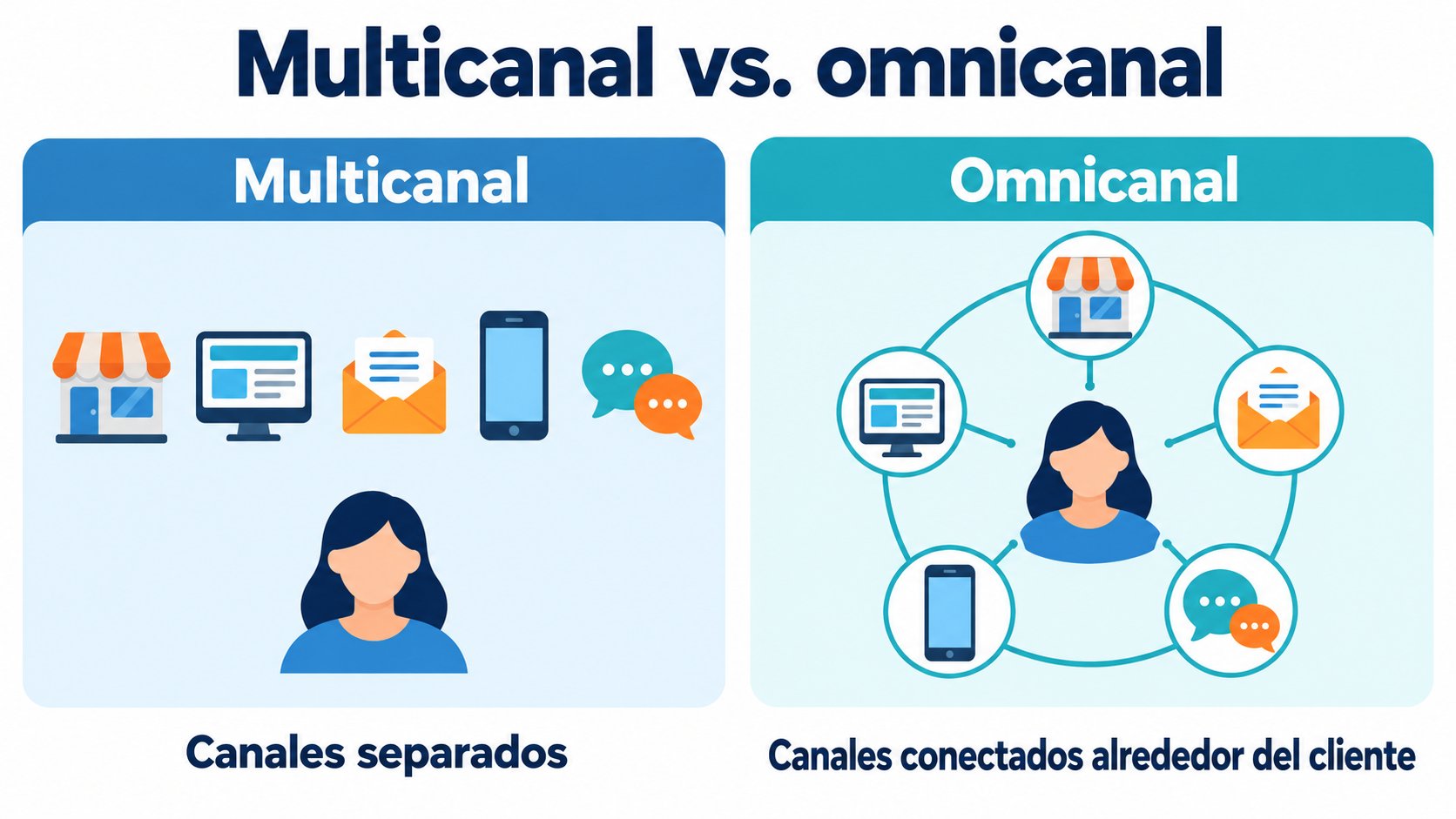
Omnichannel vs. multichannel: the differences
| Multichannel | Omnichannel | |
|---|---|---|
| Channels | Several, independent | Several, connected |
| Customer data | Each channel has its own | Shared in a single system |
| Experience | Different depending on the channel | Seamless when moving from one to another |
| Focus of the strategy | The channel | The customer |
| Example | The website and the store have different prices and offers | You buy online and return in store with no hassle |
A company can have ten channels and still not be omnichannel. What makes the difference is that they are connected.
Omnichannel examples
Buy online, pick up in store. The customer pays on the website and picks up their order at the nearest store.
A cart that carries over between devices. What you add on your phone is still there when you log in from your computer.
Customer service with history. Whoever helps you on chat can see your orders and your previous calls.
Email after a store visit. The customer gives their email at checkout and receives tips about the product they just bought.
A single loyalty program. You earn points the same way in store, on the website and in the app.
Benefits of an omnichannel strategy
More satisfied customers. They don’t have to repeat information or run into contradictory offers.
More sales per customer. When all channels push in the same direction, customers are more likely to buy again.
Better data. By bringing the information together, you understand the customer’s full journey, not just isolated pieces.
More customer loyalty. A convenient experience is a reason to stay.
Connect your email with the rest of your channels
In Mailrelay, segment your customers based on what they buy in store and online, and automate your messages.
How to build an omnichannel strategy in 6 steps
1. Map the customer journey. A customer journey map shows which channels they go through and in what order.
2. Unify your data. A CRM or a CDP brings each customer’s information together in one place.
3. Keep the same message. Consistent prices, promotions, tone and design across all channels.
4. Connect your teams. Sales, marketing and customer service should share information and goals.
5. Automate what repeats. Messages sent based on what the customer does on each channel.
6. Measure the whole. Not just each channel separately, but the full journey up to the purchase. A customer who sees an email and buys in store also counts as a sale for the email.
The role of email in omnichannel
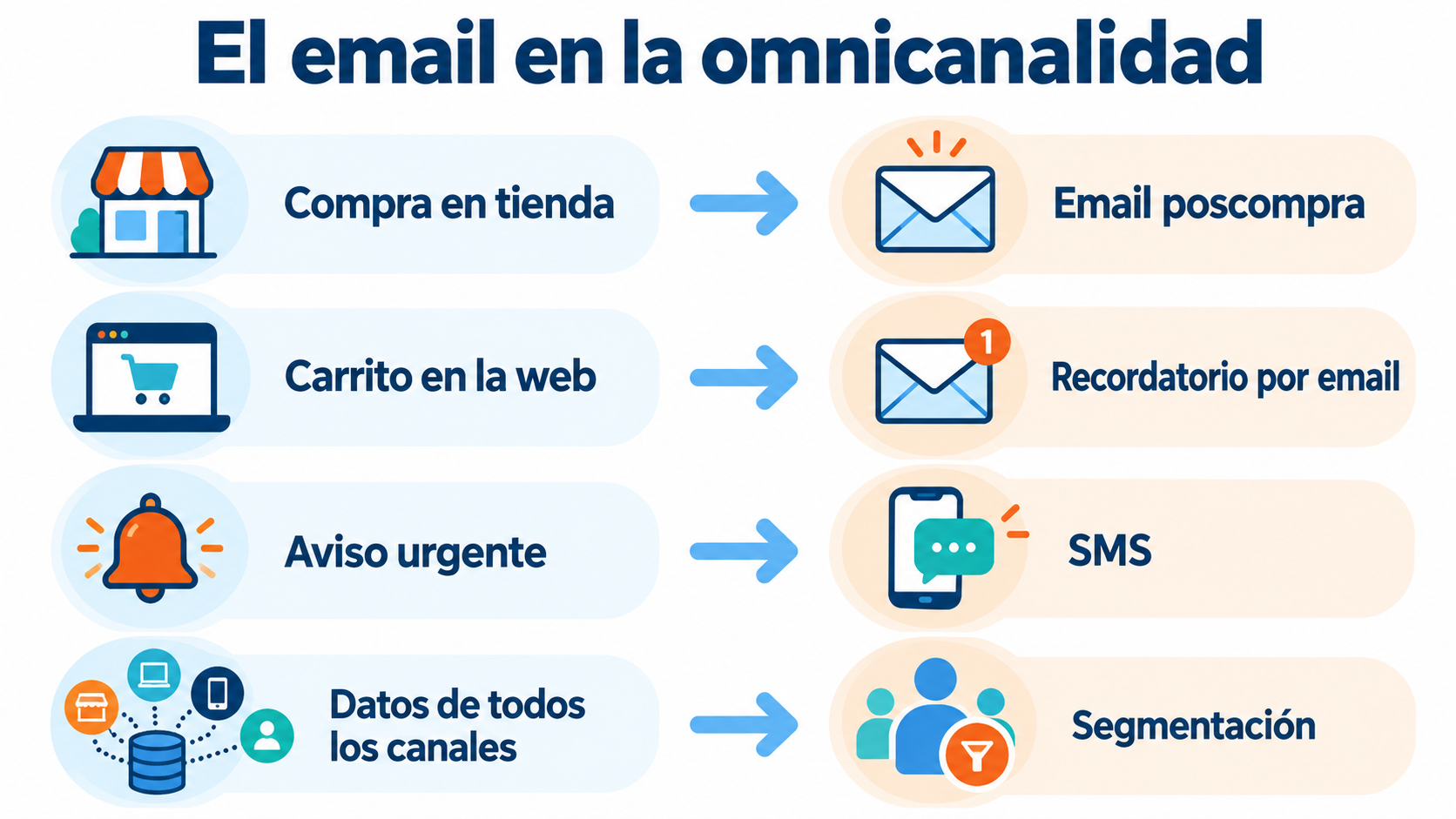
Email is often the thread that ties the other channels together, because it’s owned, personal and can be automated:
After an in-store purchase. An email with the receipt, usage tips or an invitation to the loyalty program.
When someone abandons their online cart. A reminder that lets them complete the purchase from any device.
Alongside SMS. SMS marketing for urgent alerts and email for longer content.
With segmentation. Segmentation uses what you know about the customer from other channels to send them what interests them.
Common mistakes
Being on every channel without connecting them. That’s multichannel, not omnichannel.
Different offers depending on the channel. Customers feel misled if they find a different price on the website.
Data that isn’t shared. If customer service can’t see online orders, the customer has to repeat everything.
Trying to do too much. Two well-connected channels are better than six disorganized ones.
Not training your team. Connecting your systems is of little use if the person in the store doesn’t know how to look up the customer’s history.
How Mailrelay helps you
With Mailrelay you can import your customer data, segment it based on what customers buy on any channel and automate the emails that connect your store, your website and your newsletter. You can also send SMS from the same account.
The free account includes up to 80,000 emails a month and 20,000 contacts, with human support by chat, ticket and phone.
Send your newsletters with Mailrelay
Up to 80,000 emails a month and 20,000 contacts for free, with human support on every plan.
Frequently Asked Questions
These are the most common questions about this approach.
What is omnichannel in a nutshell?
Connecting all of a company’s channels so the customer has the same experience on any of them.
What is the difference between omnichannel and multichannel?
In multichannel, the channels work separately. In omnichannel, they are connected and share information.
Which channels are part of an omnichannel strategy?
The ones your customers use: physical store, website, app, email, SMS, phone, chat and social media.
Is it only for large companies?
No. A small business can start by connecting its online store, its email and its customer service.
What tools do I need?
A system that brings customer data together, such as a CRM, and an email and SMS tool that can use it.