Spammer: what it is, what spamming means and how spammers operate
Who sends spam, how they work and what to do so your emails are never mistaken for theirs
A spammer is a person or company that sends unsolicited messages in bulk, mainly by email, but also by SMS, social media, chats or comments. What they send is called spam.
Sending spam is called spamming (in Spanish, spamear, also spelled espamear). In Spanish, spammer is an English loanword: you can also say spamero or “el que envía spam” (the one who sends spam).
What is a spammer?
It’s someone who sends messages to people who haven’t asked for them. They’re usually ads, scams or links to dubious websites, and almost always in huge quantities.
The word comes from spam. Its use for junk messages comes from a 1970 Monty Python sketch in which a group kept repeating “spam” until it drowned out any conversation. That’s what an inbox full of spam feels like.
The first unsolicited mass mailing on record was sent in 1978. Gary Thuerk, of the company DEC, advertised a computer to around 400 ARPANET users at once.
What does spamming mean?
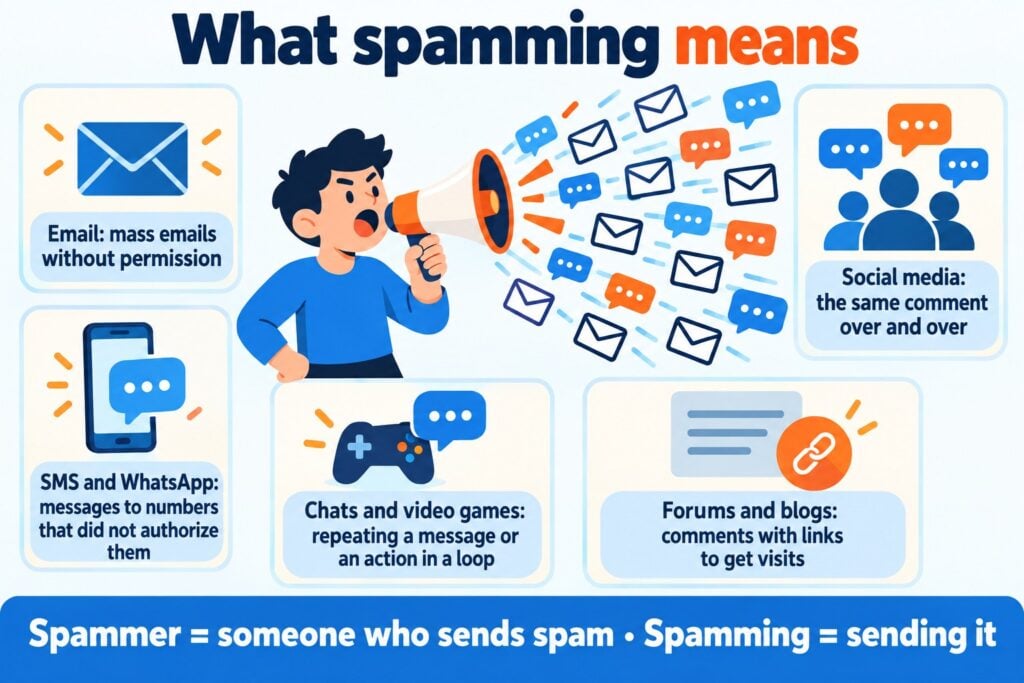
Spamming means sending the same message many times, to many people or in many places, without anyone asking for it.
The term is used in several contexts:
| Where | What spamming means | Example |
|---|---|---|
| Sending bulk emails without permission | Product offers sent to a purchased list | |
| SMS and WhatsApp | Sending messages to numbers that haven’t given their permission | “You’ve won a prize, click here” |
| Social media | Posting or commenting the same thing over and over | Repeated links in the comments |
| Chats and video games | Repeating a message or an action until it gets annoying | Typing the same phrase in the chat on a loop |
| Forums and blogs | Leaving comments with links to get visits | “Great article, visit my website” |
In video games, people also say someone is “spamming” when they use the same attack or ability over and over.
Do email marketing with permission, not spam
Double opt-in forms, an automatic unsubscribe link and bounce cleaning. Free for up to 80,000 emails a month.
How does a spammer operate?
An email spammer tries to send as much as possible while spending as little as possible. To do that, they:
- Get addresses without permission: they buy them, steal them from data leaks or scrape them from websites with automated programs.
- Use bots and infected devices: they send from networks of other people’s computers so they leave no trace.
- Fake the sender: they impersonate another brand or person, a technique called spoofing.
- Change domains frequently: this way they get around filter blocks.
Many spammers don’t just sell products. They also use spam for phishing and other frauds, known as scams.
Types of spammers
The commercial spammer. Sends bulk advertising for products or services to purchased lists.
The scammer. Uses spam to steal data, passwords or money with fake messages.
The comment and SEO spammer. Floods blogs and forums with links to improve another website’s ranking.
The social media and chat spammer. Repeats messages, mentions or links in groups, comments and direct messages.
The company that doesn’t know it is one. Sends newsletters to people who never subscribed or who have unsubscribed. It doesn’t mean any harm, but to the recipient and to the filters it’s spam.
Is it illegal to be a spammer?
In Spain, yes. The Spanish Information Society Services Act (LSSI) prohibits sending commercial communications by email or SMS without the recipient’s prior consent. There is only one exception: customers to whom you offer products similar to those they have already bought from you, and always with the option to unsubscribe.
Fines are imposed by the Spanish Data Protection Agency and, in serious cases, can reach 150,000 euros. If personal data is also used without a legal basis, the GDPR applies as well.
In the United States, the CAN-SPAM Act applies, which requires, among other things, a real sender and a working unsubscribe link.
The difference between a spammer and email marketing
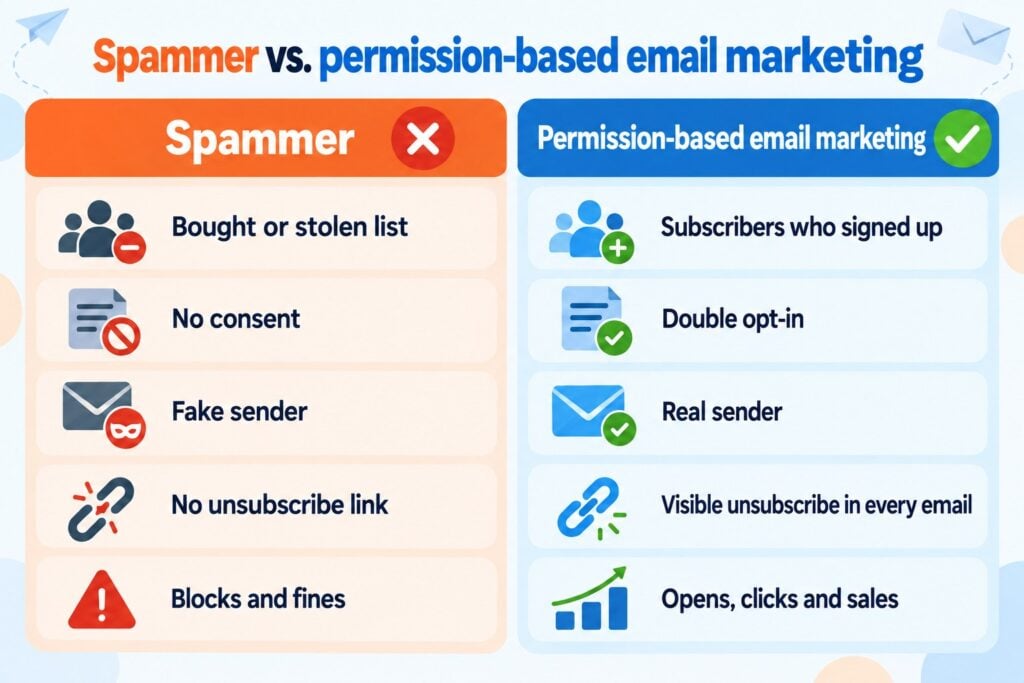
The tool is the same: email. The difference lies in permission and in how the reader is treated.
| Spammer | Legitimate email marketing | |
|---|---|---|
| List | Purchased, stolen or scraped | Subscribers who have signed up |
| Consent | Doesn’t have it | Asks for it, often with double opt-in |
| Sender | Fake or changing | Real and identifiable |
| Unsubscribe | Doesn’t exist or doesn’t work | Visible link in every email |
| Content | Misleading or irrelevant | Useful and expected |
| Result | Blocks and fines | Opens, clicks and sales |
How to avoid being mistaken for a spammer
If you send newsletters, filters and users judge you by how you send, not by your intentions. To avoid looking like a spammer:
- Don’t buy lists. Only send to people who have subscribed.
- Authenticate your domain with SPF, DKIM and DMARC.
- Include a visible unsubscribe link and honor it immediately.
- Clean your list: remove addresses that bounce (hard bounce) and subscribers who haven’t opened in months.
- Send regularly and from a sender your subscribers recognize.
If many recipients mark your emails as spam, your domain can end up on a blacklist, such as an RBL. We explain it in our post on antispam filters.
How Mailrelay helps you
Mailrelay helps you do email marketing without looking like a spammer:
- Double opt-in on forms so only real subscribers get in.
- Automatic unsubscribe link in every newsletter.
- Cleanup of addresses that bounce.
- Guide to setting up SPF, DKIM and DMARC on your domain.
The free account includes up to 80,000 emails a month and 20,000 contacts, with human support on all plans.
Reach the inbox, not the spam folder
We help you authenticate your domain, with human support on every plan.
Frequently asked questions about spammers
These are the most common questions.
What is a spammer?
A person or company that sends unsolicited messages in bulk, by email, SMS, social media or chats.
What does spamming mean?
Sending the same message many times or to many people who haven’t asked for it. It’s also used for someone who repeats messages in a chat or actions in a video game.
How do you say spammer in Spanish?
You can say spamero or simply “el que envía spam” (the one who sends spam). The verb is spamear or espamear.
Is sending spam a crime?
In Spain, sending advertising by email or SMS without consent is an infringement of the LSSI and is punished with fines. If the spam aims to steal data or money, it can also be a crime of fraud.
How do I know if I’m a spammer without realizing it?
If you send to people who didn’t subscribe, have no unsubscribe link or receive lots of spam complaints, filters will treat you as a spammer even if you don’t mean to be one.