Keyword: what it is, types and examples
From the search to your content: what a keyword is, what types there are and how to use it without forcing your text
A keyword is the term or phrase someone types into a search engine to find something, and that a website uses in its content to appear in those results. For example, “running shoes” or “how to create a newsletter”.
Keywords connect what your audience is looking for with what you offer. That’s why they are the foundation of SEO, search engine advertising and much of content marketing.
What does keyword mean?
Keyword literally means key word: in Spanish it is called “palabra clave”. It combines key, in the sense of “essential” or “important”, and word. Its plural is keywords (“palabras clave” in Spanish).
Although it is called a “word”, a keyword can be made up of several words. In fact, most searches contain three or more.
What are keywords used for?
Keywords are used to:
- Rank on Google: they tell search engines what each page is about as part of SEO.
- Understand your audience: they show what people need, how they phrase it and how many of them search for it.
- Plan content: each article answers a specific search.
- Advertise on search engines: in Google Ads you pay to appear for certain keywords.
- Measure results: rankings and clicks per keyword tell you whether a strategy is working.
Types of keywords
Keywords are classified mainly by the searcher’s intent and by their length.
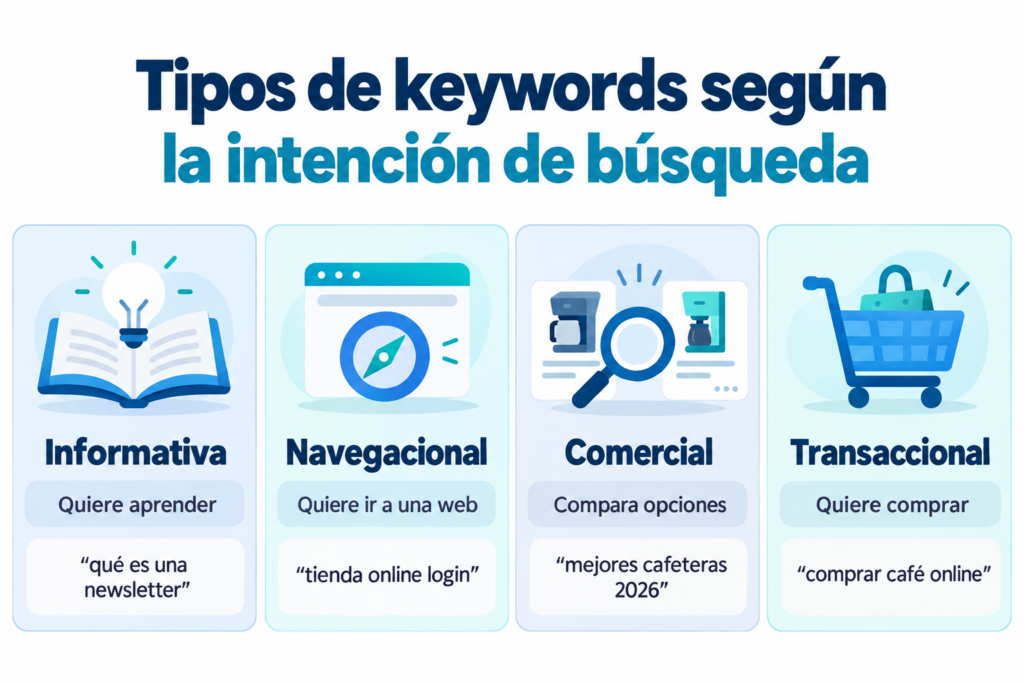
By search intent
| Type | What the user wants | Example |
|---|---|---|
| Informational | Learn something or answer a question | “what is a newsletter” |
| Navigational | Reach a specific website | “mailrelay login” |
| Commercial | Compare options before deciding | “best email marketing tools” |
| Transactional | Buy or sign up now | “sign up for free email marketing” |
By length
| Type | Features | Example |
|---|---|---|
| Short tail (head terms) | 1-2 words, high volume and high competition | “email marketing” |
| Middle tail | 2-3 words, medium volume and competition | “email marketing for online stores” |
| Long tail | 4 or more words, low volume and easier to rank for | “how to send a newsletter to my customers for free” |
Long tail keywords bring in fewer visits, but from people with a clearer need, who convert better.
Turn your Google visitors into subscribers
Add a form to your articles and email your new content to the people who have already found you. Free for up to 80,000 emails a month.
Keyword examples
This is what a group of keywords could look like for an online coffee store:
| Type | Keyword | Content it calls for |
|---|---|---|
| Informational | “how to make coffee in a moka pot” | Step-by-step guide |
| Commercial | “best coffee beans for espresso” | Comparison |
| Transactional | “buy specialty coffee online” | Product or category page |
| Long tail | “decaf Colombian coffee beans for an automatic coffee machine” | Very specific product page |
If the page doesn’t give the search what it’s looking for, Google won’t show it near the top, no matter how many times it repeats the term.
Main keyword and secondary keywords
Each page should focus on one main keyword, the most important search it answers. Around it, you use secondary keywords: synonyms, variants and related questions.
For example, a page about “what is a newsletter” can also include “email bulletin”, “what is a newsletter for” or “newsletter examples”. That way it covers the whole topic without forced repetition.
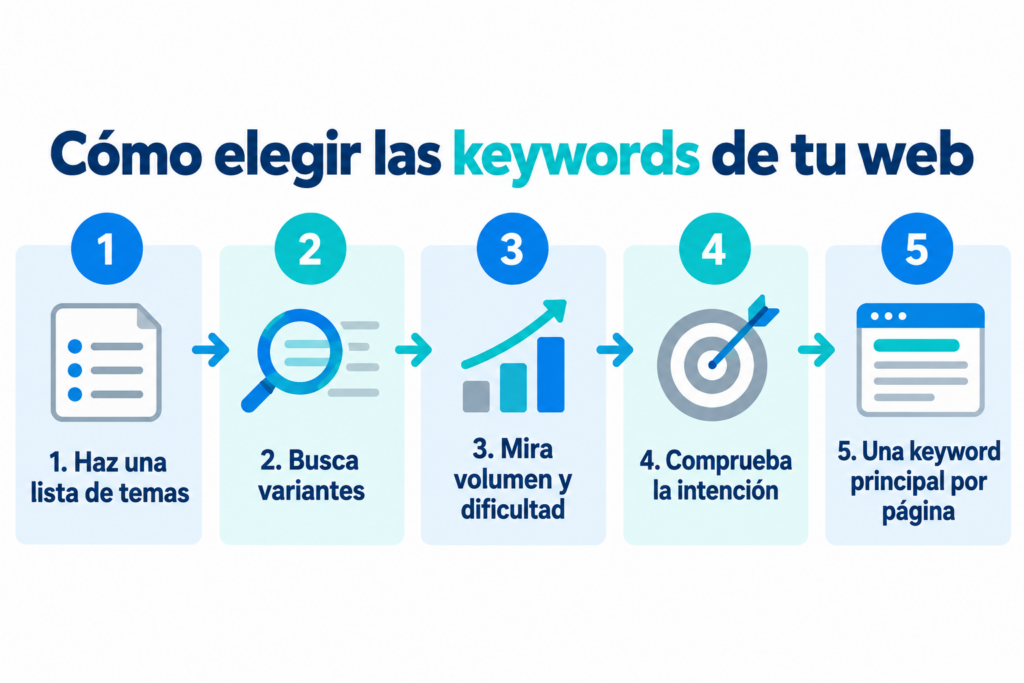
How to choose the keywords for your website
- Make a list of topics related to your business and to your customers’ questions.
- Look for variants with tools such as Google Keyword Planner, Semrush or Google’s own suggestions.
- Check the volume and difficulty of each keyword to pick the ones you can rank for.
- Check the intent by searching for it on Google and seeing what kind of pages come up.
- Assign one main keyword per page to avoid cannibalization.
This process is called keyword research.
How to use keywords in a text
Place the main keyword in the title, the URL, the first paragraph and at least one subheading. Then write naturally and use synonyms.
Repeating the same word over and over, known as keyword stuffing, makes the text harder to read and can hurt your rankings. We explain this in our guide to keyword density.
Keywords in email marketing
Keywords also help with your emails:
- Clearer subject lines: using the words your customers use to search for a product makes the subject line easy to understand at first glance.
- Content for your newsletter: informational keywords in your industry are good ideas for new emails.
- More traffic to your articles: if you link from your newsletter to well-ranked content, you get visits from two channels.
How Mailrelay helps you
With Mailrelay, you turn the visits your keywords bring in into subscribers. Add a form to your articles, send a newsletter with your new content and measure which topics get the most clicks.
The free account includes up to 80,000 emails a month and 20,000 contacts, with human support in English on all plans.
Bring your best content to the inbox
Create your newsletter with a drag-and-drop editor and find out which topics your audience is most interested in. Human support in English.
Frequently asked questions about keywords
These are the most common questions.
What is a keyword?
The term or phrase someone types into a search engine, and that a website uses to appear in those results.
How do you say keyword in Spanish?
Palabra clave. In the plural, palabras clave.
What are the types of keywords?
By intent: informational, navigational, commercial and transactional. By length: short tail, middle tail and long tail.
How many keywords should a page have?
One main keyword and several secondary keywords or synonyms related to the same topic.
What is the difference between a keyword and keyword research?
A keyword is the search term. Keyword research is the process of finding and choosing the best keywords for a website.