Email customer loyalty strategies: 8 ideas with examples
Winning a customer is expensive. Getting them to come back costs far less: 8 emails to make your customers buy again and recommend you
Winning a customer is expensive. Getting them to come back costs far less: 8 emails to make your customers buy again and recommend you
Building customer loyalty means getting customers to buy from you again and recommend you.
Email is the most direct channel for it: it reaches every customer’s inbox, costs little and can be automated.
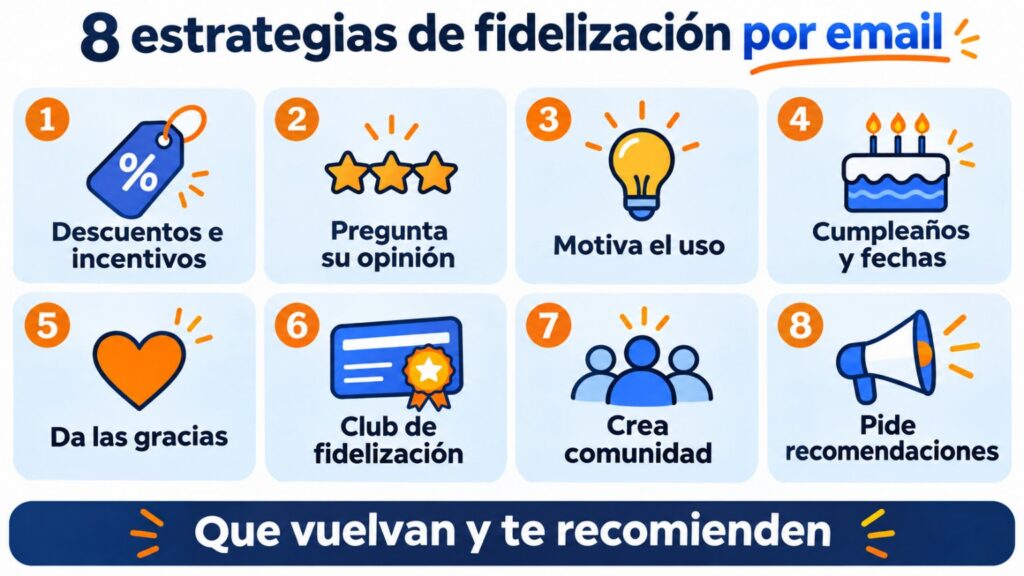
Here are 8 email customer loyalty strategies, each with a sample subject line, when to send it and how to set it up in Mailrelay.
Have you ever seen deals that are only for new contracts? If you’ve been with the same company for years, it’s frustrating: the loyal customer gets no reward.
Customer loyalty is the exact opposite: looking after the people who have already bought from you so they want to stay with you.
And it’s usually more profitable than winning new customers, although you need to do that too.
You’ll find the full definition in customer loyalty. Here we focus on how to do it with email.
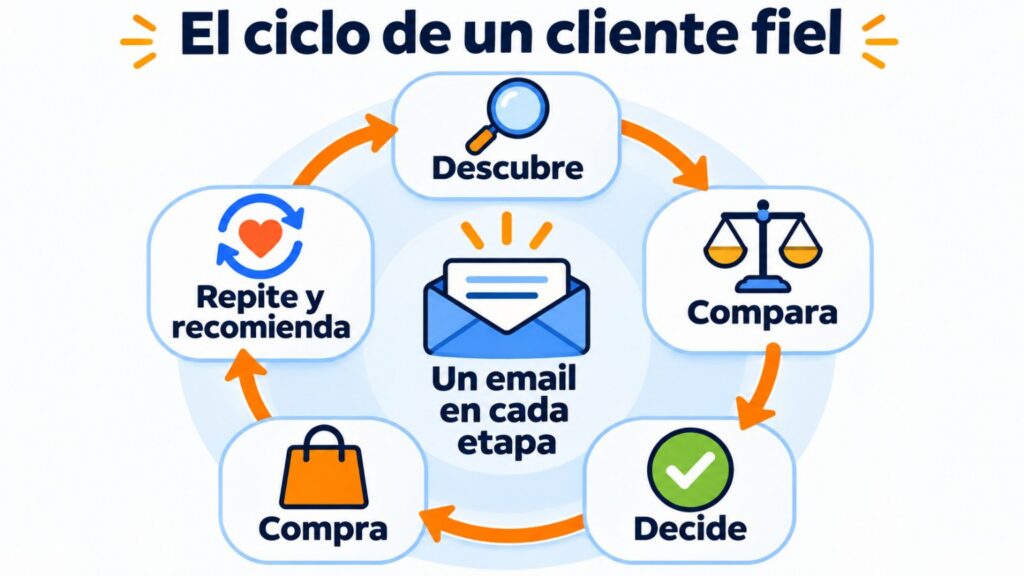
Loyalty starts before the first purchase. Every stage of the customer journey either builds loyalty or erodes it:
| Stage | What the customer needs | Which email helps |
|---|---|---|
| Awareness | Understand their problem | Useful content in your newsletter |
| Consideration | Compare options | Case studies, guides and answers to questions |
| Decision | Confidence to choose you | Customer reviews and guarantees |
| Purchase | A sense of security during the process | Clear confirmation and order tracking |
| Post-purchase | Feel looked after | Thanks, help and perks for staying |
A gift shows that you value the people who already buy from you. It can be a discount, free shipping or exclusive content for customers.
Asking customers what they think strengthens the relationship: they feel heard and you learn what to improve.
Many customers don’t leave because of a problem, but because they forget about you. A useful, well-timed reminder keeps them close.
Sending your best wishes is simple and always works: customers feel important, and a small gift invites them to buy.
Automate the emails that build loyalty
Welcome, birthday and thank-you emails that send themselves, on the free account too.
Thanking customers for a purchase, a subscription or a review costs little and leaves a good impression.
A points or rewards club is the classic customer loyalty strategy. Email is its natural channel.
A customer who feels part of something is harder to lose. Invite them to take part.
Your most loyal customer is the one who recommends you. Make it easy for them and thank them for it.
Here are the 8 strategies in a table:
| Strategy | When | What you get |
|---|---|---|
| 1. Discounts or incentives | After the first purchase or if they don’t buy again | Second purchase |
| 2. Evaluate the experience | Days after the order | Learn what to improve |
| 3. Encourage use | When they stop opening or buying | Staying top of mind |
| 4. Birthdays and special occasions | On the date | Connection and purchases |
| 5. Say thank you | After every gesture | A good impression |
| 6. Loyalty club | Regularly | Repeat purchases |
| 7. Community | Regularly | A bond with the brand |
| 8. Recommendations | After a good review | New customers |
The worst way to look after loyal customers is to offer new customers deals on far better terms that existing customers can’t get. Is it effective for winning new customers? Yes. But make sure leaving isn’t too easy for annoyed customers, or they will.
Jose Argudo, CMO at Mailrelay
If you want to automate it, there are 6 email and SMS flows ready to copy in our email and SMS retention strategy.
Loyalty doesn’t show in a single send. Watch these figures over the months:
| Metric | What it tells you |
|---|---|
| Repeat purchase rate | How many customers buy again |
| Clicks in your emails | Which topics and offers interest them |
| Unsubscribes and complaints | Whether you’re overdoing the frequency or the selling |
| Replies | Whether the customer feels there’s someone on the other end |
| Subscriber reputation | Who engages most with your emails |
In Mailrelay, each subscriber has a reputation of 1 to 5 stars based on their opens and clicks.
You can create a segment with the 4- and 5-star ones and look after them with special sends.
For those who drop to two stars or fewer, try a reactivation campaign before you stop emailing them.
Find your most loyal customers
Segment by each subscriber’s reputation and give your best subscribers your best sends.
With Mailrelay you can put these strategies into action without any hassle:
Mailrelay doesn’t detect the purchase on its own. Add the customer to a group, manually, with the integration or with the API, and the automation does the rest.
The free account lets you send up to 80,000 emails a month to 20,000 contacts.
Look after your customers from the very first email
Free account: up to 80,000 emails a month to 20,000 contacts, with human support.
The ones that give customers something real: thanks, perks for staying, help using what they bought and attention to their opinion.
Email lets you do all of them at low cost.
It depends on your business. Start with automated emails (thank-you, birthday) and a monthly newsletter, and adjust based on opens and unsubscribes.
They help get the second purchase, but if you overuse them, customers only buy when there’s an offer.
Combine them with useful content and perks that aren’t about price.
They buy again, open your emails and click. Repeat purchases and subscriber reputation are the best signals.
Retention is keeping the customer from leaving. Loyalty goes further: they want to stay and they recommend you.
Customer loyalty
What it is, types of programs and how to measure it.
Email and SMS retention strategy
6 automated flows to bring your customers back.
Birthday email
How to set up an automated birthday greeting that works.
Winback campaign
How to win back customers who have stopped opening or buying.

Jose Argudo
CMO at Mailrelay. Writes about email marketing, copywriting and conversion for small businesses and entrepreneurs.