B2B2C: what the business to business to consumer model is
When you sell to a business but your product reaches the consumer: how it works and which emails to send to each
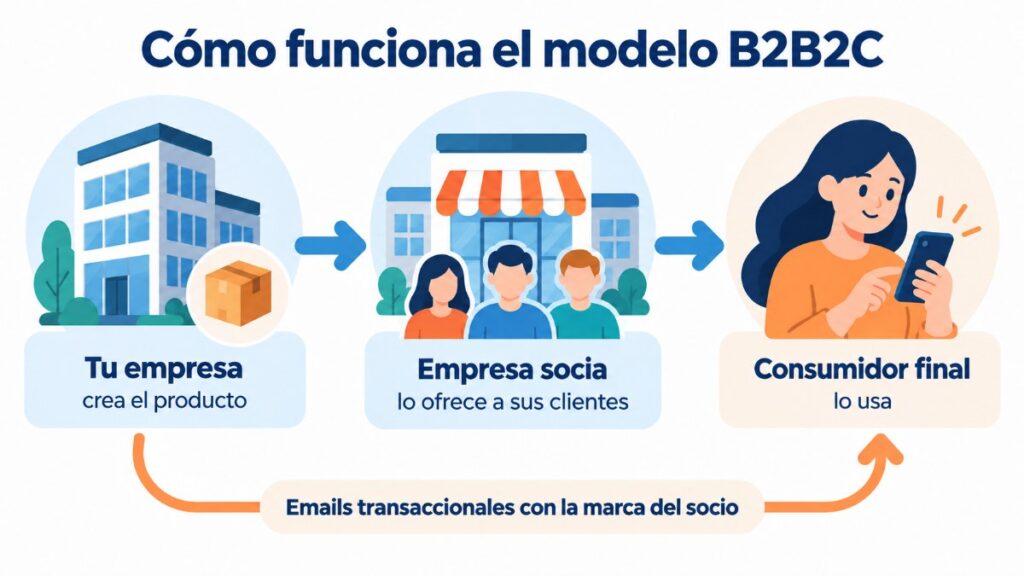
B2B2C (business to business to consumer) is a business model in which a company sells its product or service to another company, which then delivers it to the end consumer. The first company needs the second one to reach the customer, and the second one gains a product to offer.
Put simply, it means “from business to business to consumer”. It is a mix of the B2B and B2C models.
Difference between B2B, B2C and B2B2C
| Model | Who sells | Who buys | Example |
|---|---|---|---|
| B2B | A business | Another business | A manufacturer that sells to a wholesaler |
| B2C | A business | The consumer | An online clothing store |
| B2B2C | A business, through another one | The consumer | Insurance taken out at a bank branch |
The difference lies in who owns the relationship with the end customer. In the B2B2C model, that relationship is shared: both businesses reach the same consumer at different moments.
Examples of the B2B2C model
Payments for schools. A payment platform sells its service to schools and universities. Families pay their fees through it, but they do so because their school has chosen it.
Software for gyms. A company sells management software to gyms. Gym members receive their receipts and notices through it.
Insurance at banks. An insurer sells its policies through a bank’s branch network.
Brands in supermarkets. A manufacturer sells to a chain, and the chain sells to the consumer.
Booking platforms. Hotels and restaurants list their availability on a platform, and the customer books there.
Advantages and disadvantages
Advantages. You reach many customers without building your own sales network. The partner company brings its trust and its customer base.
Disadvantages. You depend on another company to reach the consumer. Also, the end customer sometimes doesn’t know your brand exists, which limits loyalty.
When it makes sense. When your product needs an intermediary that already has the customer’s trust, such as a bank, a school or a retail chain. Also when acquiring consumers one by one would be too expensive.
Communicate with your partners and their customers
Transactional emails and campaigns from a single platform, with segmentation by audience.
Email marketing in the B2B2C model
Here, email has its own challenge: you are talking to two audiences and you don’t always own the contact.
Who is responsible for the data. Before sending anything, set out in the contract which company decides on the consumer’s data and which one only processes it on its behalf. That determines who can send them commercial emails.
Emails on behalf of the partner company. Many B2B2C emails are transactional: receipts, payment notices or confirmations. They are usually sent under the partner’s brand.
Set up a recognizable sender and authenticate the domain with SPF and DKIM so they reach the inbox.
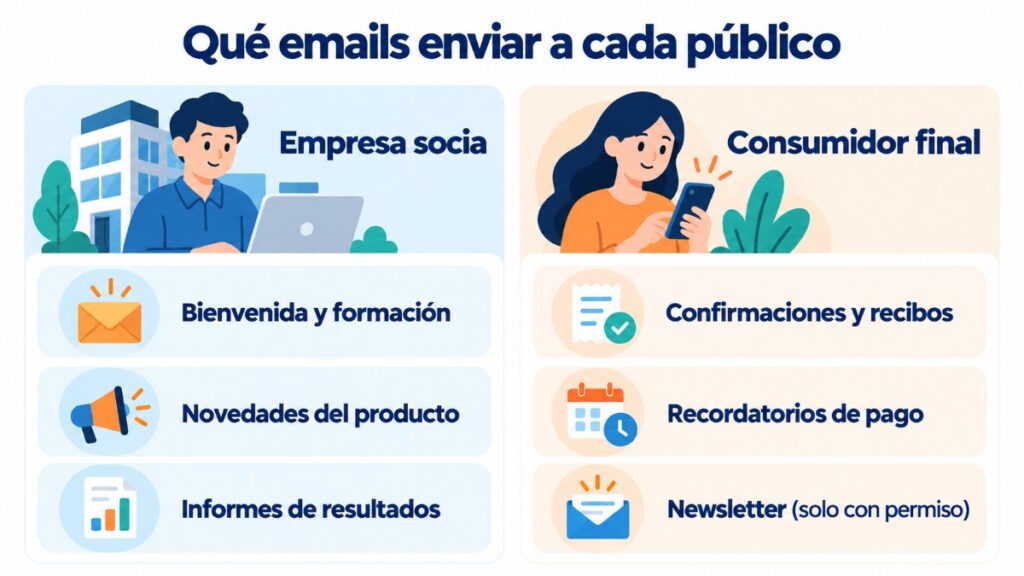
Two different kinds of communication. To the partner company you send product news, training and results. To the consumer, what they need to use the service.
Don’t mix the two in the same list.
Consent for offers. A person receiving receipts from your platform doesn’t mean they accept your advertising. To send them your own offers, you need their permission. We cover this in our entry on the GDPR.
Which emails to send to each audience
| Audience | Emails | Goal |
|---|---|---|
| Partner company | Welcome, training, news and results | Get them to sell more of your product |
| Partner company | Periodic reports | Show the value of the agreement |
| End consumer | Confirmations, receipts and notices | Keep the service running |
| End consumer | Payment reminders | Reduce missed payments |
| End consumer with consent | Newsletter and offers | Build a relationship with your brand |
For the partner company, a good onboarding sequence helps it start using your product sooner and recommend it to its customers.
Metrics in the B2B2C model
Partner activation. Companies that start using the product after signing.
Deliverability of transactional emails. Bounces and emails that don’t reach the consumer.
Payments or actions completed from the email. For example, fees paid after a reminder.
End consumer subscriptions. How many agree to receive communications from your brand.
How Mailrelay helps you
With Mailrelay you send campaigns to your partners and transactional emails to consumers via API or SMTP. You separate each audience with lists and segments, and you see the delivery, opens and clicks of every send.
The free account includes up to 80,000 emails a month and 20,000 contacts, with human support by chat, ticket and phone. SMTP and the API are included in the paid plans and can be tried for 30 days with the free account.
Start for free
Up to 80,000 emails a month and 20,000 contacts, with human support in English.
Frequently Asked Questions
These are the most common questions about this model.
What does B2B2C mean?
Business to business to consumer: a company sells to another company, which delivers the product to the end consumer.
What is an example of B2B2C?
A payment platform that schools sign up for so that families can pay their fees.
What is the difference between B2B and B2B2C?
In B2B, the end customer is the other company. In B2B2C, the product ends up in the hands of a consumer through that company.
Who can send emails to the consumer in a B2B2C model?
It depends on what the contract says about the data and on the consumer’s consent. Service emails, such as receipts and notices, are sent on behalf of the company responsible for the data.
Which emails are most important in B2B2C?
Transactional emails, because the consumer needs them to use the service. If they don’t arrive, the partner company notices right away.