Black swan: Taleb's theory explained, examples and how to prepare
An event nobody expected, that changes everything, and that afterwards everyone says they saw coming
A black swan is a highly unlikely event with an enormous impact that nobody managed to foresee and that, once it has happened, everyone believes they saw coming.
The term was popularized by essayist Nassim Nicholas Taleb in 2007, and today it is used in economics, in politics and in any company that makes plans several years ahead.
What is a black swan?
It is an event that falls outside what was considered possible and changes the rules of the game. It can be a financial crisis, a terrorist attack, an invention or a commercial success nobody expected.
The underlying idea is uncomfortable. Forecasts are built on what has already happened, and the events that weigh most in history are precisely the ones that resemble nothing before them.
Taleb, who was a trader before he turned to writing, developed the theory in his book The Black Swan: The Impact of the Highly Improbable. His thesis is that we overvalue what we know and underestimate what we don’t.
Where does the expression come from?
For centuries, only white swans were known in Europe. The Roman poet Juvenal already used the image of a black swan to describe something so rare it didn’t exist.
In 1697, the expedition of the Dutch explorer Willem de Vlamingh found black swans in Western Australia. A single sighting overturned a centuries-old certainty.
That is where the metaphor comes from. A thousand white swans don’t prove that all swans are white, and a single black one is enough to disprove it. The same goes for business risks: the fact that something has never happened doesn’t prove it never will.
What are the characteristics of a black swan?
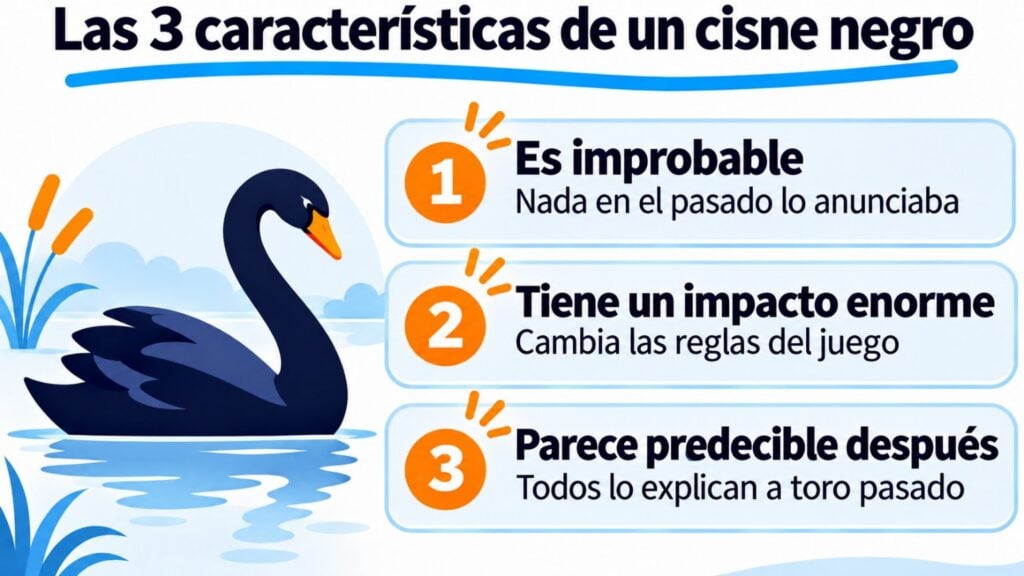
According to Taleb, an event has to meet three conditions to qualify. The first is rarity: it lies outside normal expectations, because nothing in the past convincingly pointed to it being possible.
The second is extreme impact. It upends markets, entire industries or the lives of millions of people.
The third is retrospective predictability. After the event, people build explanations that make it look logical and avoidable. It is a common bias: the brain uses shortcuts, known as heuristics, and prefers a tidy story to admitting it knew nothing.
Taleb illustrates it with a turkey. For a thousand days, the bird is fed by a friendly hand, and each passing day confirms its belief that the farmer is looking after it. On the eve of Thanksgiving, it discovers that its statistics were worthless.
The example teaches something else too: a black swan depends on who is looking. For the turkey it was a complete surprise. For the butcher, it wasn’t.
What are some examples of black swans?
Taleb cites several events from the last century that meet all three conditions. Not all of them are disasters: some of the greatest advances also arrived without anyone foreseeing them.
| Event | Year | Why it is considered a black swan |
|---|---|---|
| World War I | 1914 | Almost nobody expected such a long and devastating conflict |
| Black Monday stock market crash | 1987 | The largest single-day drop, with no clear cause |
| Collapse of the Soviet Union | 1991 | Experts didn’t anticipate it, even months in advance |
| Rise of the internet | 1990s | It changed the economy in a way nobody had planned |
| September 11 attacks | 2001 | A risk that didn’t appear in any model |
In the business world, positive black swans tend to be products or technologies that create a market out of nothing. Those who take advantage of them gain a competitive advantage that is hard to match. Those who depended on the old market can disappear within a few years, however high their barriers to entry were.
Was the pandemic a black swan?
It is the most frequently asked question since 2020, and Taleb himself said no. In an interview in March of that year he called it a “white swan”: a global pandemic was a known risk that people had been warning about for years.
Other names are used for those cases. A gray swan is an unlikely but imaginable event, one that shows up in risk analyses even though hardly anyone prepares for it.
A gray rhino, a term coined by analyst Michele Wucker, is a probable, visible, high-impact threat that is ignored all the same. You can see it coming from far away, which makes it all the harder to justify having done nothing.
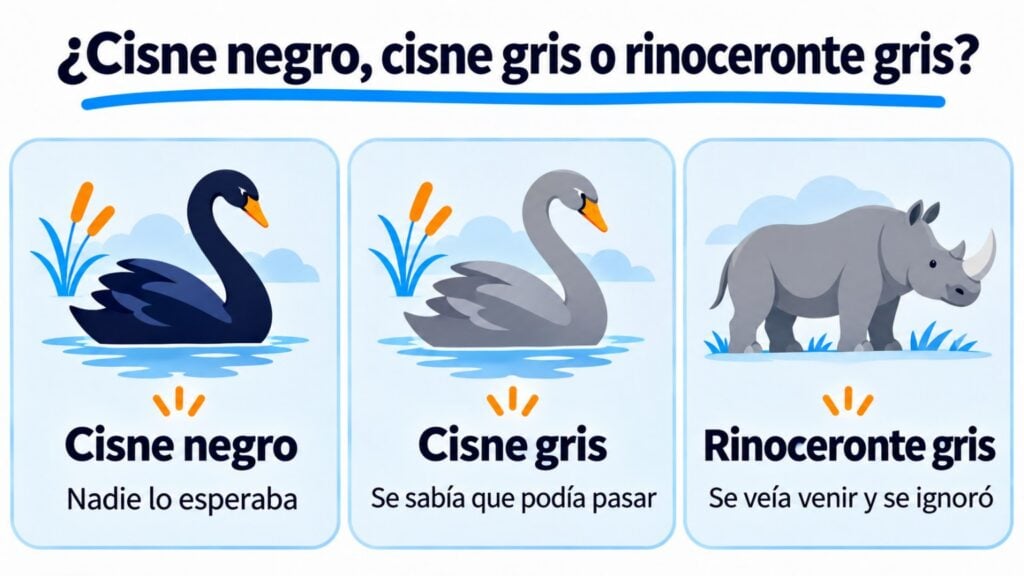
The distinction matters in practice. You can plan for a gray swan or a gray rhino. For a black swan, by definition, you can’t.
How can a company prepare for a black swan?
If it can’t be predicted, there’s no point spending effort trying to guess the next one. What Taleb proposes is building organizations that can withstand unexpected blows and are in a position to take advantage of the good surprises.
The first step is not to depend on a single thing. A single large customer, a single supplier or a single sales channel turns any setback into a threat to the whole business. If the Pareto principle holds a little too well and a handful of customers account for almost all your revenue, your risk is concentrated too.
The second is to keep some slack. A company that runs at full stretch, with no cash or spare capacity, is efficient in the good years and fragile in the bad ones. Knowing your fixed and variable costs well helps you understand how much you can withstand.
The third is to be wary of long-term forecasts. Tools such as SWOT analysis or PESTEL analysis help you organize the risks you already know about, but not the ones nobody has imagined. Use them as a map, not as a guarantee.
And the fourth is to make small bets with plenty of upside. Trying out a new product, market or format costs little if it goes wrong and can transform the company if it goes right. It is the way to expose yourself to positive black swans, and the Ansoff matrix helps you organize those bets.
What about marketing?
In marketing, the most common surprise is a change in something you don’t control: a social network’s algorithm, a search engine’s rules or the price of advertising.
That’s why it pays to spread your marketing plan across several channels and look after the ones you own. Your own contact list and a newsletter don’t depend on the decisions of someone else’s platform. Email marketing and the loyalty of the people who already buy from you are among the few things still in your hands when everything else changes.
For the small day-to-day mishaps, there’s already Murphy’s law.
A channel that’s yours
Build your contact list and write to them without depending on other people’s algorithms. Free up to 20,000 contacts.
Frequently asked questions about the black swan
Here are other common questions about the theory and its author.
Who is Nassim Nicholas Taleb?
He is an essayist and researcher born in Lebanon in 1960, who worked for years as a trader in the financial markets. Besides The Black Swan, he is the author of Fooled by Randomness (2001) and Antifragile (2012).
Can a black swan be predicted?
No. If it could be foreseen with the available data, it would no longer be one. What you can do is reduce your exposure to the negative ones and increase your exposure to the positive ones.
What is antifragility?
It is the concept with which Taleb continued his theory. Something fragile breaks under shocks and something robust withstands them. Something antifragile gets better because of them, like a muscle with exercise or a company that learns from every small mistake.
Related articles
If you’re interested in how we make decisions when information is missing, these articles cover related ideas.