Halo effect: what it is, examples and how it affects your brand
Why a good first impression makes us see everything in a better light (and a bad one, in a worse one)
The halo effect is a cognitive bias in which a single positive quality of a person, a brand or a product makes us rate everything else about them more highly.
If something makes a good impression on us in one respect, we assume it will be good in the others too.
It happens with people, with companies and, of course, with the emails you receive every day.
What is the halo effect?
The name comes from the halo of light that surrounds saints in paintings.
Just as that light bathes everything around it, a good first impression “lights up” the rest of what we know about someone. In Spanish it is also called the “efecto aureola”.
The psychologist Edward Thorndike named it in 1920, in the article “A Constant Error in Psychological Ratings”.
He asked army officers to rate their soldiers on different qualities: physique, intelligence, leadership and character.
The ratings were far too similar to each other. Soldiers who seemed strong and well turned out were also rated as smarter and better leaders.
It is one of the most studied biases in social psychology. And one of the most useful to understand if you work in marketing.
How does the halo effect work?
Our brain saves effort. Instead of analyzing each trait separately, it forms an overall impression and uses it to fill in what it doesn’t know.
The best-known experiment was carried out by Richard Nisbett and Timothy Wilson at the University of Michigan in 1977.
They recorded two interviews with the same lecturer, who spoke English with a European accent. In one he was warm and friendly. In the other, cold and distant.
The students who watched the friendly version rated his appearance, his mannerisms and his accent as appealing.
Those who watched the cold version judged those same things as irritating.
And the most striking part: they didn’t realize that how much they liked the lecturer had influenced those ratings.
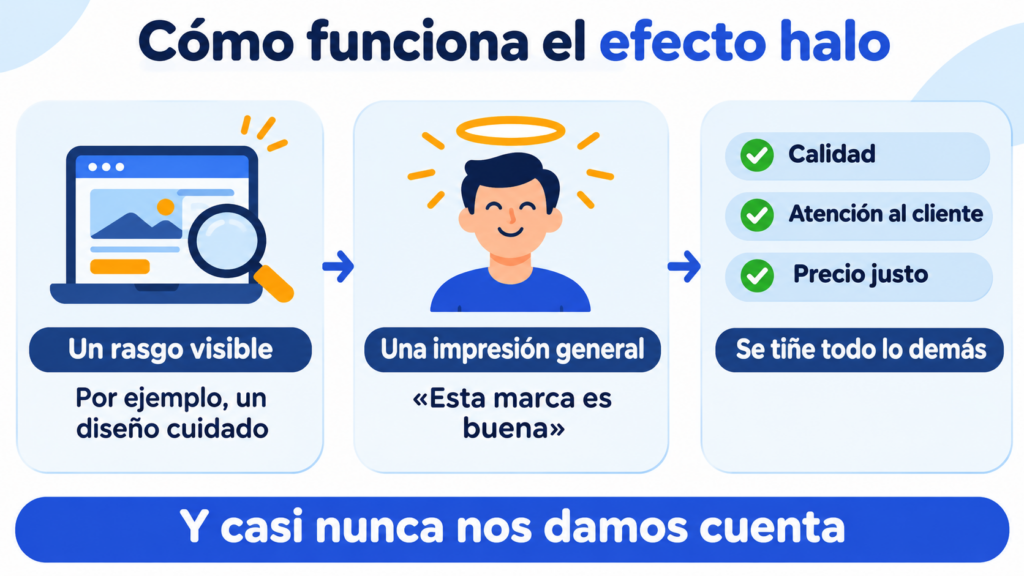
That is why the halo effect is so hard to avoid. It works below the level of what we think we are deciding.
Examples of the halo effect
You’ll find it in almost any situation where we judge without having all the information:
| Area | What happens | Example |
|---|---|---|
| People | Physical attractiveness is linked to other virtues | Thinking that a good-looking person is also smarter or more honest |
| Work | One strength inflates the whole evaluation | A manager who rates highly someone who speaks confidently, even if they don’t perform better |
| Brands | One successful product improves the image of the rest | The success of the iPod helped Apple sell more computers |
| Advertising | Someone’s fame transfers to the product | A well-loved actor advertises a coffee and the coffee seems better |
| Food | One healthy word colors the whole product | A “natural” snack seems to have fewer calories than it really does |
| Design | What looks good seems easier to use | A polished website suggests the company is reliable too |
The Apple case is often cited. According to an analysis by Branding Strategy Insider, the company’s sales rose 68% in fiscal year 2005.
And not just because of the iPod: the computer business also grew 27%.
What is the horn effect?
It is the opposite of the halo effect. One negative trait makes us see everything else in a worse light. It is also known as the horns effect or the devil effect.
| Halo effect | Horn effect | |
|---|---|---|
| Starting point | A positive quality | A flaw or a bad moment |
| What it causes | We rate everything else more highly | We rate everything else lower |
| Brand example | “If their app is this good, their support will be too” | “If they took a week to reply, their product must be just as bad” |
The horn effect usually weighs more. A single bad experience is enough to make a customer doubt everything you do well.
That is why a crisis or provocative content, such as rage bait, can damage an entire brand.
How is the halo effect used in marketing?
Brands can’t avoid the halo effect, but they can work to make it play in their favor:
- Take care of the first impression. It is what sets the halo. Your website, your logo or your first message shape how everything that follows will be seen.
- Lean on your star product. If something of yours works really well, give it visibility: its good reputation rubs off on the rest of your catalog.
- Choose your partners carefully. A sponsorship or a collaboration with influencers transfers their image to your brand. For better and for worse.
- Be consistent. The halo breaks when the experience doesn’t live up to what you promise.
That last part is the one most often forgotten. The halo effect attracts, but it doesn’t sustain a brand. If the product fails, the good impression turns into disappointment, and that is where the horn effect comes into play.
The halo effect in your emails
In email marketing, the halo effect starts before anyone opens your message. The sender name and the subject line are the first impression.
If subscribers trust whoever is writing to them, they open the email in a different frame of mind.
Some moments carry more weight than others:
| Moment | How it creates a positive halo | What turns it into a horn |
|---|---|---|
| The welcome email | It arrives right away, explains what you will send and offers something useful | It arrives late or is just an offer |
| The design | Clean, easy to read on mobile and consistent with your brand | Broken images or text that can’t be read |
| The sender | A recognizable name, always the same one | It changes with every send or is a “no-reply” |
| The frequency | You write when you have something to say | You flood their inbox |
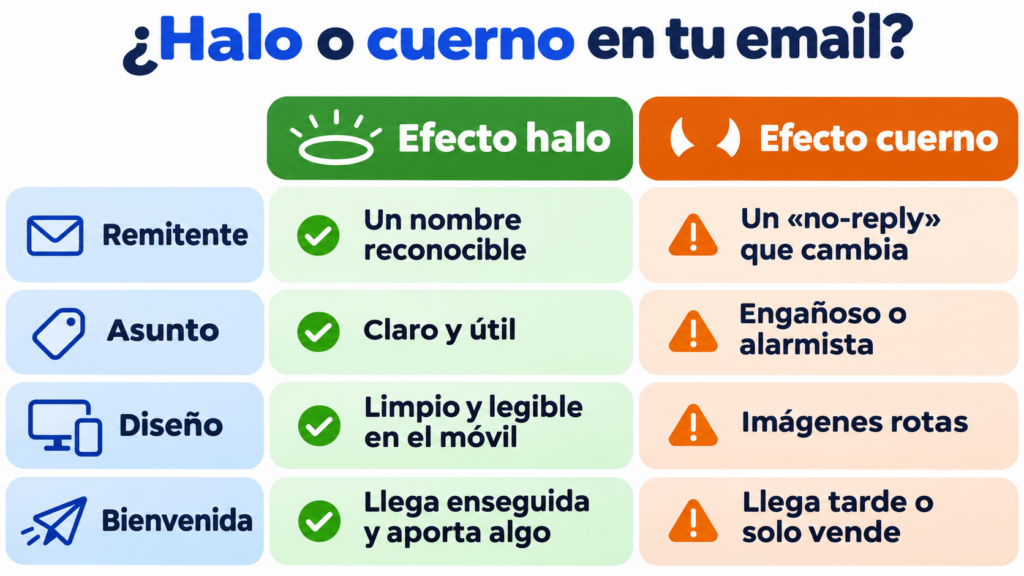
The horn effect exists here too. An annoying email can end up as a spam complaint, and that affects your sender reputation.
Then it isn’t just that message that loses out: all the following ones lose visibility too.
With Mailrelay you can take care of that first impression from the start. The editor’s templates are responsive, you can set up a welcome automation and each send’s statistics show you whether a message has connected or annoyed.
Make your first email leave a good impression
Create your free Mailrelay account: up to 80,000 emails a month, responsive templates and human support on every plan.
Frequently asked questions about the halo effect
These are the most common questions about this bias.
Who discovered the halo effect?
The psychologist Frederic L. Wells described it in 1907, but it was Edward Thorndike who demonstrated it with data and named it in 1920.
How is it different from confirmation bias?
The halo effect creates the overall impression from a single trait. Confirmation bias comes afterwards: we look for and remember the information that fits that impression and discard the information that doesn’t.
How can you avoid the halo effect when evaluating someone?
Assess each aspect separately and with criteria defined in advance. In a job interview or a performance review, it helps to score one quality at a time and compare against data, not against the overall impression.