Marketing plan: what it is and how it differs from other plans
The roadmap that connects your company's goals with every marketing action
A marketing plan is the document that sets out what your company wants to achieve with marketing, for whom, with which actions and with what budget, over a defined period.
In a small business it usually runs to just a few pages. In a large company there may be one per product or per market.
What doesn’t change is that it has to be written down.
A report by the Content Marketing Institute and MarketingProfs (2022) offers a clue: 64% of the most successful B2B marketers had a documented content strategy. Among the least successful, only 19% did.
It’s about content, but the lesson applies to all marketing: whatever isn’t written down ends up being improvised.
If you want to put one together step by step, there’s a guide to creating a marketing plan with a free PDF template. Here we focus on what it is, what types there are and how it differs from similar documents.
What does a marketing plan include?
Every plan answers three questions: where you’re starting from, where you want to get to and how you’re going to get there.
Almost all of them start with a situation analysis, such as a SWOT analysis, and a description of the audience, often in the form of a buyer persona.
Then come the SMART goals, the strategy and the marketing mix, the schedule, the budget and the KPIs that will measure the results.
Types of marketing plan
Not all plans have the same scope. They are usually classified by the time they cover and by the part of the company they span.
By time horizon
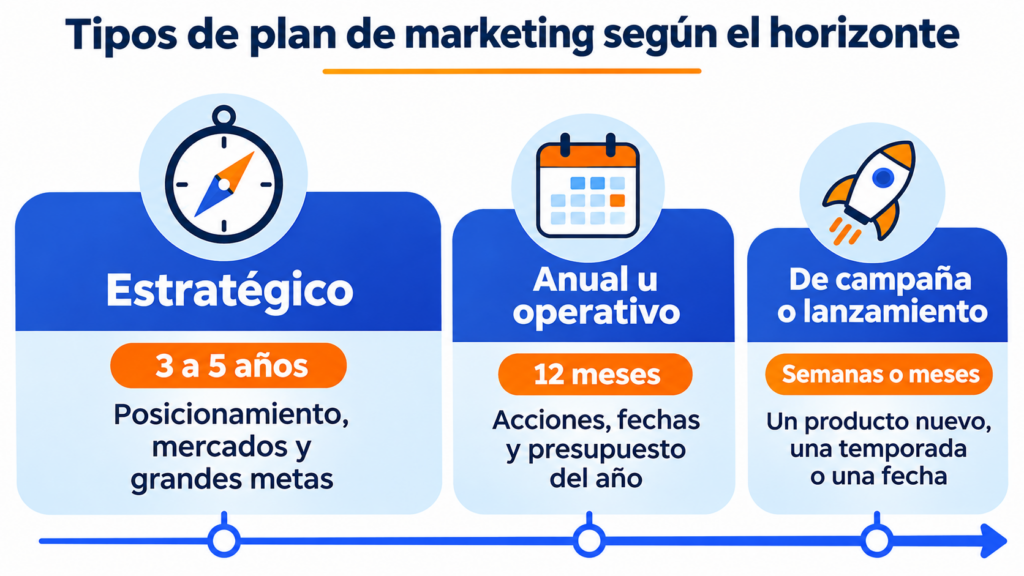
- Strategic (three to five years): sets the positioning, the markets and the big goals. This is the territory of strategic marketing.
- Annual or operational: brings that strategy down to the year’s actions, dates and budget. It’s the most common type in small businesses.
- Campaign or launch: covers a few weeks or months. It’s used for a new product, a season or dates like those on the marketing calendar.
By scope
- Company: brings together all of the company’s marketing.
- Product or brand: makes sense when each line has its own audience and its own budget. The BCG matrix helps you decide which one to invest in.
- Channel: the digital plan, the social media plan or the email plan. They are chapters of the overall plan, not standalone documents.
Differences between a marketing plan and other plans
It’s easy to confuse it with other documents, because they all talk about goals and actions. What sets them apart is how far each one reaches.
| Document | What it covers | Relationship to the marketing plan |
|---|---|---|
| Business plan | The whole company: product, finance, operations and team | It contains it. The marketing plan is one of its chapters (business models) |
| Marketing strategy | Audience, positioning and value proposition | The plan turns it into actions, dates and budget (digital marketing strategies) |
| Communication plan | Messages, audiences (internal ones too) and spokespeople | It develops the communication part of the plan |
| Media plan | Where and when paid advertising runs | It specifies the media investment |
| Social media plan | Goals, content and calendar on social media | It’s one piece of the plan, focused on a single channel |
The most common confusion is between plan and strategy. Think of a trip. The strategy chooses the destination and the route. The plan books the tickets, sets the dates and works out how much you’re going to spend.
What does a marketing plan look like in a small business?
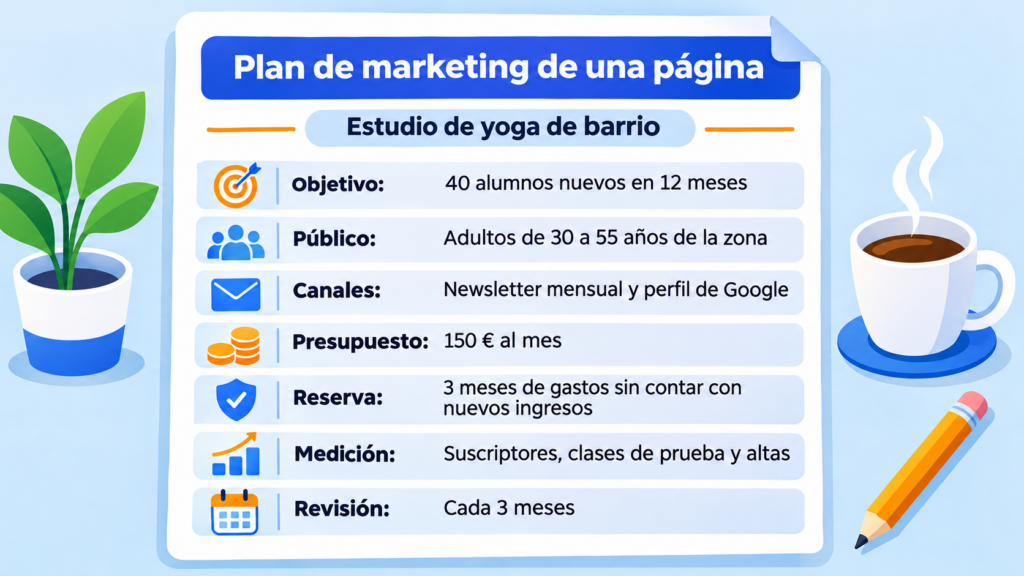
A small company doesn’t need a long document. One page is often enough.
It can hold a clear goal, the audience, one or two channels you can measure, the budget and the date of the next review.
What gets adjusted over time are the actions. The goals should hold for at least a year: if you change your target every month, you won’t know what worked.
Something small businesses’ marketing plans tend to overestimate is the profit they’ll make. You can estimate it, but it isn’t an exact figure. So don’t count 100% on that money for your business to survive. It’s better to plan a budget that lets you hold out if the launch doesn’t go as you expect. Many businesses close too early because they take for granted profits that may never arrive.
Jose Argudo, CMO at Mailrelay
Which measurable channel fits a plan like this? Email is one of the easiest to sustain: it costs little, the list is yours and every send tells you who opens, who clicks and who buys.
To give it its place in the plan, see how to put together an email marketing strategy.
Launch the easiest channel to measure in your plan
Create your free Mailrelay account and send up to 80,000 emails a month to 20,000 contacts, with human support on every plan.