Inbox
The place every email wants to reach (and how to get there)
The inbox is the folder in your email account where the messages you receive arrive. It’s the first thing you see when you open Gmail, Outlook or any other email client. And it’s also the place every company that sends campaigns wants to reach.
Because an email that doesn’t show up there, in practice, doesn’t exist for the person receiving it.
What is an inbox?
The word combines in and box: the box where incoming mail lands. It works just like a mailbox. Each new message appears at the top. You’ll usually see the sender‘s name, the subject line and the first lines of the text.
However, not everything people send you ends up there. Email providers filter every message before showing it to you. The ones that look suspicious go to the spam or junk folder.
Outside email, inbox is also used for private messages on social networks. When someone says “check your inbox” or “I’ll send it to your inbox”, they may mean a direct message. It could be on Instagram, Facebook Messenger, LinkedIn or TikTok, and only the person receiving it can see it.
The idea is the same: a private space where you receive what people write to you. But here we focus on the email inbox, which is the one that matters most in email marketing.
How Gmail, Outlook and Apple Mail organize it
Today it’s no longer a single list. The big providers split it up so you see what matters first:
- Gmail: sorts mail into the Primary, Promotions, Social, Updates and Forums tabs. Newsletters and offers usually land in Promotions.
- Outlook: its Focused Inbox splits messages into two tabs, Focused and Other, based on what you usually read.
- Apple Mail: since iOS 18.2 it sorts mail into the Primary, Transactions, Updates and Promotions categories.
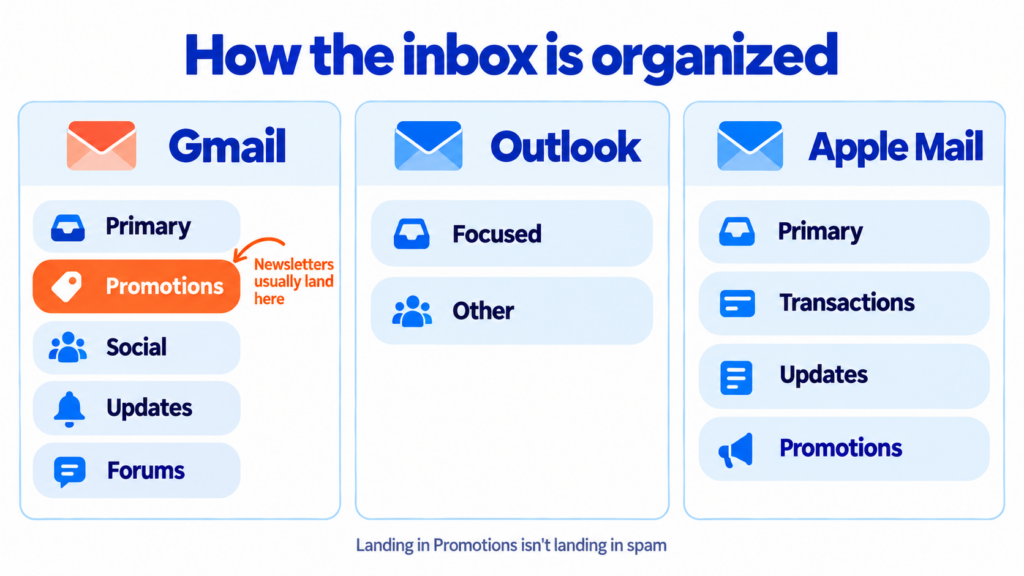
Landing in Promotions isn’t the same as ending up in spam. Your email has arrived and the user can see it, although it competes with more commercial messages.
The other folders in your email
Your email client has other folders too, and it’s worth not mixing them up:
| Folder | What it holds |
|---|---|
| Inbox | Received messages the provider considers legitimate |
| Spam or junk | Suspicious messages, or ones users have marked as spam |
| Sent | The emails you’ve sent |
| Drafts | Messages you started and haven’t sent yet |
| Trash | What you’ve deleted, until it’s emptied |
Why reaching the inbox matters in email marketing
An email being delivered doesn’t mean it reached the inbox. The server may accept it and still send it to spam. That’s why there are two different metrics. Deliverability measures how many emails the server accepts. The inbox placement rate measures how many actually show up there.
The gap isn’t small. According to research by Validity, an industry reference, roughly one in six legitimate emails never reaches its destination. And if your email isn’t there, nobody opens it. Your open rate, your clicks and your sales drop along with it.
On top of that, every provider decides where to place it based on your sender reputation. If your subscribers open and reply, your next sends will have an easier time. If they ignore them or mark them as spam, the opposite happens.
How can you tell where your campaigns end up? A simple way is to send tests to your own Gmail, Outlook and Yahoo accounts and check which folder they land in. It’s also worth watching opens by provider. If they suddenly drop at one of them, your emails are most likely going to spam.
Get your campaigns into the inbox
Mailrelay helps you authenticate your domain and keep your list clean to protect your deliverability from the very first send.
Create a free accountHow to get your emails into the inbox
There’s no single trick. But these practices make a difference:
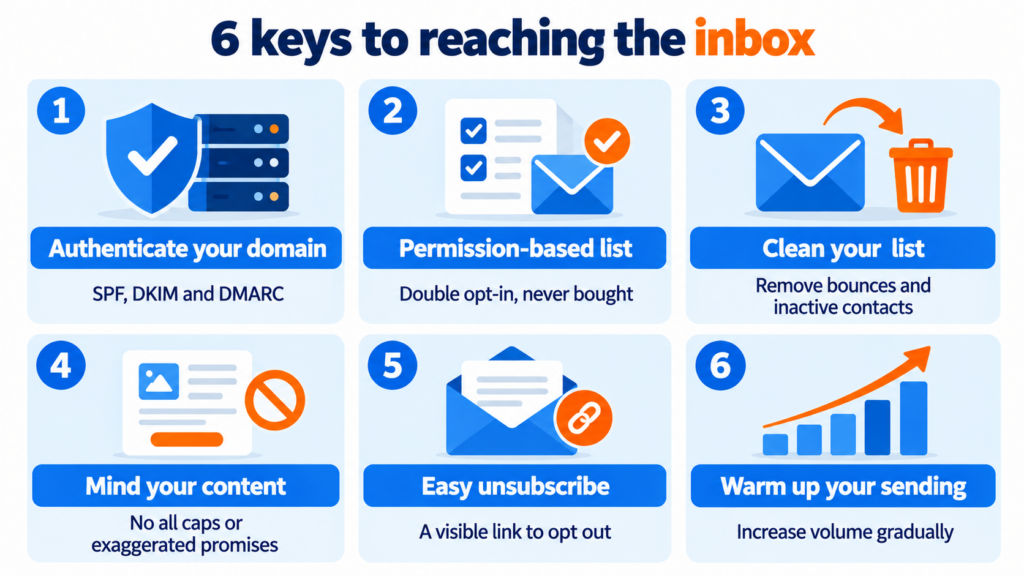
- Authenticate your domain: set up SPF, DKIM and DMARC. Since 2024, Gmail and Yahoo require it, as we explain in our guide to bulk sender requirements.
- Build a permission-based list: use double opt-in and never buy databases.
- Clean your list: remove addresses that bounce and people who haven’t opened in months.
- Take care of your subject line and content: avoid all caps, too many exclamation marks and exaggerated promises, which trigger antispam filters.
- Make unsubscribing easy: a visible unsubscribe link keeps people from marking you as spam.
- Warm up a new domain or IP: start with small volumes and increase them gradually with IP warming.
If you want to go deeper, check what you need to meet Outlook, Gmail and Yahoo requirements and keep your emails out of spam.
How Mailrelay helps you avoid the spam folder
At Mailrelay, deliverability is a priority. We guide you through authenticating your sending domain and automatically clean out addresses that bounce. You also see real-time delivery, bounce and unsubscribe stats for every campaign.
And if something doesn’t work as expected, our support team reviews the case with you by chat, ticket or phone —on the free account too—. That account lets you send up to 80,000 emails a month to 20,000 contacts.
Send more and land better, for free
Up to 80,000 emails a month and 20,000 contacts for free, with real-time delivery stats and human support.
Try Mailrelay for freeFrequently asked questions about the inbox
What does inbox mean? It’s the folder where you receive your emails. On social media, it’s also used to talk about private messages.
Why isn’t an email reaching my inbox? Most often, the filter has sent it to spam. It can also happen that the sender hasn’t authenticated their domain or that your mailbox is full. Check your spam folder first.
Is it bad if my emails land in Gmail’s Promotions tab? No. The email has arrived and the user can see it. What you want to avoid is the spam folder.
What’s the diffrence between the inbox and spam? The first holds messages the provider considers legitimate. Spam collects suspicious ones or those users have marked as unwanted.