20 lead magnet ideas to get more subscribers (with examples by business type)
Guides, templates, discounts, email challenges and more: what to offer depending on your business and how to deliver it automatically so your list grows every day
Guides, templates, discounts, email challenges and more: what to offer depending on your business and how to deliver it automatically so your list grows every day
A lead magnet is a useful gift you offer in exchange for someone’s email address: a guide, a template, a discount or a mini-course. It’s the most direct way to get people to join your list without feeling like you’re asking them for a favor.
The problem is rarely knowing what one is. The problem is deciding what to offer. In this guide you’ll find 20 lead magnet ideas grouped by type, each with a concrete example and the kind of business it suits best. At the end, you’ll see how to deliver it automatically, plus two emails ready to copy.
For the full definition, the different types and the most common mistakes, see our glossary entry on what a lead magnet is.
Before you look at the list, think about three things. The first is what specific problem the person landing on your website has. The second, what they can use today, in less than 15 minutes. The third, how it relates to what you sell.
A good lead magnet ticks all three boxes. A 40-page guide to “digital marketing” attracts lots of people, but hardly anyone reads it and few end up buying. A template for pricing a service attracts fewer people, but they’re exactly the ones you want.
Another useful tip: look at the questions people ask you most often on WhatsApp, over the phone or in your store. Recurring questions are the best starting point. If you already have a blog, also check which articles get the most visits.
Deliver your lead magnet automatically
Create the form, confirm sign-ups and send the gift instantly. Free for up to 80,000 emails a month.
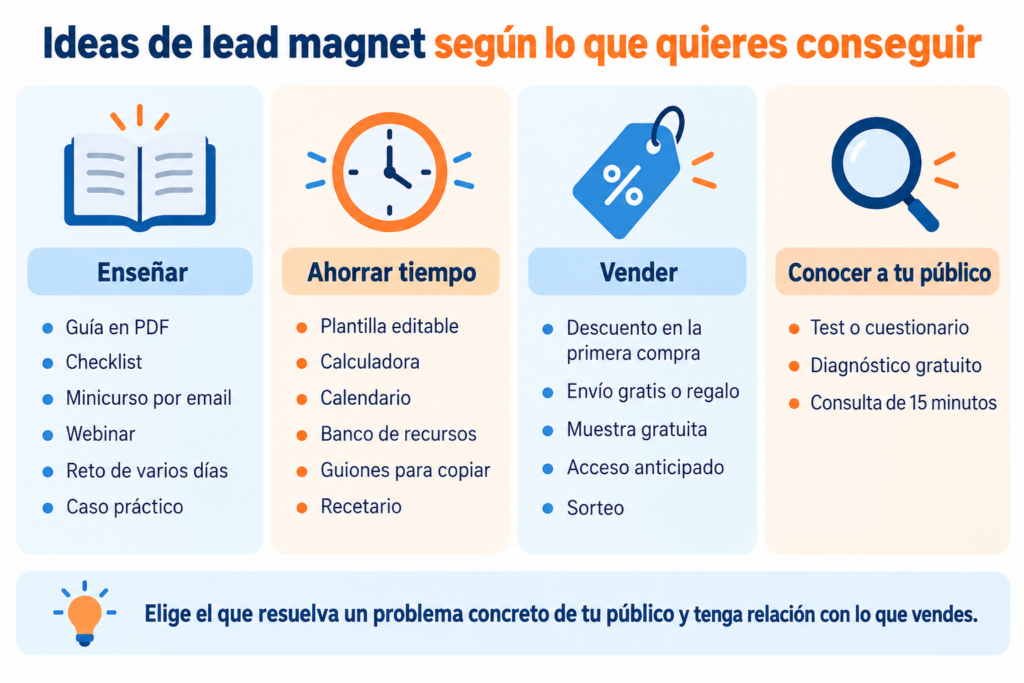
These are the classics of content marketing. They work well for services, training and B2B businesses, where customers need to trust you before they buy.
A short guide of 5 to 10 pages that solves a specific problem. Example: an accounting firm offers “Tax calendar for the self-employed: what to file and when”. Short with clear steps beats long and generic. If you want to turn it into a more complete digital book, see how to put together an ebook.
A one-page checklist. Example: a travel agency offers “Checklist to plan your trip to Japan”. It takes a minute to read and gets saved for later, so your brand shows up again.
Five short lessons, one a day, delivered straight to the inbox. Example: a yoga teacher offers “5 days to start meditating”. Besides delivering value, it gets people used to opening your emails from day one.
A 30- to 45-minute session with Q&A at the end. Example: a training school offers “How to prepare for a job interview in English”. The recording can keep working as a lead magnet for months afterwards. You’ll find more ideas in our entry on webinars.
A challenge with a daily task and a clear goal. Example: a personal trainer offers a “7-day challenge to walk 10,000 steps”. It builds a habit and gets lots of replies, because people want to share how they’re getting on.
How you solved a real problem for a client, with figures. Example: a consulting firm offers “How a dental clinic cut missed appointments in half”. It’s a good fit for B2B sales, where buyers need proof.
Here the value is that people don’t have to start from scratch. These ideas are very easy to consume and usually convert better than long-form content.
A document ready to fill in. Example: an accounting firm offers an “Excel invoice template for freelancers”. If your audience works with email, you can give away an email template for a specific situation.
A tool that gives a personalized result. Example: a real estate agency offers “Mortgage calculator: how much you’ll pay each month”. People leave their email address to get their result or the full spreadsheet.
A calendar with useful dates for the industry. Example: a garden center offers a “Month-by-month vegetable planting calendar”. It’s useful all year round, so the download never goes out of date.
A selection of tools, suppliers or resources you’ve already tried yourself. Example: a photographer offers “The 15 apps I use to edit photos on my phone”. It takes little effort to put together and shows your expertise.
Ready-to-use phrases and messages. Example: a sales consultant offers “20 replies for when a customer says it’s too expensive”. It works really well with a professional audience, who value saving time.
A themed collection. Example: an organic food store offers “15 quick gluten-free dinners”. It’s a good fit for food, home decor, DIY and any business with a visual product.
These ideas are directly linked to the purchase. They’re the favorites of online stores and local businesses, because they bring the first sale closer.
The most widely used lead magnet in ecommerce. Example: “10% off your first order”. It works, but it also attracts bargain hunters. To avoid that, pair it with useful content in the follow-up emails rather than just sending promotions.
An alternative to a discount that doesn’t lower the product’s price. Example: a cosmetics store offers a “Free toiletry bag with your first order”. It protects your margin and your brand image.
Ideal if your product wins people over once they try it. Example: a coffee roaster offers a sample of three blends for just the cost of shipping. In software, the equivalent is a free trial or a free account.
Letting people know before anyone else about a launch or a sale. Example: a clothing brand offers “24-hour early access to the winter sale”. It costs nothing and builds anticipation.
It brings in lots of sign-ups quickly, but of lower quality. Example: a restaurant raffles off dinner for two among everyone who subscribes in October. Use a prize linked to your product, never a generic gift like a smartphone.
Already know what you’re going to give away?
Set up the form and the delivery email in Mailrelay in an afternoon, no coding required.
These ideas return a personalized result. On top of the email address, they give you information to segment your sends from day one.
A few questions with a result at the end. Example: a cosmetics store offers “Find out your skin type in 2 minutes”. Each answer tells you which products to recommend to each person.
A short analysis done by you or with a tool. Example: an SEO agency offers a “Free 10-point review of your website”. It attracts fewer people, but they’re highly qualified contacts for an expensive service.
A short call to answer a specific question. Example: a nutritionist offers “15 minutes to review your weekly meal plan”. It’s the most direct idea for professional services, although it takes up your time.
If you don’t know where to start, this table sums up the ideas that usually work best for each type of business.
| Type of business | Ideas that work best | Example |
|---|---|---|
| Online store | Discount, free shipping, quiz, early access | “Find your perfect size” |
| Professional services | Checklist, template, assessment, consultation | “Quote template” |
| Training and academies | Mini-course, free class, challenge | “First class free” |
| Local business | Discount, giveaway, calendar | “Free coffee on your first visit” |
| B2B and software | Case study, calculator, free trial | “Calculate your annual savings” |
| Blog or media outlet | Guide, recipe book, resource library | “The 50 best bike routes” |
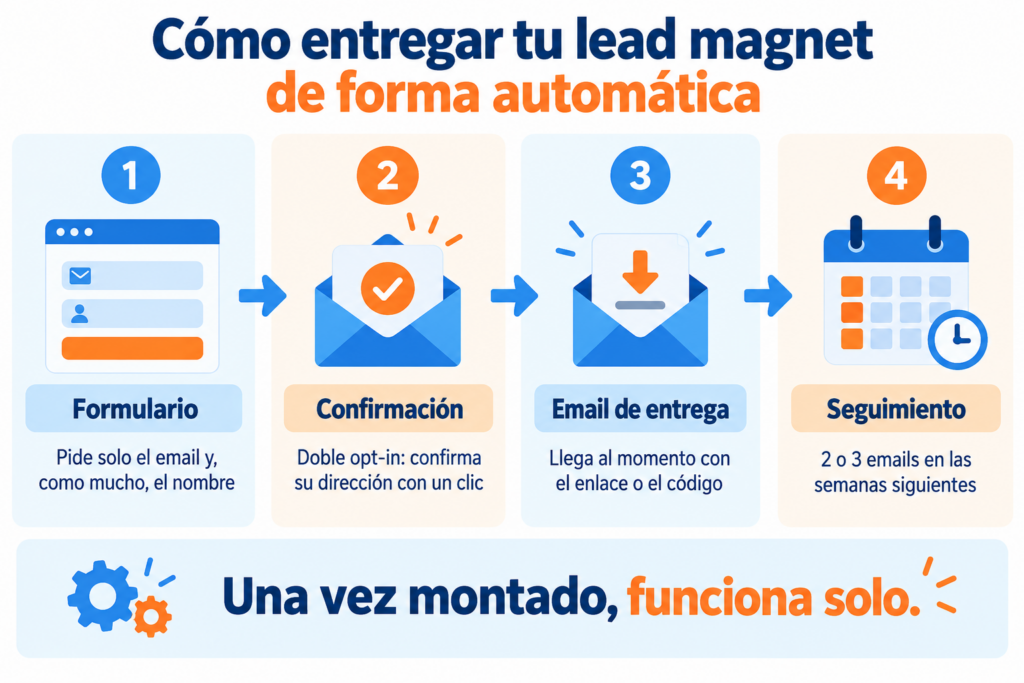
A good idea is no use if the delivery fails. The process has four steps and, once it’s set up, it runs on its own.
The first is the form. It can go on a dedicated landing page, in a pop-up or at the end of your articles. Ask only for the email address and, at most, the name: every extra field reduces sign-ups. You’ll find copywriting tips in our guide to writing your subscription form.
The second step is confirmation. With double opt-in, people confirm their address with one click. This keeps out fake addresses and your list stays clean from the start.
The third is the delivery email. It arrives as soon as someone confirms and contains the download link or the code. It’s your first contact, so it’s worth making the most of it as a welcome email.
The fourth is follow-up. Schedule two or three more emails over the following weeks with an autoresponder. That way you turn a download into a relationship, which is the whole idea behind lead nurturing.
Here’s an example of a delivery email for a PDF lead magnet. Replace the details in square brackets with your own.
Subject: Here’s your [lead magnet name]
Hi [name],
Thanks for subscribing. You can download your [guide / template / checklist] from this link: [download link].
I recommend starting with [specific page or section]. It’s what helps beginners the most.
Over the next few days I’ll send you [what they’ll receive and how often]. If at any point you’re no longer interested, you can unsubscribe with one click.
Best wishes, [your name]
And here’s an example for a welcome discount at an online store:
Subject: Your 10% discount is now active
Hi [name],
Welcome to [store name]. Your discount code is [CODE] and it’s valid until [date].
Just enter it when you check out. If you don’t know where to start, these are our best-selling products: [link].
Questions about sizes, shipping or returns? Reply to this email and a real person will get back to you.
Best wishes from the [store name] team
The most common one is offering something too generic. “Get our newsletter” is not a lead magnet. People need to know what they get and when they’ll receive it.
The second mistake is promising more than you deliver. If the form promises “the ultimate guide” and three pages arrive, you lose their trust with the very first email. And trust is what gets them to open the next ones.
The third is forgetting the follow-up. Many people download the gift and don’t hear from the brand again until the next offer. By then, they no longer remember why they signed up.
Finally, take care of the legal side. Explain on the form what people will receive in addition to the gift. Use an unticked checkbox if you’re going to send marketing communications, and link to your privacy policy. That way you comply with the GDPR and your subscribers know what to expect.
With Mailrelay you can create a subscription form and embed it on your website, and every sign-up goes through double opt-in. You can customize the confirmation email with your brand and your tone of voice.
Then an automation sends the delivery email as soon as the person confirms and schedules the next ones. Automations are included in the free account too.
If you offer several lead magnets, record which one each person downloaded in a subscriber group or a custom field. That way you can send each of them content related to what they were interested in.
The free account includes up to 80,000 emails a month and 20,000 contacts, with human support on all plans.
Turn every download into a loyal subscriber
Automate delivery and follow-up with Mailrelay’s free account.
There’s no single best one for everyone. The one that works best is the one that solves a specific problem for your audience and is directly related to what you sell. For online stores, discounts and quizzes tend to win; for services, templates and assessments.
One well-made lead magnet is enough to get started. Once you have traffic across several sections of your website, you can create a lead magnet for each topic and offer the best-fitting one in each article.
Yes, a lead magnet is offered in exchange for an email address, with no payment. What you can do is make the gift a sample of a paid product, such as the first chapter of a course.
Look at the form’s conversion rate: sign-ups divided by page visits. Also look at how many of those people open the following emails and how many end up buying. If you see lots of sign-ups and few opens, the gift is attracting an audience that isn’t yours.
Yes, as long as you clearly explain what people will receive and how they can unsubscribe. If you’re also going to send advertising, ask for explicit consent with an unticked checkbox.