Earned media: what it is and how to get it
No one can buy what others say about you, but you can work to get them to say it
Earned media is the visibility a company gets thanks to others, without paying for it: press articles, reviews, social media mentions, recommendations or citations in AI answers.
It is also known as earned publicity. It is part of the owned, paid and earned media model: what you own, what you pay for and what you earn.
It is the hardest of the three to get. And also the one that builds the most trust.
What is earned media?
It is every time others talk about your brand of their own accord.
A journalist who quotes you, a customer who leaves five stars or a creator who recommends your product without being paid (if they are paid, it is paid influencer marketing).
Its value lies in trust. People believe a third party more than a digital advertising ad.
That is why a single mention in the right outlet can carry more weight than an entire campaign.
The downside is that you don’t control it. You don’t decide when it comes, what is said or where it appears. All you can do is create the conditions for it to happen.
Examples of earned media
These are the most common types of earned media, with an example of each:
| Type | Example |
|---|---|
| Press and media | A local newspaper runs a story on your store after receiving your press release |
| Reviews | Ratings on your Google Business Profile or on Trustpilot |
| Social media mentions | Customers who post photos with your product (user-generated content) |
| Recommendations | A customer’s word of mouth to a friend, or a referral program |
| Links | An industry blog links to your guide (backlinks) |
| AI citations | ChatGPT, Gemini or Google’s AI summaries name you as a source or as a recommended option |
| Awards and rankings | You appear in a “best tools” list put together by an independent outlet |
AI citations are the newest form of earned media. Working on your content so that AI mentions you is known as AEO, or answer engine optimization.
How to get earned media
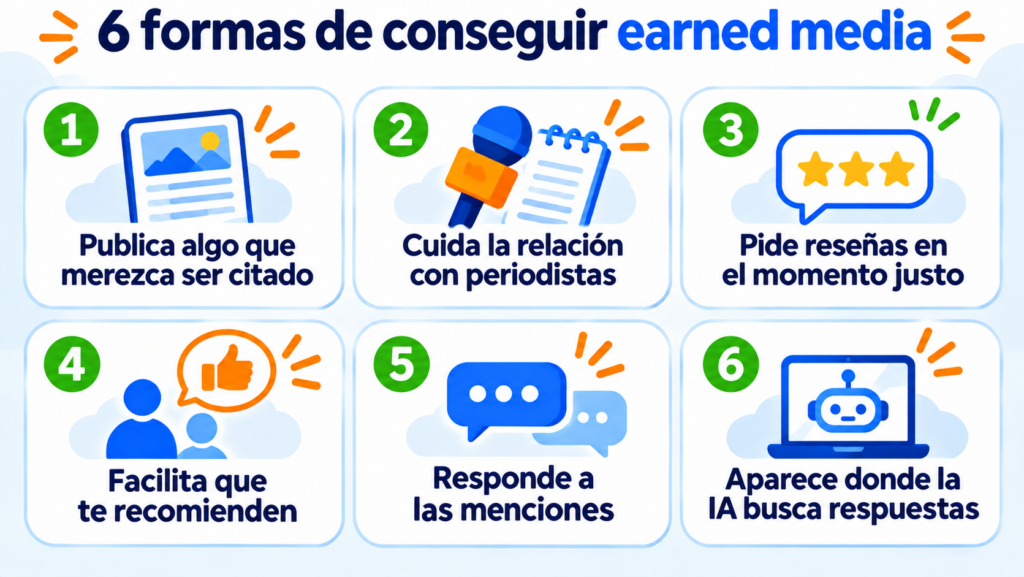
No one can buy an earned mention, but you can work to deserve it. These six approaches work for businesses of any size.
Publish something worth citing
Your own data, a simple study, a useful guide or a clear opinion. Journalists and AI tools cite those who offer something that isn’t found in other sources.
Good content marketing is the foundation of almost every mention that comes without you seeking it.
Nurture your relationships with journalists and creators
Public relations is about offering stories that interest their audience, not sending out press releases in bulk.
Ask for reviews at the right moment
The best moment is right after a good experience. An automated email a few days after the purchase, with a direct link to leave a rating, multiplies your reviews with no manual effort.
You can set it up with an email marketing automation that is triggered after each order.
Make it easy to recommend you
A referral program with a benefit for both the person who recommends and the person who signs up turns satisfied customers into an acquisition channel.
Respond to mentions
Thanking people, answering questions and sharing what your customers post encourages them to do it more.
And if criticism comes your way, responding well also helps: others see how you handle it.
Show up where AI looks for answers
AI assistants summarize what they find on websites, forums and media outlets. Answer the questions your customers ask clearly on your website, and try to get other sites in your industry to mention you. That increases the chances of being named when someone asks about your category.
How to measure earned media
Measuring what you earn is harder than measuring ads. These indicators help:
- Number of mentions and the outlets they appear in.
- Traffic coming from links on other websites.
- Number of reviews and their average rating.
- How often AI tools name you in questions about your industry.
Some agencies calculate earned media value (EMV): how much it would cost to get that same visibility with ads.
It is useful for comparison, but it is best taken as a rough guide. A mention in a trusted outlet is worth more than its equivalent in impressions.
For a fuller picture of what is being said about your brand, see this guide on how to measure your brand’s reputation.
Differences between earned media, paid media and owned media
| Earned media | Paid media | Owned media | |
|---|---|---|---|
| What it is | What you earn | What you pay for | What you own |
| Cost | Indirect: time and quality | Each impression or click | Tools and time |
| Control | Third parties | The platform | Yours |
| Credibility | Highest | Lowest | Medium |
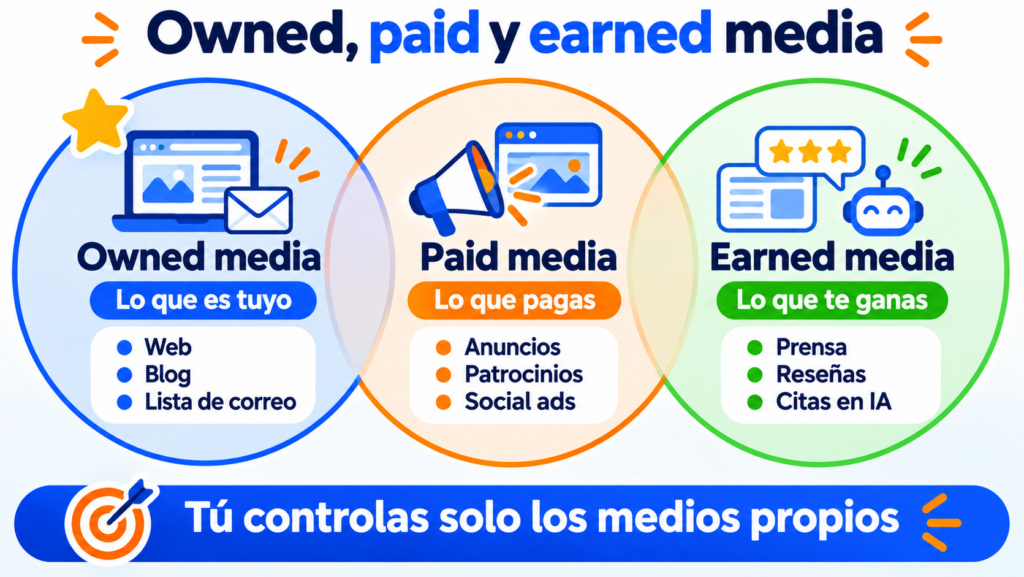
The three feed into each other, and it pays to plan them together in your media plan. An ad (paid media) can bring someone to your website, and a good experience generates a review.
And if that person subscribes to your newsletter, they move into your own channel, where you can ask them for the next review or recommendation.
Ask for reviews without doing it by hand
With Mailrelay’s automations, you send the review request when a contact becomes a customer. Free account with 80,000 emails per month.
Frequently asked questions about earned media
Two common questions about earned media.
Your profile isn’t: it is a channel you manage yourself on someone else’s platform. What others post about you on social media (mentions, reviews, customer content) does count as an earned mention.
What is earned media value?
It is an estimate of what the visibility a mention has given you would have cost in ads. It is useful for comparing campaigns, but it does not measure the trust a mention brings.