Email marketing for lawyers: what to send your clients without breaking the code of ethics
How to be there when a client needs a lawyer, without seeming like aggressive advertising or compromising professional secrecy
Email marketing for lawyers is the use of email to stay in touch with clients, prospective clients and other professionals who recommend a law firm.
Nobody needs a lawyer every day. They need one suddenly: when they receive a letter from the court, when they want to set up a company or when they have a problem with their landlord.
At that moment, they call the firm they remember. Email is the simplest way to make sure that firm is yours.
What is email useful for in a law firm?
In a law firm, email is not about selling with every send. It is about making sure that, when the problem arises, the client already trusts you because they have been reading what you write for months.
It is also useful for the day-to-day work on ongoing matters: reminding someone of an appointment, asking for a document or flagging a deadline. These are transactional emails that save phone calls and give an impression of good organization.
These emails count as much as the newsletter in email marketing for lawyers.
There is a third use that many firms forget. Satisfied clients are the main source of new clients.
An email when the matter is closed is the natural moment to ask for a referral.
If you work with companies, email keeps you close to the decision-makers. A change in employment or tax regulations explained clearly, and in good time, is worth more than any ad.
You will find more ideas for that audience in B2B email marketing.
Which emails can a law firm send?
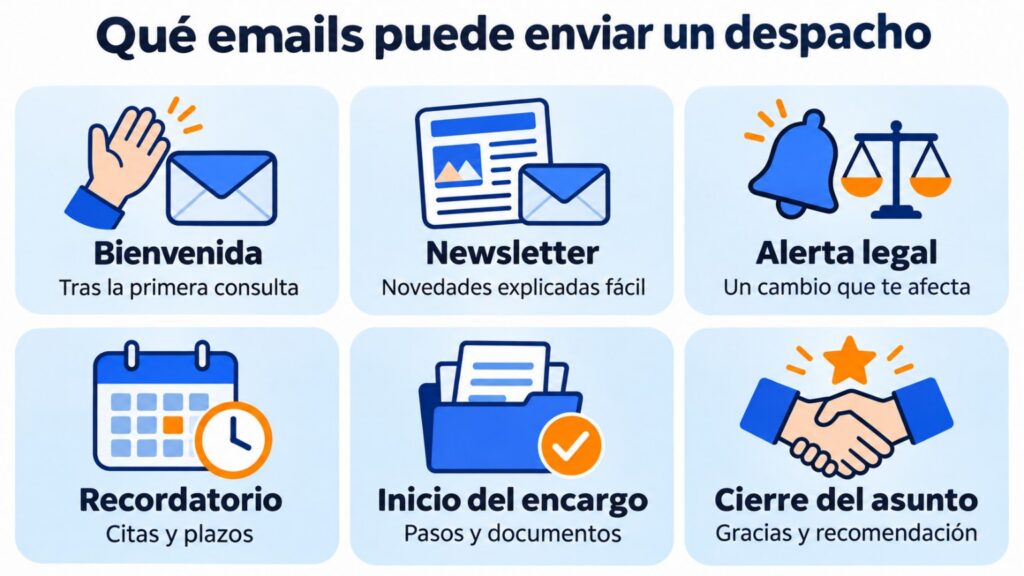
These are the most useful ones. You don’t need to start with all of them: with the welcome email, a monthly newsletter and legal alerts, you have the essentials covered.
| For whom | Example subject line | |
|---|---|---|
| Welcome | Someone who has made an inquiry | “Thanks for your inquiry: here’s what you can expect” |
| Newsletter | Clients and contacts | “The three legal changes this month that affect you” |
| Legal alert | Clients in a specific practice area | “The deadline to file a claim is changing: what you need to know” |
| Reminder | Client with an appointment or deadline | “We’ll see you at the office tomorrow at 10:00” |
| Start of the engagement | New client | “Next steps and the documents we need” |
| Closing the matter | Client whose matter is ending | “Thank you for your trust” |
For the newsletter, you can start from the Law firm newsletter template. For urgent changes, use the Legal alert template. Both can be adapted with your law firm’s logo and colors.
The welcome email arrives right after the first inquiry. It thanks the person for getting in touch, explains how you work and makes clear what they will receive if they subscribe to your updates.
The email at the start of the engagement is your client onboarding. It explains what is going to happen, on what timeline and what you need from the client. For appointments, you can start from the Appointment reminder template.
And if you have outstanding invoices, a friendly payment reminder by email usually works better than an awkward phone call.
The question every newsletter has to answer is simple: what changes for me? Readers aren’t interested in the number of the law or the legal debate.
They want to know whether they need to do something and by what date.
Write the way you would talk to a client in your office, without jargon. If you have to use a legal term, explain it in the same sentence.
One topic per email, or three at most, with a link to your website for anyone who wants to read more.
A regulatory change explained with an example, the questions you are asked most this month or upcoming deadlines all work well. So does a practical guide to a common procedure.
This kind of content marketing shows what you know without having to say you are the best. It is the foundation of good email marketing for lawyers.
Your legal newsletter, ready in an afternoon
Newsletter and legal alert templates, segments by practice area and free sending of up to 80,000 emails a month.
How should a law firm segment its list?
A family law client is not interested in a corporate tax reform. Splitting your list stops you from sending emails that don’t concern anyone.
The most useful criterion is the practice area: employment, family, corporate, tax, criminal or whichever areas you work in.
Next comes the type of client, because an individual and a company need different messages even when the topic is the same.
It also helps to know where each contact stands. Someone who only made an inquiry is not the same as a client with an open matter or one whose matter has ended.
Store this data as custom fields and create a segment for each send. You can ask for the area of interest in the subscription form on your website.
Which rules does a lawyer’s email marketing have to follow?
A law firm has to follow the same rules as any other business, plus those specific to the profession.
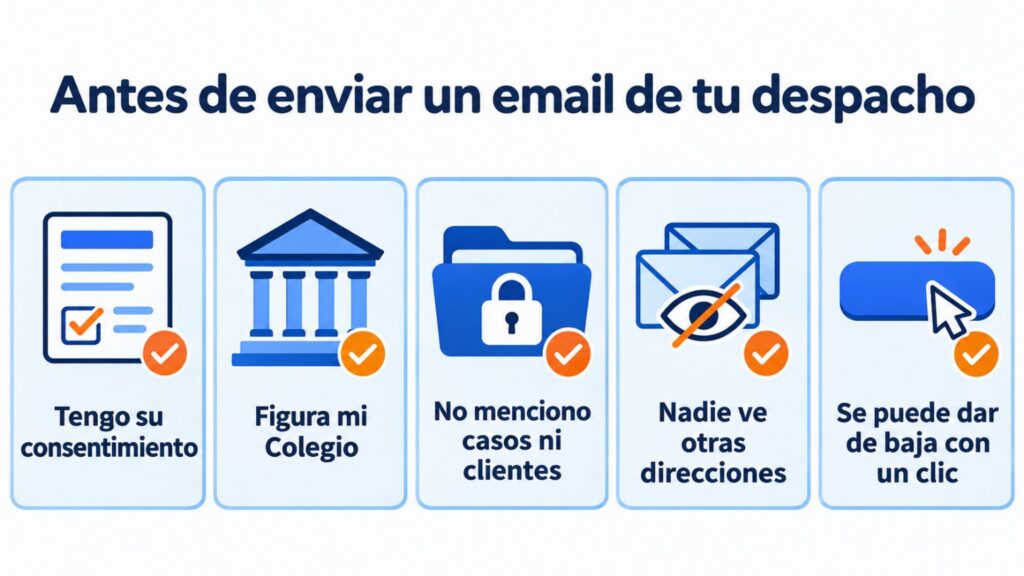
The first is permission. To send a newsletter or commercial communications, you need each person’s consent, under the GDPR and Article 21 of the LSSI (Spain’s e-commerce law).
With double opt-in, subscribers confirm their address and you keep proof of that permission.
The exception is your clients: you can write to them about services similar to the ones they hired you for if you gave them the option of not receiving those emails.
The second is the code of ethics. The Spanish Legal Profession’s Code of Ethics (Código Deontológico de la Abogacía Española), approved in 2019, regulates advertising in its Article 6.
Among other things, it requires you to state in your advertising the Bar Association you belong to.
The most practical approach is to include it in the footer of all your commercial emails, or in your email signature, along with your contact details.
The same article prohibits offering your services to victims of catastrophes, calamities or crimes, and also encouraging people to sue. Be careful with emails tied to a news story.
Reporting a change in the law is fine. Encouraging people affected by a specific event to file a claim may not be.
The third is professional secrecy. Never mention a case or a client in an email without their express permission, not even anonymously if they could be recognized.
And be careful with emails sent from the firm’s own mailbox: a circular with every address visible reveals who your clients are.
If you don’t use a tool, always put the addresses in BCC.
Better still, send with an email marketing platform, which sends an individual email to each person and adds an unsubscribe link to every send.
You will find the rest of the general obligations, step by step, in legal email marketing.
How do you know if it works?
In a law firm, an email’s success is not measured in immediate sales. Look at three things.
The open rate tells you whether your subject lines are interesting. The CTR shows which topics spark the most curiosity: if an employment law alert gets far more clicks than the rest, you know what to write about more.
The third signal is outside the tool. It’s the inquiries that mention an email, the direct replies and the clients who come back. Ask every new client how they found you.
Common mistakes in a law firm’s email marketing
The first is writing as if it were a court filing. Long paragraphs, references to articles and Latin terms push readers away.
An email from a law firm has to be clear on the first read.
The second is writing only when there is something to sell. If your only emails are service offers, people stop opening them.
Useful information is what makes people read the sales email when it arrives.
The third is lumping everyone into the same list. And the fourth is forgetting about clients once the matter is closed, just when they are most willing to recommend you.
How Mailrelay helps with your law firm’s email marketing
With Mailrelay, you can store the practice area and type of client in custom fields and send each group only what interests them.
You have templates designed for law firms, such as the newsletter and the legal alert, which you can adapt to your brand without any design skills.
Automations, included in the free account, send the welcome email after an inquiry or appointment reminders without you having to remember.
And if you prefer a more direct alert, you can also send SMS from the same platform.
Each person receives their own email, so nobody sees anyone else’s address.
The servers are in the European Union and Mailrelay acts as the processor of your data, under the GDPR.
With open and click statistics, available in the free account and in Enterprise, you know which topics interest your clients.
The free account lets you send up to 80,000 emails a month to 20,000 contacts, with human support on every plan.
Stay in touch with your clients effortlessly
Create your account, import your contacts and send your first legal alert today.
Frequently asked questions about email marketing for lawyers
These are the most common questions from law firms that are just getting started.
Can a lawyer advertise by email?
Yes. Advertising by lawyers is allowed, as long as it follows the rules for commercial communications.
It must also follow those of the Code of Ethics: be truthful, state the Bar Association and not target victims of disasters or crimes.
You can write to your clients about services similar to the ones they hired you for, as long as you gave them the option of not receiving those emails.
To send it to contacts who only made an inquiry, ask for their consent first.
How often should a law firm send emails?
One newsletter a month is usually enough. Legal alerts, whenever there is a change that really affects your clients. It’s better to send a few useful emails than a lot of filler.
Related articles
If you want to see how email is used in other sectors or review the rules and formats mentioned in this entry, continue here.