Experiential marketing: what it is, 10 examples and how to apply it to your business
How to get your customers to live your brand instead of just seeing it, with real examples and emails to put it into practice
How to get your customers to live your brand instead of just seeing it, with real examples and emails to put it into practice
The goal of any brand is not only to sell, but also to build customer loyalty so that customers come back to buy again and sales grow. However, with so much competition, building a strong brand-user relationship is no longer enough.
Today, consumers want an exciting experience during the purchase process, and to feel special every time they visit an online store to shop or hire services online.
So… what is the formula for companies to spark these feelings in consumers so that they end up choosing their brand?
The challenge for brands is to give consumers experiences that make them feel new emotions, and this is achieved with what we call experiential marketing.
To help you better understand this technique and apply it properly in your business, so that it resonates with your customers and turns them into brand ambassadors, in this article I’ll share some keys to getting the most out of it.
Specifically, I’ll tell you:
Experiential marketing is a strategy that aims to get customers to live an experience with the brand, instead of just seeing an ad. That experience, which can be physical or digital, makes them remember the brand and talk about it. It is also known as experience marketing or experiential marketing.
With this type of marketing, as its name suggests, the aim is for the customer to live experiences. This way, the memory lasts over time and creates a closer bond than any other traditional marketing strategy.
But before looking at how to develop an effective experiential marketing strategy, let’s see exactly what it is, what its potential benefits are and how it differs from emotional marketing.
Experiential marketing is a journey that lets users associate positive emotions with a particular brand.
The idea is to make them feel they are living a unique and unforgettable experience through emotions and neuromarketing techniques. As a result, this type of marketing leaves an immeasurable and lasting mark on the consumer’s mind, much deeper than any other marketing action.
A customer will choose a particular product or service because of the emotional journey it conveys right before the purchase.
With this concept in mind, these are the benefits your brand will get if you apply it correctly:
● Differentiation: It is a way to set yourself apart from the rest, who still use traditional marketing actions to attract their target audience.
● Brand identification: That emotional journey will lead users, almost unconsciously, to associate the brand with positive experiences.
● Recommendation: Both word of mouth and social media are the channels users rely on to recommend the brand to their friends and family.
● Engagement: The interaction happens in the moment, and this will make users trust the brand more, even turning them into loyal customers.
● Increased sales: An increasingly close relationship with your audience will let you improve the user experience, and you’ll see this reflected in your sales.
The idea became popular in the late nineties. In 1998, Joseph Pine and James Gilmore talked about the “experience economy”: companies no longer compete only with products and services, but with the experiences they offer.
A year later, in 1999, Professor Bernd Schmitt published Experiential Marketing. In it, he describes five types of experiences a brand can create:
| Experience | What it aims for | Example |
|---|---|---|
| Sensations | Reaching people through the senses | The smell of a store or the music in a venue |
| Feelings | Stirring emotions | A surprise that makes you smile |
| Thoughts | Making people think or sparking curiosity | A challenge or a game |
| Actions | Inviting people to do something | Trying the product, taking part in a race |
| Relationships | Making people feel part of a group | A customer community or a fan event |
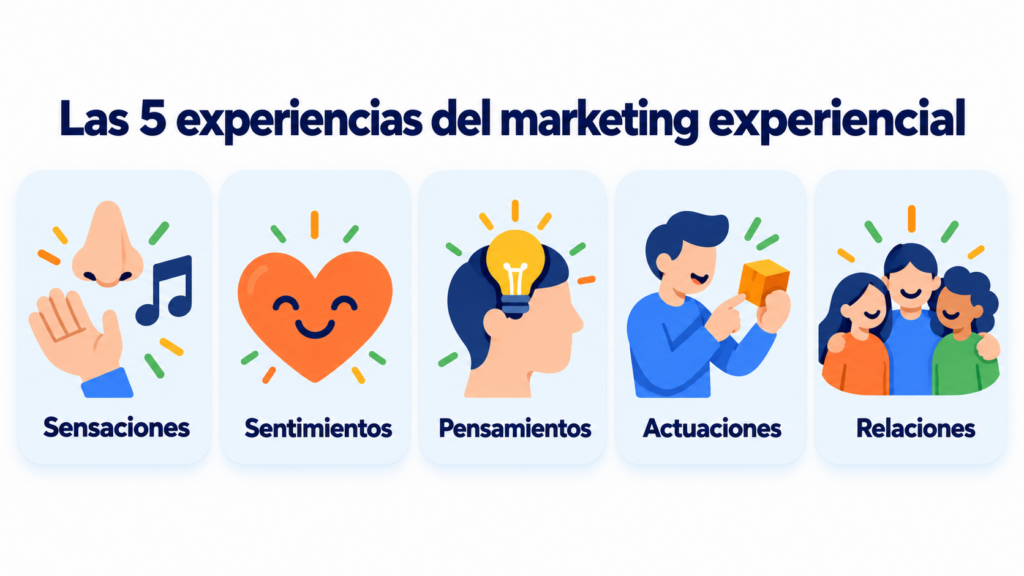
The best campaigns combine several at once.
Experiential marketing and emotional marketing are closely related. In fact, experiential marketing uses emotions to create bonds between brand and users, but they are not the same.
On the one hand, emotional marketing uses different techniques to reach consumers, such as storytelling, where emotions come first and the brand takes a back seat.
So emotional marketing focuses on analyzing how the unconscious part of the brain works in order to improve advertising campaigns.
So this type of marketing aims for customers to make their purchase decision based on their positive experiences, which goes beyond an emotional story.
This table sums up the differences with other related techniques:
| Technique | What it focuses on | Example |
|---|---|---|
| Experiential marketing | The customer living something with the brand | A store where you try the product |
| Emotional marketing | Telling a story that moves people | A Christmas ad |
| Sensory marketing | The five senses | The scent of a clothing chain |
| Guerrilla marketing | Surprising people in the street on a small budget | A bench turned into an ad |
To help you better understand this technique, let’s look at some examples of brands that have used experiential marketing in their campaigns, some of which even went viral thanks to the power of social media.
Would you also like to always be top of mind for your target audience? Then let’s see how these brands did it so you can get inspired:
Here are 10 examples of brands that have turned their message into an experience:
| Brand | Type of experience | The idea |
|---|---|---|
| Carozzi | Action | A giant keyboard for tweeting with your feet |
| Heineken | Feelings | Swapping your flight for a surprise destination |
| Sensations | Pop-up stores that gave away donuts | |
| IKEA | Relationships | A night in a store for a group of fans |
| Red Bull | Thoughts | A jump from the stratosphere broadcast live |
| LEGO | Action | An entire building to build and play in |
| Ben & Jerry’s | Feelings | One day a year of free ice cream |
| Spotify | Relationships | A personal year in review to share |
| Airbnb | Action | Activities hosted by locals |
| Sephora | Sensations | Trying on makeup with augmented reality |
This brand created a large keyboard so people could write tweets with their feet. It was an action against a sedentary lifestyle, very much in line with Carozzi‘s values, since the brand sponsors the Santiago de Chile marathon, where this action took place.
A super fun experience for everyone. Watch the video and judge for yourself:
What you can learn: the experience works best when it is tied to the brand’s values, in this case sport.
At one of New York’s airports, Heineken offered people the chance to give up their flight and travel somewhere completely different, chosen by a roulette wheel.
Heineken paid for the trip, and its aim was to encourage new adventures and experiences to break out of the routine:
What you can learn: a well-chosen surprise makes the brand the memory of a trip.
Google’s Home Mini is the size of a donut. That’s why they used the slogan “Small as a donut but with the power of a superhero”.
The brand created a pop-up store where people asked Home Mini questions and it answered by randomly giving away boxes full of donuts or a Home Mini.
These stores opened all over the US at different times. See all the buzz it created:
What you can learn: a simple play on words, like the size of a donut, can become an experience.
In 2011, IKEA invited a group of fans to sleep in its Essex store (UK). The idea came from a Facebook group of thousands of people who wanted to spend the night among its beds. There were manicures, massages and even a sleep expert.
What you can learn: listen to your community. Sometimes your customers are already giving you the idea.
In October 2012, with the Red Bull Stratos project, skydiver Felix Baumgartner jumped from a height of about 39 kilometers. Millions of people watched it live on YouTube.
What you can learn: not everyone has to live the experience in person. It also works if people experience it live.
In 2017, LEGO opened LEGO House in Billund (Denmark), a building shaped like bricks where children and adults build, play and see giant creations.
What you can learn: when the product lends itself to it, the best experience is letting people use it.
Since 1979, Ben & Jerry’s has celebrated Free Cone Day every year: a day when it gives away ice cream in its stores. Lines form and people share it on social media.
What you can learn: an annual tradition builds anticipation and makes customers look forward to it every year.
Every December, Spotify sends its users Spotify Wrapped, a summary of the songs and artists they listened to the most. It is designed to be shared and floods social media every year.
What you can learn: your data can become a personal experience. It is an idea you can also bring to an email.
In 2016, Airbnb launched Experiences: activities hosted by locals, such as cooking classes or guided tours. With them, it sells more than accommodation: it sells the trip.
What you can learn: think about what customers want to experience, not just what they buy.
Sephora lets you try on makeup products from your phone with augmented reality, without going to the store. The experience of trying things on also moves to the digital channel.
What you can learn: experiential marketing also works online if you help customers try before they buy.
Bring the experience to the inbox
Personalize your emails, automate your welcome message and surprise every subscriber with Mailrelay.
You don’t need a big brand’s budget. These steps also work for a small business:
1. Set a goal. Awareness, new contacts, sales or loyalty from the customers you already have.
2. Get to know your audience. Define your buyer persona: what they like, where they are and what excites them.
3. Look for an idea tied to your brand. The experience has to remind people of what you sell or what you stand for, like sport for Carozzi.
4. Choose the format. An event, a pop-up store, a product trial, an online game or an email action.
5. Plan how to capture contacts. A QR code or a subscription form so that whoever lives the experience stays in touch with you.
6. Measure the results. Attendees, mentions, contacts captured and sales in the following weeks.
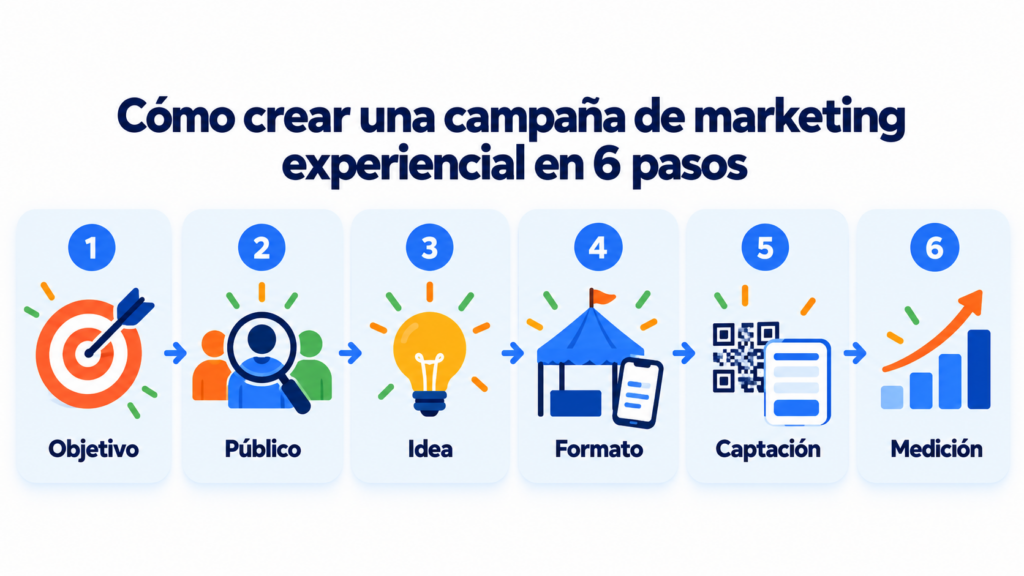
To develop an experiential marketing strategy in your business, you should first assess all the tools you have at your disposal to get good results.
Best of all, if you do it well and offer great experiences, your users will become allies and true ambassadors for your brand. In other words, you’ll go viral thanks to the influence of opinions on social media.
However, social media is not the only channel you should consider to get the most out of experience marketing.
Email marketing is another of the most influential channels, so you shouldn’t overlook it as a way to win customers and brand advocates.
One of the things you should consider when applying experience marketing to your mailings is humanizing the brand. The idea is to make it tangible and keep it present in the consumer’s mind over time.
But in addition, with your email marketing campaigns your goal will be to stimulate the user’s senses, stirring an emotion, making them feel good and giving them a unique experience.
With your mailing campaigns, you can achieve the following:
Given all the potential of experiential marketing in email marketing, it’s time to take action and apply some strategies to your emails. Take note of these tips:
It’s not enough to know your ideal customer’s age, gender and purchasing power.
Make the effort to go a step further and learn about their fears, concerns, aspirations, routines, family environment or which social networks they are on. The more details you have, the better your chances of moving them.
Then think carefully about how to segment your audience so you send each person the right message. It makes no sense to send an email to someone who has no interest in the product you’re promoting.
Always offer a personalized experience. To do so, always address each subscriber by name in your emails and send them a personalized message that speaks to their needs or pain points.
Build an emotional commitment to the brand, trying to make customers always feel like the protagonists.
Coca-Cola always uses experiential marketing to spark interest here, and it does it very well. Remember the happiness ATM? Coca-Cola installed an ATM that let people withdraw 100 euros.
The only condition the brand set was that the money had to be shared with other people. An action very much in tune with its values (sharing with friends) that strengthens the emotional bonds between brand and user.
Offer surprise discounts that can be used beyond your store. So you can ask them to make a purchase in your store and, in return, offer them something different (which of course will depend on their tastes).
For example, if your audience loves movies, give them a cinema ticket; or if they like rock, give them a ticket to a concert by one of their favorite bands.
Can you imagine a customer’s face when it’s time to pay and suddenly a discount is applied? You can either display those offers prominently, which is recommended to attract more customers, or surprise your customers unexpectedly right at the moment of purchase.
With experiential marketing, you shouldn’t focus only on your business’s sales. What matters is the customer, which is why you should focus on offering them a unique experience.
One way to achieve this is by sharing common experiences and interests to build closer relationships. For example, if you organize an event, invite your audience to take part and create unforgettable memories and experiences.
What this type of marketing aims for is to make customers feel good. That’s why you should try different actions that give your brand added value, taking your audience’s tastes into account.
Try surprise gifts, a voucher to redeem whenever they want… In short, let your imagination run wild and bring out your most creative side to surprise them!
Email is an inexpensive way to create small experiences, one at a time. Here are some ideas:
| What experience it creates | When to send it | |
|---|---|---|
| Welcome email | Feeling welcome and knowing what’s coming | Right after subscribing |
| Birthday email | A personal surprise | On their birthday, with a gift |
| Year in review | Seeing their history with the brand | At the end of the year, with their data |
| Exclusive invitation | Feeling part of a group | Before an event or a launch |
| Interactive email | Taking part | With a survey, a quiz or a game |
To personalize them, you need data on each contact, such as their name or date of birth, stored in custom fields, and good segmentation.
Here is a year-in-review template you can adapt:
Subject: Your year with [Brand], [Name]
Hi [Name],
This year you’ve placed [number] orders with us and your favorite was [product]. You also joined us at [event or action].
Thank you for being part of this story. To start next year off right, here’s a gift for you: [perk].
See you soon!
Don’t let the experience end at the event
Capture the contacts of the people who live your experience with forms and stay in touch with your newsletters.
An experience is moving, but it also has to deliver results. These are the most useful metrics:
| Metric | What it measures |
|---|---|
| Participants | How many people lived the experience |
| Mentions and user-generated content | How much people talk about it on social media |
| Contacts captured | How many people gave you their email or phone number |
| Satisfaction | What people think, for example through a survey |
| Sales | How much you sell in the following weeks |
Use a unique code or URL for each action to know where each contact and each sale comes from.
With Mailrelay, you can create the form to capture the people who live your experience and send the welcome email automatically. You can also personalize each message with custom fields and segment your contacts. And measure the results of each send.
The free account includes up to 80,000 emails a month and 20,000 contacts, with human support by chat, ticket and phone.
Send your newsletters with Mailrelay
Up to 80,000 emails a month and 20,000 contacts for free, with human support on every plan.
These are the most common questions about experiential marketing.
It means getting the customer to live an experience with the brand, instead of just seeing an ad, so that they remember it and talk about it.
The term became popular with Bernd Schmitt, who published Experiential Marketing in 1999, and with Pine and Gilmore’s “experience economy” (1998).
Emotional marketing tells a story that moves people; experiential marketing makes the customer feel that emotion first-hand.
Yes. A product trial, a workshop in your store or a birthday email with a gift are experiences that don’t need a big budget.
Yes. Augmented reality apps, personalized year-in-review summaries or interactive emails are experiences people live online.
Experiential marketing is a strategy that connects quickly with the audience, thanks to the emotional bond created through experiences. The connection is so deep that if you strike a chord with your audience, you’ll undoubtedly achieve a level of loyalty that would be very hard to reach with other marketing techniques.
However, you need to be careful, because even the smallest mistake in this strategy can throw away months of work.
That’s why you should keep in mind all the tips I’ve given you to surprise the right audience and spark positive emotions that give them a unique journey with your brand. Keep in mind that any negative experience a consumer has will hurt you enormously if it spreads on social media.
So my advice is: leave no loose ends if you decide to bet on experiential marketing in your business!
This approach is very close to storydoing, where the brand doesn’t just tell a story but lets the customer live it.