Domain authority (DA)
What it is, how it's measured, and how to improve it
Why can’t a new website with an excellent article show up on Google, while an established outlet ranks with mediocre content? Much of the answer lies in the trust each site has built up over the years. To try to measure it, the SEO industry uses a very popular concept: domain authority.
Domain authority, or Domain Authority (DA), is a metric created by Moz. It estimates the likelihood that a website will rank well in search results compared to other domains.
It’s expressed on a scale from 1 to 100. The higher the score, the more strength the website is presumed to have to compete in the SERPs.
There’s also a sister metric, page authority (PA). It does the same calculation, but for a specific URL instead of for the entire domain.
An important clarification: Google doesn’t use it
Let’s be clear about this. Domain authority is an estimate produced by a third-party tool. Google doesn’t use it as a ranking factor.
Google has its own systems for assessing a website’s quality and relevance, and it doesn’t make them public. What Moz and other tools do is try to predict that behavior based on the data they collect themselves.
That’s why DA is useful as a comparative benchmark. But it makes no sense to obsess over raising a number that the search engine doesn’t even look at.
The idea originated with PageRank. With this algorithm, Google began ranking websites based on the quantity and quality of the links they received. For years, Google publicly displayed a score from 0 to 10.
In 2016 it stopped showing it, although the logic of valuing links is still part of its algorithm. Without that official figure, SEO tools created their own metrics to fill the gap. Moz’s became so popular that “DA” ended up being used almost as a synonym for authority in general.
How it’s calculated
Moz doesn’t publish the exact formula, but it does explain the main ingredients. The biggest weight goes to backlinks: how many different domains link to your website and how much authority those domains have in turn.
A link from a national newspaper carries much more weight than a hundred links from small, irrelevant websites. The model also tries to detect artificial patterns, such as networks of purchased links.
The scale is logarithmic. Going from 20 to 30 is relatively easy; going from 70 to 80 is much harder. And since the score is recalculated with every update to Moz’s index, your DA can drop even if you haven’t done anything. It’s enough for other sites to have grown more.
DA, DR, and Authority Score: other similar metrics
Moz isn’t the only tool that offers an authority score. These are the best known:
- Domain Authority (Moz): scale from 1 to 100, focused on the link profile.
- Domain Rating (Ahrefs): also from 0 to 100, it measures the strength of a domain’s link profile.
- Authority Score (Semrush): combines links with estimated organic traffic data.
- Trust Flow (Majestic): assesses the quality and trustworthiness of the links a website receives.
Each tool uses its own link index, so the values don’t match between them. The sensible approach is to pick one and always use it for comparison.
It depends on who you’re comparing yourself to.
A local shop with a DA of 25 might be well above its direct competitors. For a national media outlet, on the other hand, that score would be low. The useful benchmark is the gap with the websites competing with you for the same keywords.
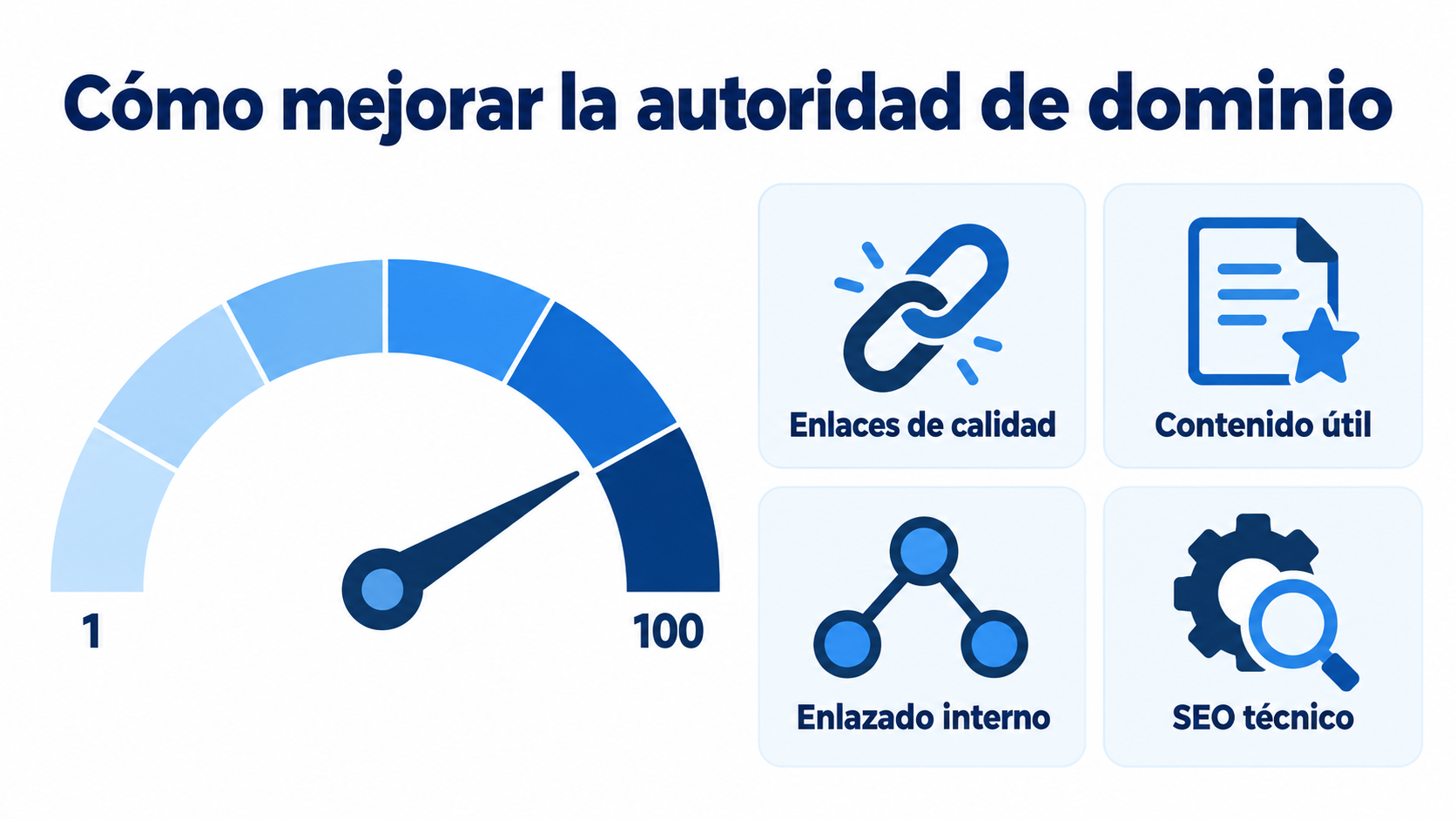
DA rises as a result of doing the underlying work well. These are the actions that make the biggest difference:
- Get quality links: a good linkbuilding strategy prioritizes sites relevant to your industry over quantity.
- Publish content worth linking to: original research, comprehensive guides, or free tools attract links naturally.
- Take care of your internal linking: distribute link juice to your most important pages.
- Fix technical errors: broken links, 404 pages, or a slow website that isn’t mobile-friendly all hurt your SEO.
- Review your link profile: identify toxic or artificial links that could hurt you.
Email marketing doesn’t improve DA directly, but it does help. Every time you send a newsletter featuring your latest content, you bring qualified visits to your website. And you increase the chances that someone will share it or link to it from their own site.
And watch out for a common mix-up: domain authority has nothing to do with domain reputation in email marketing. The former is an SEO metric; the latter is the assessment Gmail or Outlook makes of your sending domain, and it determines your deliverability.
How we can help at Mailrelay
At Mailrelay, we make it easy to share your content with your subscribers. You can send your latest articles with polished templates and segment based on each contact’s interests. You can also measure which content generates the most clicks to your website.
We also take care of the deliverability of your sends so your emails reach the inbox instead of spam. All of this with a free plan of up to 80,000 emails a month and 20,000 contacts. If you want to try it, you can create your Mailrelay account today.
Does domain authority affect Google rankings? Not directly. It’s a Moz metric that tries to predict rankings, but Google doesn’t use it.
How often is it updated? Moz recalculates it periodically, every time it updates its link index. That’s why it’s normal to see small variations without any changes on your website.
How can I check a website’s DA? With tools like Moz Link Explorer or its browser extension. Other platforms, like Ahrefs or Semrush, offer equivalent metrics.
In conclusion
Domain authority is a useful compass for comparing your website with the competition and for knowing whether your link strategy is on the right track. But it isn’t the destination.
If you do good work on content, links, and user experience, DA will rise as a result. And with it, almost always, your organic traffic.
Related entries
- Backlink
- Anchor Text
- SEO Search Engine Optimization
- Cloaking
- Rich Media
- Link Juice
- Conversion Rate
- Robots.txt
- SERP Search Engine Results Page
Discover how Mailrelay can help you with your email marketing strategy.