Content marketing: what it is and how to build a strategy that attracts customers
How to attract customers by answering their questions instead of interrupting them with ads
Content marketing is a strategy that consists of creating and distributing useful content to attract a specific audience and turn those people into customers. Instead of advertising a product, the company answers the questions of the people who might buy it.
An article explaining how to choose running shoes, a tax guide for freelancers or a video with seasonal recipes are all examples. The sale comes later, once the reader already trusts the brand.
What does content marketing mean?
In Spanish it is called marketing de contenidos. It is part of inbound marketing: instead of chasing customers with ads, the company attracts them with information they look for on their own.
The difference from advertising lies in the goal of each piece:
| Advertising | Content marketing | |
|---|---|---|
| Goal | Sell now | Help, inform or entertain |
| Message | Talks about the product | Talks about the customer’s problems |
| Duration | As long as you pay for the ad | The content keeps attracting visits for months or years |
| Relationship | Interrupts | The audience comes on its own |
| Result | Short-term sales | Trust, visits and contacts that grow over time |
What is content marketing for?
Attracting visits from Google. Every article that answers a search is a gateway to your website.
Building trust. People who learn from you have more reasons to buy from you.
Getting contacts. A downloadable guide or a newsletter turns visitors into subscribers. It is the foundation of lead generation.
Supporting the buying decision. There is content for people who are just starting to research and for those already comparing options.
Building loyalty. Continuing to add value after the sale brings the customer back.
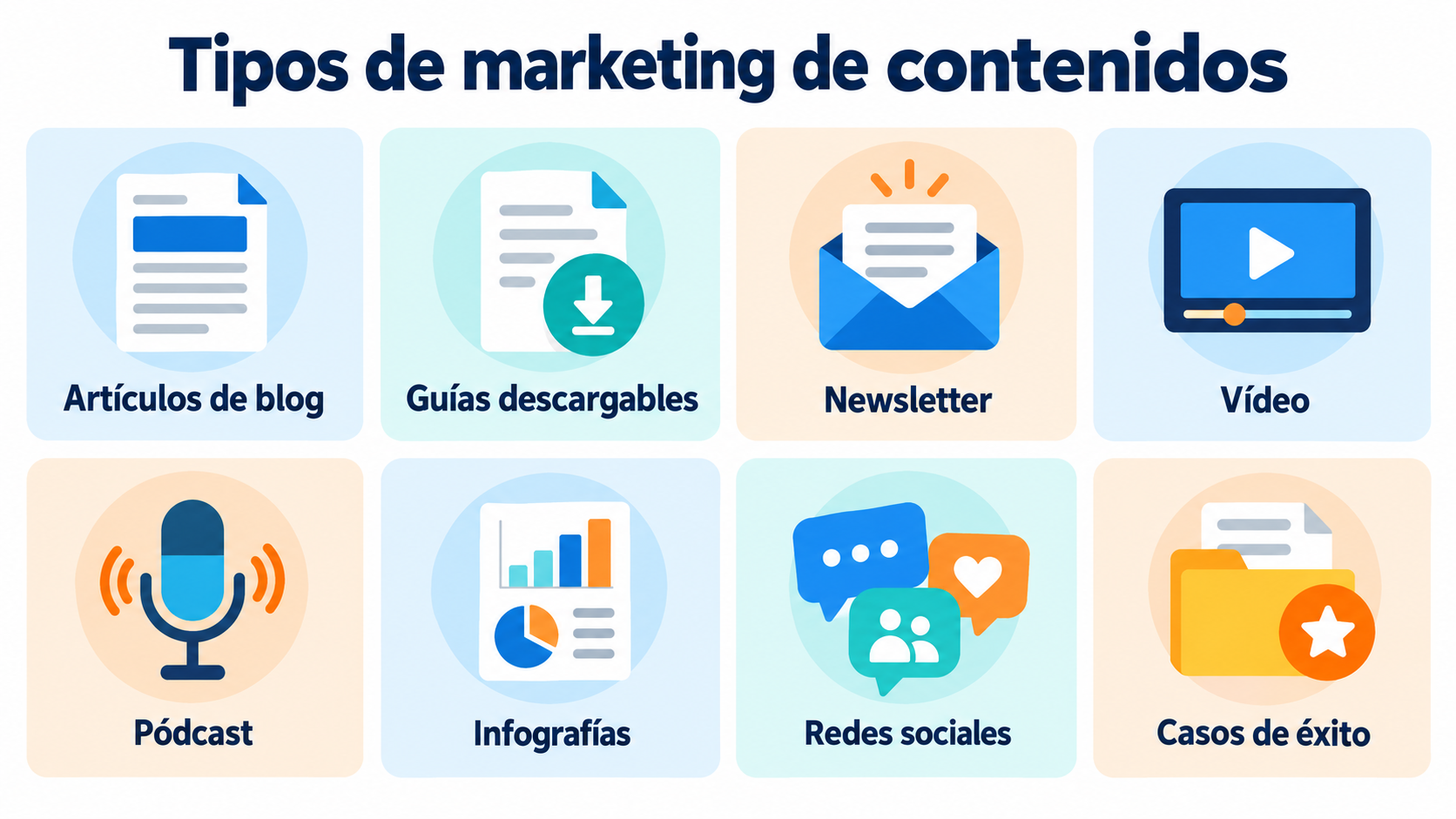
Types of content marketing
Blog articles. Guides, tutorials, lists and comparisons. They are the foundation of almost any content marketing plan.
Downloadable content. An ebook, a template or a report offered as a lead magnet in exchange for an email address.
Newsletter. A regular email with your best content, which lets you talk to your readers again without depending on Google or social media.
Video. Tutorials, demos and webinars. Video marketing works well for explaining how to use something.
Podcast. For an audience that listens while driving, working out or working.
Infographics. Data or processes summarized in an easy-to-share image.
Social media. Short posts that spread the content and start conversations.
Success stories. Real customer stories that show concrete results.
Content marketing examples
A garden center publishes a month-by-month planting calendar and emails it to its subscribers every month.
An accounting firm writes articles about each tax procedure of the year and offers a downloadable guide for freelancers.
A language school shares a weekly video with useful expressions on social media.
A software company publishes comparisons and success stories for people who are choosing a tool.
You can see more cases in our article on content marketing examples.
Turn readers into subscribers
Create forms for your blog in Mailrelay and send your new articles in a newsletter.
How to create a content marketing strategy in 7 steps
1. Define your goal. More visits, more subscribers or more sales. Each goal calls for a different type of piece.
2. Get to know your audience. Describe your buyer persona: what problems they have, what they are looking for and where they get their information.
3. Choose your topics. The questions your customers ask you are the best source of ideas. Keyword tools tell you how many people search for them.
4. Prepare an editorial calendar. What you are going to publish, in what format and on what date. Consistency matters more than quantity.
5. Create quality content. Useful, clear and better than what already exists. Copywriting and storytelling help keep people reading to the end.
6. Distribute it. Publishing it is not enough: share it in your newsletter, on social media and in related articles on your website.
7. Measure and improve. Visits, reading time, subscribers gained and sales. Update what works and remove what doesn’t add value.
Content marketing and email marketing
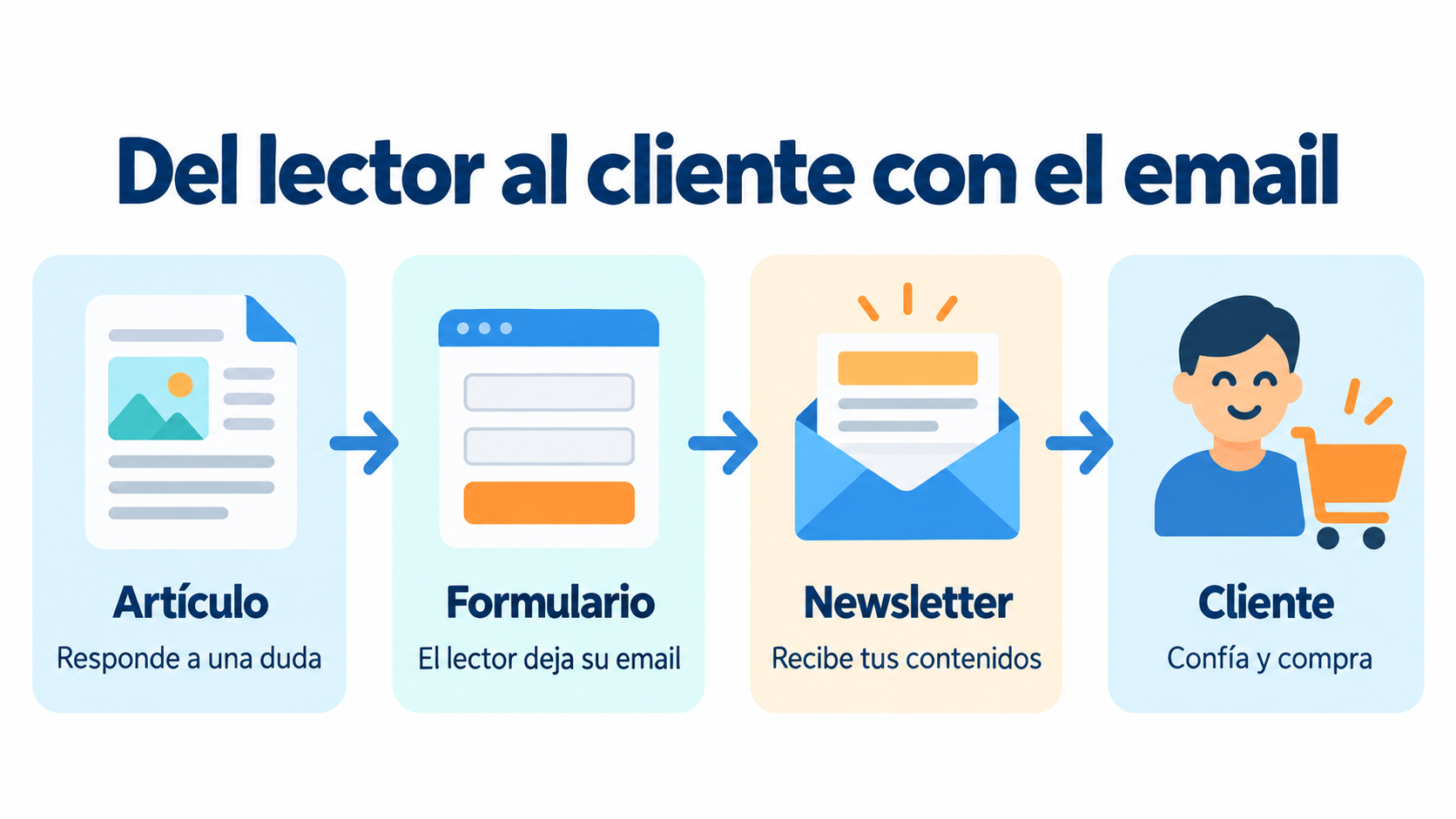
Without email, content marketing depends on readers coming back on their own. Email turns an occasional reader into a contact you can talk to again:
Capture. A form at the end of each article or a downloadable guide in exchange for an email address.
Distribute. A newsletter with your new articles brings visits to your website every time you send it.
Nurture. An automated email sequence for people who download a guide. This is lead nurturing.
Segment. If a subscriber reads about a topic, send them more content on that topic.
Repurpose. A good article can become an email, and an email that works can become an article.
Common mistakes
Talking only about your product. If every piece is an ad, nobody will read it.
Publishing without a plan. Writing about whatever comes to mind each week rarely attracts the audience you are looking for.
Prioritizing quantity. Ten weak articles add less than one that truly answers a question. Google penalizes thin content.
Not capturing contacts. Without a form or a newsletter, visitors come and go.
Not updating. An article with five-year-old data loses visits and credibility.
Expecting immediate results. Content marketing is a medium-term investment: the first results usually arrive within a few months.
How Mailrelay helps you
With Mailrelay you can create forms to capture subscribers on your blog, send a newsletter with your new articles and automate the delivery of your downloadable guides. Open and click statistics show you which topics interest your audience most.
The free account includes up to 80,000 emails a month and 20,000 contacts, with human support by chat, ticket and phone.
Send your newsletter with Mailrelay
Up to 80,000 emails a month and 20,000 contacts for free, with human support on every plan.
Frequently Asked Questions
These are the most common questions about this strategy.
What is content marketing in a nutshell?
Creating useful content to attract potential customers instead of advertising to them.
How is it different from inbound marketing?
Inbound marketing is the complete methodology for attracting, converting and retaining customers. Content is the piece that makes it work.
How long does it take to get results?
It depends on the industry and on consistency, but the first results usually appear between three and six months after getting started.
Is it useful for a small business?
Yes. It doesn’t require a big budget: a blog with useful articles and a monthly newsletter are a good starting point.
What does it have to do with email?
Email is the channel that turns readers into subscribers and, over time, into customers.