Newsletter editor: how to create professional emails with Mailrelay’s New editor
Templates, drag and drop, AI and your own HTML: everything you can do without writing a single line of code

Templates, drag and drop, AI and your own HTML: everything you can do without writing a single line of code
Have you ever spent a whole afternoon wrestling with a template that looked perfect on your computer but came out all jumbled on your phone?
It’s one of the most common problems in email marketing. And the culprit is often the tool.
A good newsletter editor saves you that pain.
It gives you quality templates, lets you build the email by dragging blocks and makes sure the HTML looks right in any inbox.
In this article we explain what a newsletter editor should have, how Mailrelay’s New editor works in 8 features and when it makes sense to use your own HTML, for example one made with tools like Stripo, Beefree or MJML.
A newsletter editor is the tool you use to design your emails without writing code. You pick a template, change the text and images, add buttons and the editor generates the HTML for you.
It sounds simple, but email has its own rules. Each email client (Gmail, Outlook, Apple Mail) renders HTML in its own way, and what works on a website doesn’t always work in an inbox.
That’s why not just any editor will do.
These are the features you should expect:
| Feature | Why it matters |
|---|---|
| Quality templates | You start from a proven design instead of a blank page |
| Drag and drop | You build the email without knowing HTML |
| Responsive design | The email adapts to mobile on its own, where many of them are read |
| Reusable blocks | You keep the same header, footer or signature in all your sends |
| Personalization | Each contact sees their name or the content they care about |
| Plain text version | Some email clients and readers use it, and it helps deliverability |
| HTML editor | You can use your own code when you need to |
Below we explain how Mailrelay’s newsletter editor handles each point.
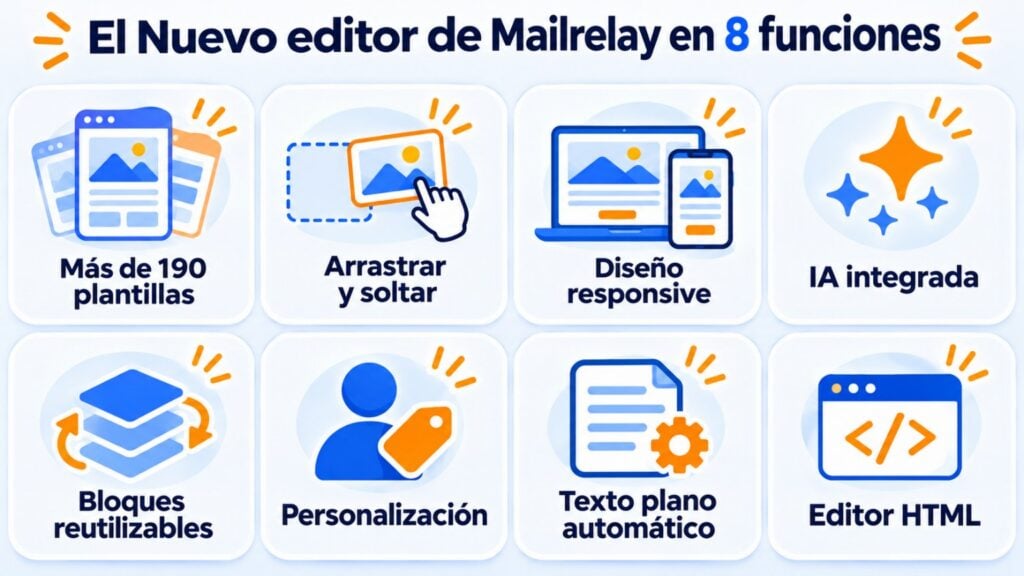
Mailrelay’s New editor is the drag-and-drop newsletter editor you use to create your campaigns. Let’s look at what you can do with it, feature by feature.
You don’t have to start from scratch. The newsletter editor includes a gallery of email templates with over 190 designs, organized into 10 categories.
| Category | What it’s for |
|---|---|
| Offers | Promotions, discounts and flash sales |
| Catalog | Showcase products or collections |
| Newsletters | Regular bulletins with several news items |
| Welcome | The first email to a new subscriber |
| Events | Invitations, webinars and reminders |
| Ecommerce | Orders, carts and online store emails |
| Basic | Simple layouts you can adapt to anything |
| Announcement | Launches and news |
| Seasonal | Christmas, sales and other dates of the year |
| Text templates | Emails with almost no design and a personal tone |
You can preview each full template before choosing it. And if you’re planning the year, our 2027 marketing calendar tells you which template fits each date.
You build the email like a puzzle. You drag text, image, button, column or social media blocks and place them wherever you want.
Then you change the content, colors and spacing from the side panel.
You can choose from 11 email-tested fonts and insert animated GIFs.
If you want to know why there’s no Comic Sans and which font to use in each case, we explain it in our article on Comic Sans.
This block system is what designers call modular email design: pieces you combine to create different emails without losing consistency.
Templates created with the drag-and-drop newsletter editor adapt to mobile on their own. You don’t have to prepare a separate version or adjust columns by hand.
You also get a preview to check how it looks before sending it. That said, it’s always a good idea to send a test to your own accounts: it’s the best way to see the email exactly as your list will receive it.
If you want to learn more, we explain it in the glossary entry on responsive email.
Mailrelay’s newsletter editor includes AI. You can ask it to generate a template from a description, improve or shorten a text and create images for your email.
AI helps you get started faster, but the final review is yours: always check that the design and tone fit your brand.
You’ll find ideas and prompts to copy in our guide to AI in email marketing.
Save it once and use it forever. You can save blocks (a header with your logo, a footer with your contact details or a social media section) and reuse them in other templates.
With this newsletter editor feature you keep the same look in all your emails and save time on every campaign.
It’s especially useful if several people prepare the sends and you want them all to go out in the same style as your brand image.
Each contact can see a different email. With dynamic variables you insert the subscriber’s name or any custom field, and with conditional blocks you show or hide parts of the email based on their data.
For example, you can greet them with “Hi, Ana!” and show a padel offer only to those who play padel. All from the same email and with the same template.
The newsletter editor automatically generates the plain text version of your email. It’s the version without design that some email clients and screen readers use, and it’s part of a well-built email.
You don’t have to write it separately: Mailrelay creates it for you from the content. If you’re interested in the difference between the two formats, we cover it in HTML or plain text.
If you already have your template in HTML, you can use it too. In addition to the drag-and-drop editor, Mailrelay has an HTML editor where you can paste your own code.
They are two separate editors: the drag-and-drop one to design without code, and the HTML one for those who bring their template ready-made.
It’s the option for agencies, designers or teams that already work with their own HTML.
Try Mailrelay’s New editor
Over 190 templates, drag and drop and AI, on the free account too.
It’s a common question: do I need a separate template editor or is the one in my sending tool enough? Tools like Stripo or Beefree are standalone visual editors that export HTML, and MJML is an open-source language for writing responsive emails that is then converted into HTML.
For most businesses, the newsletter editor in their sending platform is enough: it has the templates, responsive design and sending all in one place.
An external editor makes sense in specific cases.
| Your situation | What suits you |
|---|---|
| You’re just starting out and want to send your first newsletter | Mailrelay’s New editor and a template from the gallery |
| You send campaigns every week and want to work fast | The New editor with saved reusable blocks |
| You have a designer who delivers the finished HTML | Mailrelay’s HTML editor: paste the code and send |
| Your team already works with Stripo, Beefree or MJML | Export the HTML from that tool and paste it into Mailrelay’s HTML editor |
| You want to personalize with the name or show blocks based on the contact | The New editor, with dynamic variables and conditional blocks |
As you can see, it all depends on where you want to work.
What matters is that the end result is HTML that looks good and that your sending tool takes care of deliverability.
Here’s the shortest path from a new account to your first sent campaign. You can do it with the free account:
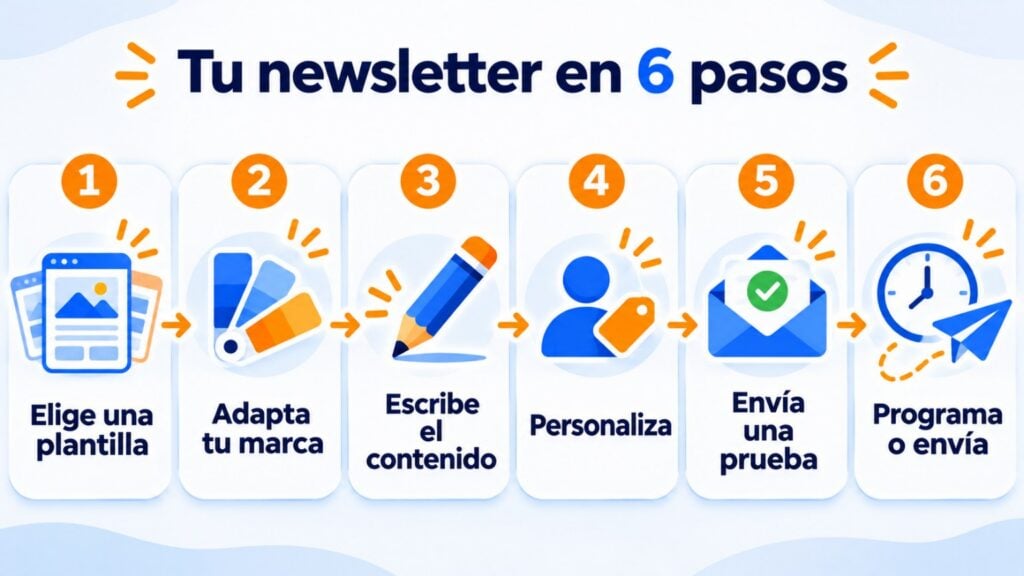
If you’d rather see it with screenshots, check out the step-by-step tutorial for creating your newsletter in Mailrelay.
Imagine you have a home decor store. In ten minutes you choose a Catalog template, add your fall products, greet each customer by name and send the test to your phone.
The next campaign will be even faster, because the header and footer will already be saved.
The newsletter editor handles the technical side, but some decisions are yours. These tips will help you get the most out of any newsletter editor:
| Tip | Why |
|---|---|
| Don’t put important text inside images | If the image doesn’t load, the message is lost |
| Always add alt text | It describes the image to those who can’t see it |
| Use safe fonts for the body | They look the same on almost every device |
| Check dark mode | Some email clients invert the colors |
| Send a test before every campaign | It’s the only way to see it as your list will |
If you want to go further, our guide to accessible email explains how to make emails that everyone can read.
With Mailrelay you have the newsletter editor, the templates and the sending in the same account.
You design with the New drag-and-drop editor or paste your own HTML, personalize with variables, send tests and measure the clicks of each campaign.
You can test two subject lines or two senders with an A/B test and automate your welcome or follow-up emails.
And if you have questions, human support helps you on every plan.
The free account includes up to 80,000 emails a month and 20,000 contacts. You can see the details on our pricing page.
Design your next newsletter in minutes
Choose a template, personalize it and send it to your list. Up to 80,000 emails a month for free, with human support on every plan.
A good newsletter editor goes unnoticed: it lets you focus on the message. It gives you proven templates, takes care of responsive design and lets you reuse what already works.
With Mailrelay’s New editor you can start from one of over 190 templates, get help from AI and personalize every email.
And if you already have your own HTML, just paste it into the HTML editor and you’re done.
If you’re looking for content ideas, take a look at our email marketing examples or at how to write a good email subject line.
These are the most common questions about the Mailrelay editor.
It’s the tool you use to design your emails without writing code: you pick a template, change the text and images and the editor generates the HTML.
The best ones include responsive design, reusable blocks and personalization.
Yes. Templates created with the New drag-and-drop editor are responsive and adapt to mobile on their own.
You can check this in the preview and with a test send.
Yes. Mailrelay has an HTML editor, separate from the drag-and-drop editor, where you can paste your own code, for example a template exported from another tool.
Yes. You can save blocks, such as a header, a footer or a social media section, and reuse them in other templates.
Yes. The New editor, the templates and the editor’s AI are available on the free account, which lets you send up to 80,000 emails a month to 20,000 contacts.

Jose Argudo
CMO at Mailrelay. Writes about email marketing, copywriting and conversion for SMEs and entrepreneurs.