Loyalty card: what it is, types and how to create one for your business
Everything you need to create your customer card, on paper, in an app or on the phone
A loyalty card is a card, physical or digital, that records a customer’s purchases and rewards them for coming back: a free product, a discount or points they can redeem. It is the best-known tool in customer loyalty programs.
You’ll find them in coffee shops, hair salons, supermarkets, gas stations and online stores. They work in any business where customers buy more than once.
What is a loyalty card?
It is a way to identify the customer and keep track of what they buy. Every time they pay, they show their card and collect a stamp or some points. Once they reach a certain number, they get a reward.
A loyalty card is not a payment method. Nor is it the same as a membership card. A membership card gives access to a club or a service, usually for a fee. A loyalty card rewards repeat purchases.
For the business, it has two advantages:
- It brings the customer back, because every purchase brings them closer to the reward.
- It provides data: what each customer buys, how often and how much they spend. With it, you can personalize your offers.
Types of loyalty cards
These are the most common models:
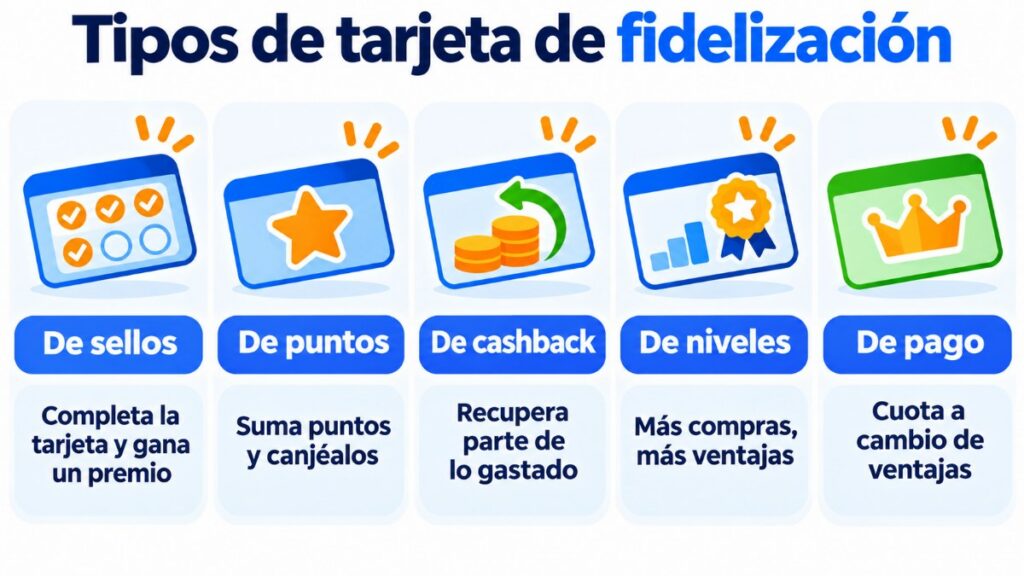
| Type | How it works | Which businesses it suits |
|---|---|---|
| Stamp card | Each purchase earns a stamp. Complete the card and there’s a reward | Coffee shops, bakeries, hair salons |
| Points card | Every euro spent earns points that can be redeemed for discounts or gifts | Supermarkets, stores, ecommerce |
| Cashback card | A variant of points: it returns a percentage of what was spent as credit | Stores with frequent purchases |
| Tiered card | The more you buy, the higher your tier and the better the perks | Fashion, travel, beauty |
| Paid card | The customer pays a fee and gets perks from day one | Ecommerce, services, leisure |
The stamp card is the simplest: “Buy 9 coffees and get the tenth free.” The tiered card is the most ambitious, because it turns loyalty into a kind of game, an idea close to gamification.
Physical card, in an app or on the phone
The card can come in several formats:
- Physical: made of cardboard or plastic. It is cheap and easy to understand, but it gets lost and gives you no customer data unless you register it.
- In an app: the customer carries it in your brand’s app. It gives you plenty of data, but requires them to download the app.
- In the phone’s wallet: an Apple Wallet or Google Wallet pass. It needs no app, updates remotely and can show alerts on the lock screen, for example when points are about to expire.
Many businesses combine formats: the digital card for those who want it and the physical one for those who prefer paper.
How to create a loyalty card step by step
- Define the mechanics and run the numbers. Choose the type of card and work out how much each reward costs you. It should be attractive for the customer and profitable for you.
- Choose the tool. Anything from a cardboard card with a stamp to a loyalty platform connected to your till or your online store.
- Design the card and the rules. Use your brand identity and explain clearly how rewards are earned and redeemed, and whether they expire.
- Connect the data. Link the card to your sales system and your CRM to know what each customer buys.
- Comply with data protection. Ask only for the data you need and for clear consent, with no pre-ticked boxes, to send commercial communications. If in doubt, consult a GDPR specialist.
- Test before launching it. Start in one store or with a group of customers and adjust whatever doesn’t work.
Bring your customers back
Let them know their balance, rewards and when their points expire with automated emails.
How to promote your loyalty card by email
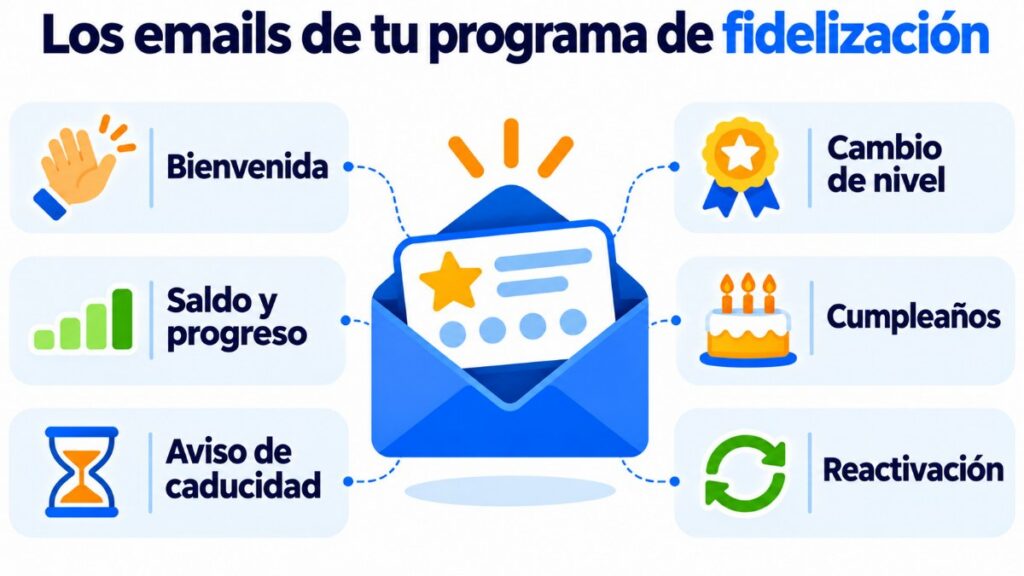
A card the customer forgets in their wallet builds no loyalty. Email keeps the program alive with little effort. These are the key messages:
- Welcome: when they sign up, explain how the card works and what they’ll get. It is the ideal moment for the welcome email.
- Balance and progress: “You’re 3 stamps away from your free drink.” Reminding them how close the reward is encourages them to come back.
- Expiry: let them know before their points or reward expire.
- Tier upgrade: congratulate them when they move up a tier and tell them about their new perks.
- Special dates: a gift in their birthday email strengthens the relationship.
- Reactivation: if they haven’t bought in a while, remind them of the points they haven’t used.
You’ll find more ideas in these loyalty messages and in our stamp card template, ready to adapt.
How to manage your card’s emails with Mailrelay
With Mailrelay, you can sign up members for your program with forms, pop-ups or a landing page. Double opt-in, always on, confirms that every address is real and that the customer wants to receive your emails.
Store data such as tier or points balance in custom fields and create segments to send each group its own message. With automations, the welcome or birthday email goes out on its own.
With the free account, you can send up to 80,000 emails a month to 20,000 contacts, with human support on every plan.
Bring your loyalty program to life
Automated welcome, birthday and reminder emails. Free up to 80,000 emails a month.
Frequently asked questions about loyalty cards
These are the most common questions.
What is a loyalty card?
It is a card, physical or digital, that records a customer’s purchases and rewards them for coming back with discounts, gifts or points.
What is the difference between a loyalty card and a membership card?
A loyalty card rewards repeat purchases. A membership card gives access to a club or a service, often in exchange for a fee.
How much does it cost to create a loyalty card?
It depends on the format. A cardboard stamp card costs very little. A digital card or an app requires a platform, usually with a monthly fee.
Which loyalty card suits a small business?
A stamp card is usually the best way to start: it is easy to understand and manage. If you want data on your customers, switch to a digital format.
Can I use the card’s data to send emails?
Yes, if the customer has given explicit consent to receive commercial communications. Ask for it separately, with an unticked box.