RFP and RFQ: what they are, how they differ and when to use each one
How to request proposals and quotes from suppliers so you can compare them and choose better
RFP and RFQ are two documents a company sends to several suppliers in order to choose one. With an RFP (Request for Proposal), it asks for a complete proposal. With an RFQ (Request for Quotation), it only asks for a price for something it has already defined.
Both bring order to purchasing and make suppliers compete under the same rules.
What is an RFQ and what does it mean?
RFQ stands for Request for Quotation, also known as a request for quote or a price quote request. It’s used when you know exactly what you want to buy and only need to compare prices and terms.
For example: “I need 5,000 full-color, 24-page catalogs on 135 gsm paper, delivered by November 15.” Each supplier replies with its price, lead time and payment terms. The best financial offer almost always wins.
In Spanish, the plural is written “RFQ” or “los RFQ”, with no added s, although in the industry you’ll often see “RFQs”.
What is an RFP and what does it mean?
RFP stands for Request for Proposal. It’s used when you have a problem or a goal but don’t know what the best solution is.
Instead of asking for a price, you describe your situation and ask each supplier to explain how they would do it, with what team, on what timeline and at what cost. Choosing an agency, a piece of software or an email platform usually starts with an RFP.
In consulting and technology, it’s the standard document for contracting large projects.
What’s the difference between an RFI, an RFP and an RFQ?
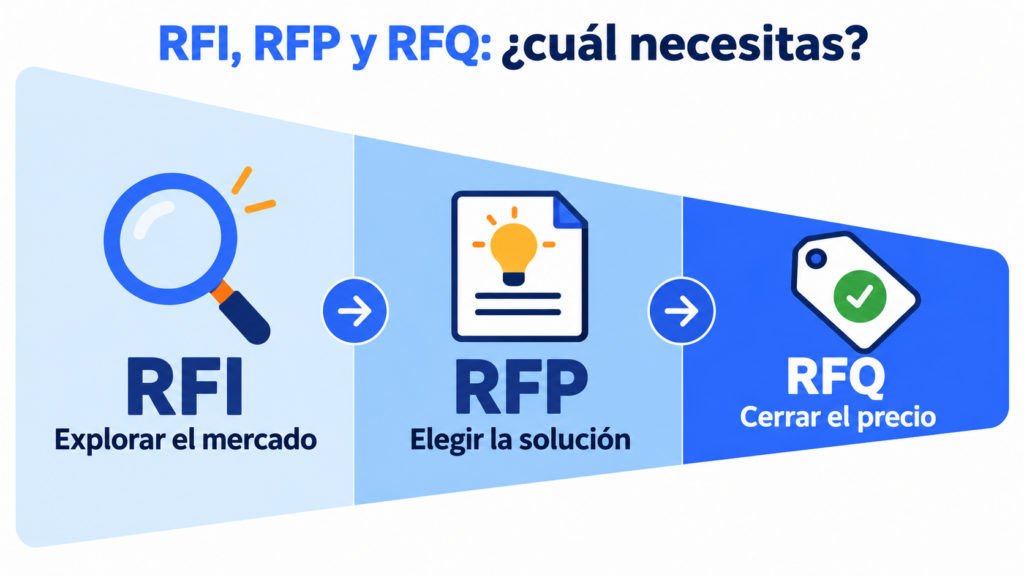
There’s a third document alongside these two: the RFI (Request for Information), which is used to get to know the market before asking for anything. Here’s the difference between the three:
| RFI | RFP | RFQ | |
|---|---|---|---|
| Meaning | Request for information | Request for proposal | Request for quotation |
| When it’s used | At the start, to explore options | When the problem is clear, but the solution isn’t | When you know exactly what you want |
| What you ask for | General information about the supplier and what it offers | A complete solution, with approach, timeline and price | A price and terms |
| How the decision is made | No decision, just a shortlist | On quality, experience and price | Mainly on price |
| Example | “Which email platforms offer an API?” | “Propose how to automate our campaigns” | “Price for sending 200,000 emails a month” |
Many companies use them in order: an RFI to build the shortlist, an RFP to choose the solution and, sometimes, an RFQ to close the final price.
What does an RFP include?
A good RFP gives suppliers what they need to respond well and be compared on equal terms. It usually has these parts:
- An introduction to your company and the project.
- The goals and problem you want to solve.
- Requirements: mandatory features, integrations, volume and regulations.
- An approximate budget, if you can share it.
- Evaluation criteria and their weight, for example, 40% solution, 30% price and 30% experience.
- Timeline: response deadline, Q&A round and decision date.
- Response format and contact person.
An RFQ is shorter. All it needs is the exact description of the product or service, the quantities, the delivery date, the payment terms and the response deadline.
Comparing email platforms?
Try Mailrelay for free before you decide and see how it works with your own data.
How to request a quote by email: RFQ template
Many RFQs are sent by email. You can use this template as a starting point:
Subject: Request for quote: [product or service] – reply by [date]
Hi [name],
At [company], we need [product or service] with these specifications: [quantity, specifications and delivery date].
Could you send us your quote by [date]? Please include the unit price, delivery time, payment terms and how long the offer is valid.
If you need more information, feel free to email me or call me at [phone].
Thank you,
[Name, job title and company]
Use a clear subject line, send it from your corporate email and schedule a follow-up email if they don’t reply in time. If you’re the one responding to an RFP, this guide to writing a business proposal by email will help.
Using an RFP to choose an email marketing platform
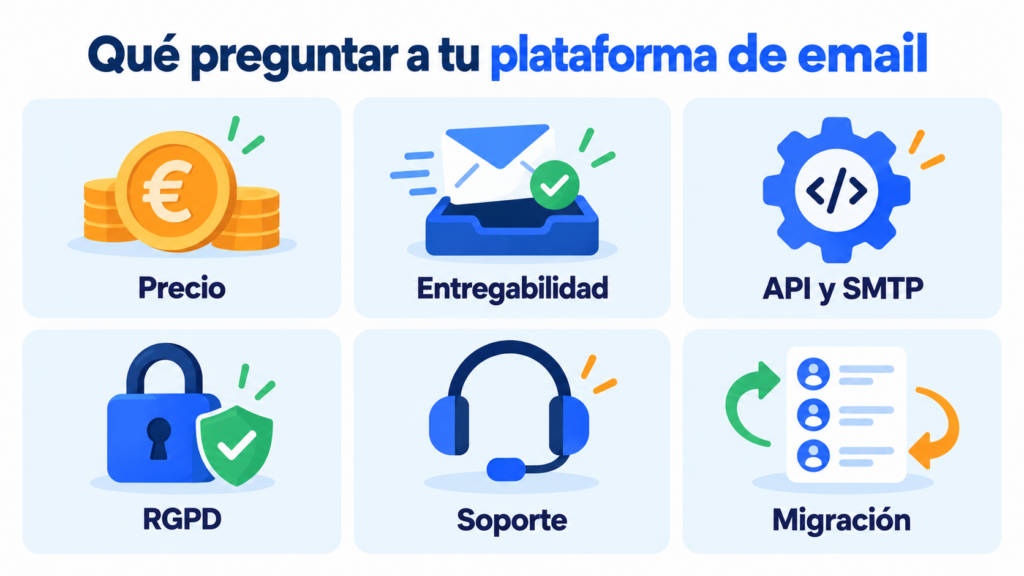
If you’re switching email providers, an RFP keeps you from deciding based only on the headline price. These are the questions worth including:
| Aspect | What to ask the provider |
|---|---|
| Volume and price | How much does it cost to send my monthly emails to my contacts? What happens if I grow? |
| Deliverability | What is your inbox placement rate? Do you offer a dedicated IP? |
| Integrations | Do you have an API and SMTP to connect my CRM or my store? |
| Data protection | Where is the data stored? Do you comply with the GDPR? |
| Support | Through which channels, in which language and during what hours? |
| Migration | Will you help me import my lists and templates? |
Also ask for a demo or a trial account. Seeing the tool in action with your own data is worth more than any written answer.
How Mailrelay helps you
If you’re preparing an RFP to choose an email platform, Mailrelay makes it easy: you can try it for free before you decide, with no commitment.
The free account includes up to 80,000 emails a month and 20,000 contacts. You get SMTP and API, a dedicated IP with annual billing, and human support via chat, ticket and phone on every plan.
Send your campaigns with Mailrelay
Up to 80,000 emails a month and 20,000 contacts for free, with human support on every plan.
Frequently Asked Questions
These are the most common questions about RFPs and RFQs.
What is an RFQ in purchasing?
It’s a request for quotation: the company asks several suppliers for a price for a product or service it has already defined.
What is an RFP in consulting?
It’s the request a company sends to several consulting firms asking them to propose how they would handle a project, including their approach, team, timeline and price.
Which comes first, the RFP or the RFQ?
It depends on the purchase. If the solution isn’t clear, the RFP comes first. If you already know what you want, an RFQ is enough.
How do you say RFQ in Spanish?
Solicitud de cotización or solicitud de presupuesto. RFP translates as solicitud de propuesta.
Are an RFP and an RFQ the same as a tender?
They’re similar. A tender is the usual term in the public sector, with rules set by law. RFPs and RFQs are more common in private companies.