Wordplay: types, examples and 30 catchy email subject lines
What it is, the types with examples and 30 subject lines to copy for your newsletters

What it is, the types with examples and 30 subject lines to copy for your newsletters
Why do you open one email and not another? Often it’s because of a subject line that makes you smile or leaves you curious. That’s where good wordplay makes the difference.
Wordplay means phrases that use the sound, the double meaning or the order of words to surprise or amuse. In this article you’ll find the best-known types with examples, 30 email subject lines to copy and a guide to when wordplay works and when it confuses.
A play on words is a figure of speech that uses a word or phrase in a clever way. It can play on two meanings at once, on words that sound alike or on the order of the words.
We use them every day without noticing. They’re in proverbs, jokes, riddles and many slogans. And in literature too: the writers of the Spanish Golden Age, such as Quevedo, were true masters.
In marketing they have a clear advantage: people remember them. A phrase that makes you think for a second sticks in your head longer than a flat one. That’s why they show up so often in copywriting, slogans and email subject lines.
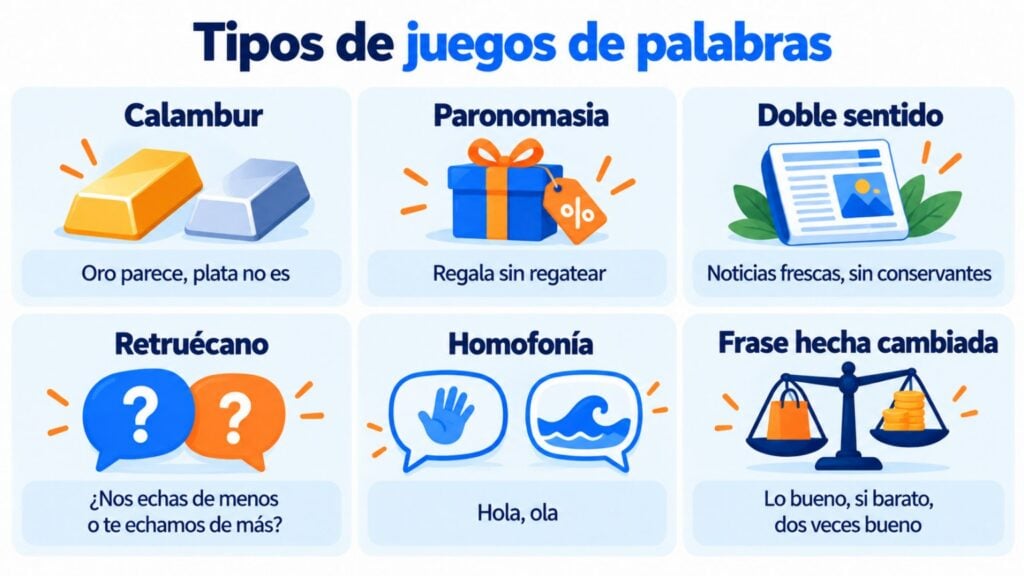
These are the most common types. The table includes a classic example of each one and another applied to an email subject line:
| Type | What it is | Classic example | Subject line example |
|---|---|---|---|
| Oronym | The syllables are grouped differently and the meaning changes | “Su majestad escoja” (“es coja”, Quevedo) | “I scream, you scream: ice cream delivered to your door” |
| Paronomasia | Words that sound almost the same but mean different things | “Translator, traitor” | “Presents, not pressure: gifting made easy” |
| Double meaning | One word with two meanings at once | The “cardenales” (cardinals and bruises) in El Buscón | “Fresh news, no preservatives” |
| Chiasmus | A phrase is repeated with the word order reversed | “Eat to live, not live to eat” | “Are you missing us, or are we missing you?” |
| Homophone | Words that sound the same but are spelled differently | “Hi” and “high”, “sea” and “see” | “Sea the deals: summer offers are here” |
| Alliteration | The same sound is repeated across several words | “Peter Piper picked a peck of pickled peppers” | “Super savings season” |
| Twisted idiom | A proverb or set phrase is taken and turned on its head | “Good things come to those who wait” | “Good things come to those who click first” |
The oronym, known in Spanish as calambur, is perhaps the most famous kind of wordplay. It regroups the syllables of a phrase so that it says something else.
The best-known anecdote is attributed to Quevedo, who supposedly said to the queen, who walked with a limp, “entre el clavel blanco y la rosa roja, su majestad escoja” (“between the white carnation and the red rose, Your Majesty, choose”). Read in one breath, “su majestad escoja” sounds like “su majestad es coja”: “Your Majesty is lame”.
Riddles are full of oronyms. The Spanish riddle “oro parece, plata no es” (“it looks like gold, but it isn’t silver”) hides “plátano”, banana. In an email subject line, an oronym is hard to pull off, but when it works, people remember it.
Paronomasia puts together words that sound alike but mean different things. “Translator, traitor” is the textbook example, and so is the Spanish saying “del dicho al hecho hay mucho trecho” (it’s a long way from saying to doing).
It’s the easiest type to bring to email. Just pick a word from your message and find another that sounds similar: presents and pressure, deal and ideal, save and savor.
Double meaning uses a word that has two meanings and lets the reader catch both. Quevedo does it in El Buscón when he tells how a convict, after being flogged, was accompanied by “two hundred cardenales”, yet none of them was called Your Eminence: “cardenales” means both cardinals and bruises.
In marketing it’s very useful because the subject line says something literal and, at the same time, gives the reader a wink. “Deals that won’t melt” talks about summer and about prices that hold.
Chiasmus repeats a phrase with the order of the words reversed. The meaning changes and the phrase gains strength: “eat to live, not live to eat”.
It works very well in re-engagement emails or in messages with a reflective touch. Keep in mind that it makes the subject line longer, so use it with short phrases.
Put your best wordplay to the test
Compare two subject lines with an A/B test and keep the one that gets the most opens.
Many old jokes are, deep down, plays on words. They help you see how each device works and, along the way, raise a smile:
| Joke | Technique |
|---|---|
| —What do you call a deer with no eyes? —No idea (no-eye deer) | Oronym |
| What do you call a sleeping dinosaur? A dino-snore | Oronym |
| What did the grape say when it got stepped on? Nothing, it just let out a little wine | Paronomasia |
| What did one wall say to the other? Meet you at the corner | Oronym |
| —Why is your laptop so cold? —I left too many Windows open | Double meaning |
Notice that you get every one of them in a second. That’s the golden rule for email too: if the joke needs explaining, it won’t work as a subject line.
Here are 30 subject lines with wordplay, ready to adapt. They’re grouped by type of email so you can quickly find the one you need.
| Subject line | Technique |
|---|---|
| Today we’re cutting everything except quality | Double meaning |
| Ideal deals | Paronomasia |
| This isn’t a discount, it’s a mega-discount | Supersized word |
| Good things come to those who click first | Twisted idiom |
| Black Friday: dark day, golden deals | Color contrast |
| Super savings season | Alliteration |
| We’ve made it easy (and easy on your wallet) | Extended idiom |
If you’re planning your November campaign, you’ll find more ideas in our guide to the Black Friday email and SMS campaign.
| Subject line | Technique |
|---|---|
| You’re one of the family now (and this is your home) | Extended idiom |
| You’re right on time: it’s welcome time | Double meaning |
| New, brand new and full of news | Alliteration |
| Something to talk, tweet and text about | Idiom |
In a welcome email, a playful touch sets the tone for everything that follows.
| Subject line | Technique |
|---|---|
| Don’t depart, your cart misses you | Rhyme |
| Did you leave something on the table… or in your cart? | Twisted idiom |
| Your cart is waiting with open arms (and open wheels) | Extended idiom |
| Are you missing us, or are we missing you? | Chiasmus |
| We haven’t seen hide nor hair of you | Idiom |
| It’s not goodbye, it’s see you later (if you want) | Idiom |
| Subject line | Technique |
|---|---|
| Fresh news, no preservatives | Double meaning |
| This week: less waffle, more meat | Idiom |
| Ideas you’ll devour this month | Twisted idiom |
| We did the reading so you don’t have to | Play on the verb |
| Subject line | Technique |
|---|---|
| Presents, not pressure: gifting made easy | Paronomasia |
| You turn a year older, we turn up with a gift | Paronomasia |
| Love at first sight (and first click) | Extended idiom |
| Sea the deals: summer offers are here | Homophone |
| Deals that won’t melt | Double meaning |
| Back to school with a full load (for your backpack) | Double meaning |
| Subject line | Technique |
|---|---|
| Save the date, then save your seat | Paronomasia |
| Your two cents are worth more than that | Twisted idiom |
| Drop us a line (not a fishing line) | Double meaning |
Want more ideas with a sense of humor? Here are 15 examples of funny emails and a list of emojis for the subject line to go with them.
Write subject lines people remember
Design your newsletter and send up to 80,000 emails a month for free.
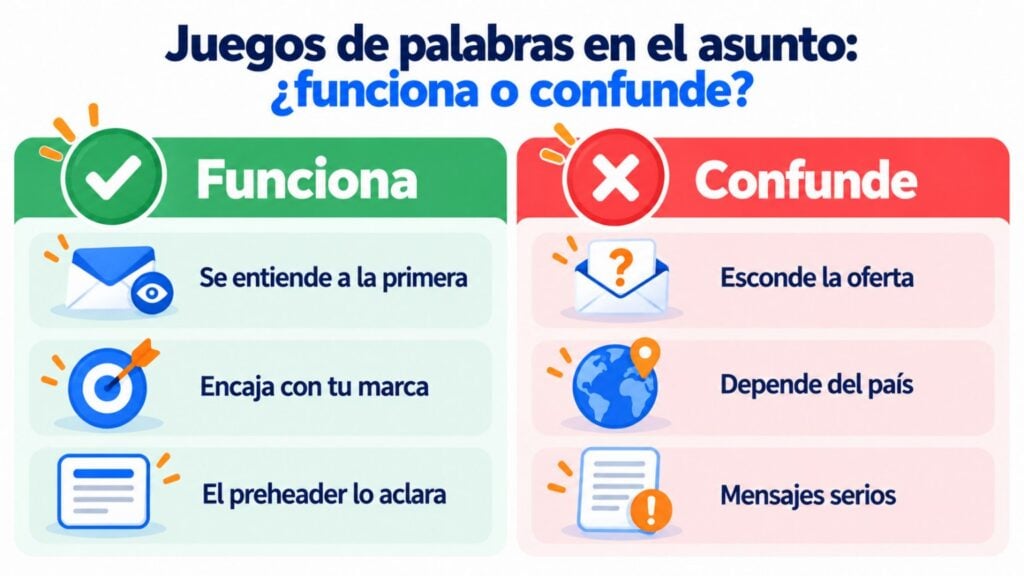
A play on words in the email subject line can lift your opens or sink them. It all depends on whether people get it the first time.
It works when people get it without thinking too hard. The reader has one second to decide. If they have to read the subject line three times, they’ll move on to the next email.
It works when it fits your brand. A gift shop can get away with more jokes than a law firm. The tone of the subject line has to match the rest of the email.
It confuses when it hides the offer. If the joke doesn’t make clear what the email is about, the reader can’t tell whether it’s relevant to them. The preheader is your ally: the subject line plays and the preheader explains.
It confuses when it depends on the country. Many idioms differ between the US, the UK and other English-speaking countries. “Waffle” or “taking the mickey” don’t land the same way everywhere. If your list is international, choose more universal wordplay.
It has no place in serious messages. In a payment notice, a service incident or a reply to a complaint, humor undermines trust.
Watch out for words that look like spam. Wordplay with “free”, “urgent” or lots of capital letters can trigger spam filters. Put the wit in the idea, not in the exclamation marks.
You don’t need to be Quevedo. These steps help you come up with one in a few minutes:
Cuando tengas dos o tres opciones, no elijas por intuición. Haz un test A/B con el asunto con juego de palabras y otro más directo. Con una parte de la lista sabrás cuál abre más y enviarás el ganador al resto. Ya lo dice una de las leyes de Murphy del email marketing: cuanto más tiempo pasas puliendo un asunto, menos se abre.
If your audience is young, you can also mix the wordplay with a bit of internet slang. But don’t overdo it: a subject line with too many in-jokes stops making sense.
With Mailrelay you can test your wordplay without risking the whole campaign:
A/B tests. Compare two subject lines with part of your list and send the one that performs best to the rest.
Editable preheader. Write the text that appears next to the subject line in the inbox to explain the joke or complete the offer.
Statistics. On the free account and on the Enterprise plan you see the opens and clicks of every send, so you know what kind of humor works with your list.
Segments. Send the boldest subject lines only to the audience that connects with that tone.
And with the free account you can send up to 80,000 emails a month to 20,000 contacts, with human support on every plan.
Your next newsletter, with a hook from the subject line
Free account with human support on every plan.
It’s a figure of speech that uses the sound, the double meaning or the order of words to surprise or amuse. There are many types, such as oronyms, paronomasia and chiasmus.
It’s a play on words that regroups the syllables of a phrase so that the meaning changes. For example, “I scream” and “ice cream”, or the Spanish riddle “oro parece, plata no es”, which hides the word “plátano” (banana).
In an oronym, the way the syllables are grouped changes. In paronomasia, two different words that sound alike are put together, such as “translator” and “traitor”.
It’s a figure of speech that repeats a phrase with the word order changed, so that the meaning changes. For example, “eat to live, not live to eat”.
Yes, if people get it the first time and it fits your brand’s tone. Pair it with a preheader that makes clear what the email is about, and try it with an A/B test before you send it to your whole list.

Jose Argudo
CMO at Mailrelay. Writes about email marketing, copywriting and conversion for small businesses and entrepreneurs.