Engagement
The metric that measures how involved your audience is
Having 10,000 followers or 20,000 subscribers sounds good. But if nobody comments, nobody clicks and nobody replies, that audience is worth much less than it seems. What makes the difference is how many people actually engage with what you publish. And that has a name: engagement.
What is engagement?
Engagement is the degree of interaction and commitment an audience has with a brand. In Spanish it is often translated as «compromiso» or «implicación», although marketers almost always use the English term.
It shows up in specific actions. A comment on Instagram, a click in a newsletter, a reply to an email or a shared article are all signs of interest. Each one shows that the person has spent some of their time on your content.
That is why it is considered an indicator of the quality of your relationship with your customers, beyond the size of your audience.
Why it matters so much
An engaged audience is an audience that listens. People who interact with your brand often trust your recommendations more. And they are more likely to end up buying.
It also affects visibility. Social networks show more of the content that generates interaction. Something similar happens with email. Gmail and Outlook take into account how your subscribers react. They use that information to decide whether your messages go to the primary inbox or to spam.
On top of that, it is a very valuable source of information. Knowing which content gets the most response helps you understand your buyer persona and decide what to publish next.
In the long run, all of this is reflected in customer loyalty and in the ROI of your campaigns.
How to measure engagement
There is no single metric. It depends on the channel you are analyzing:
- Social media: likes, comments, shares, saves and mentions of your brand.
- Website and blog: time on page, pages per session and bounce rate.
- Email: open rate, CTR, CTOR, replies and unsubscribes.
Not all interactions are worth the same. A comment or a share takes more effort than a simple like, so it usually signals greater interest.
It is a good idea to choose a few key metrics for each channel and track them consistently. That way you can turn them into KPIs and compare your progress month by month.
How to calculate the engagement rate
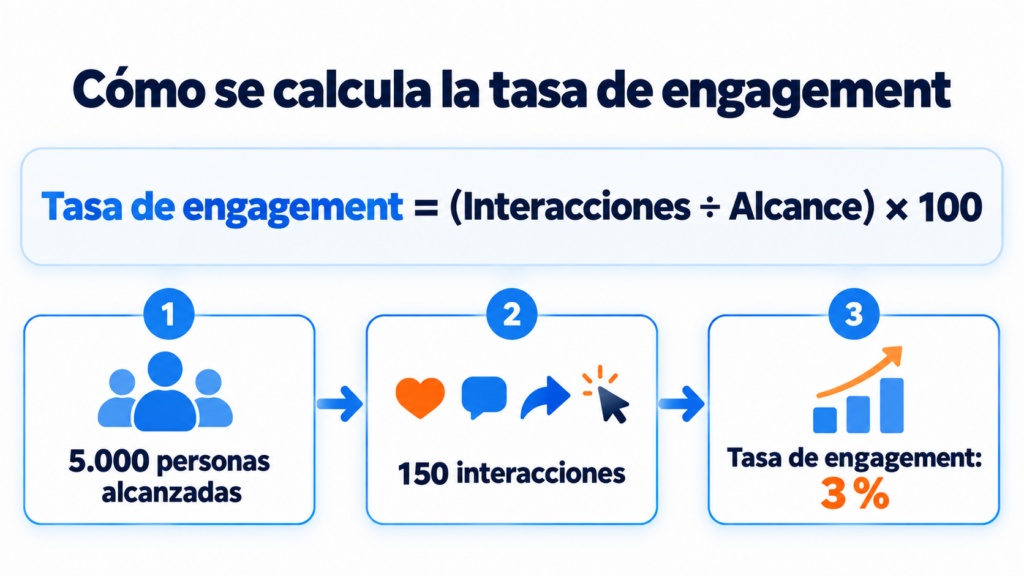
The engagement rate expresses interactions as a percentage, so you can compare different posts or periods. The most common formula is:
Engagement rate = (total interactions ÷ reach) × 100
Let’s look at an example. A post reaches 5,000 people and receives 150 interactions in likes, comments and shares. Its rate would be 3%.
Some tools use the number of followers instead of reach. Both options are valid, but don’t mix criteria: if you change formulas, comparisons stop making sense.
In email, the equivalent calculation is the CTOR. It is calculated by dividing unique clicks by unique opens. This tells you what percentage of the people who opened the message were interested in the content.
Engagement in email marketing
In email marketing, your subscribers’ engagement has a direct consequence: it affects your deliverability.
Email providers watch how people react. Whether they open your messages, move them to the primary inbox or delete them without reading. If many contacts ignore your emails for months, your messages can end up as graymail or go straight to spam.
There is another important nuance. Since 2021, Apple Mail’s privacy feature can record opens even if the user has not opened the message. That is why clicks and replies are now more reliable indicators than the open rate.
How to improve engagement
These are the actions that have the biggest impact, whatever the channel:
- Get to know your audience: analyze which content performs best and who interacts with it.
- Segment: segmentation lets you send each group what interests them, instead of one generic message for everyone.
- Personalize: using the contact’s name or recommending products based on their previous purchases increases response. We explain how in personalization in email marketing.
- Provide value before selling: a good content marketing strategy and storytelling spark more conversation than constant promotion.
- Invite interaction: ask questions, run polls or ask for feedback. Sometimes all it takes is asking.
- Test and compare: with an A/B test you can check which subject line, image or call to action works best.
- Clean your list: good list hygiene removes inactive contacts that only drag you down.
Beware of vanity metrics
A post with thousands of likes may not generate a single sale.
These are what are known as vanity metrics. Figures that look good in a report but are not related to your business goals. Follower count and impressions are the most typical examples.
Useful engagement is the kind that brings you closer to conversion. A click through to your store or a reply to your newsletter says much more about your audience. The same goes for a webinar sign-up.
How we help you at Mailrelay
At Mailrelay, we make it easy for you to measure and improve your subscribers’ engagement. Every campaign includes statistics on opens, clicks and unsubscribes, with reports that show which links generate the most interest.
You can segment your list based on that behavior. For example, by sending a re-engagement campaign to people who haven’t opened your emails in months. You can also automate welcome or birthday messages that keep the relationship alive.
All of this on a free plan of up to 80,000 emails a month and 20,000 contacts. If you want to try it, you can create your Mailrelay account today.
Frequently asked questions about engagement
What is a good engagement rate? It depends on the channel, the industry and the size of the account. Small accounts usually have higher rates than large ones. The most useful thing is to compare yourself with your own track record and with similar competitors.
Are engagement and reach the same thing? No. Reach tells you how many people have seen your content; engagement, how many have done something with it.
How do you say engagement in Spanish? The most common translations are «compromiso», «implicación» or «interacción». In the industry, however, the English word is almost always used.
In conclusion
Engagement tells you whether your audience is really paying attention to you. That is why it is more useful than any follower or subscriber count.
Measure it wisely, focus on the interactions that bring you closer to your goals and take care with every email you send. A small but engaged community is usually worth more than a large one that doesn’t listen.
Related entries
Discover how Mailrelay can help you with your email marketing strategy.