Corporate Social Responsibility (CSR)
What it is, dimensions and benefits
Today, selling a good product at a good price is no longer enough. Your customers want to know how you treat your team and what you do with your waste. And which causes you devote part of your profits to. More and more, they choose brands based on those answers.
Corporate social responsibility (CSR), also known as business social responsibility, is a voluntary commitment. Through it, a company sets out to manage its impact on society and the environment. It goes beyond what the law requires.
A company with a good CSR policy doesn’t just focus on generating profits. It also looks after its employees and respects the environment it operates in. And it maintains an honest relationship with customers, suppliers and other stakeholders.
Because reputation no longer depends only on what you sell. It also depends on how you do it.
The three dimensions of CSR
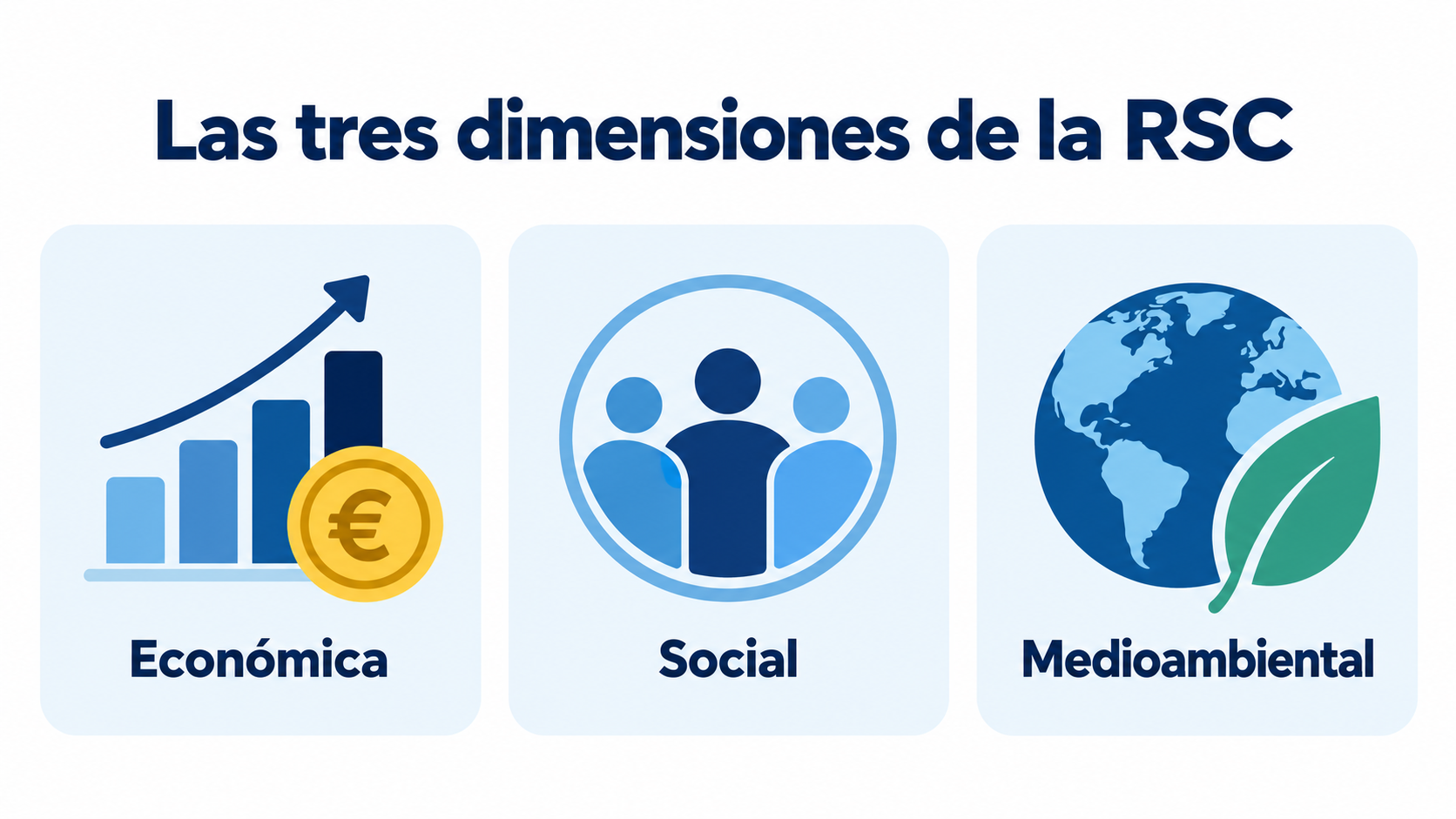
Social responsibility is most commonly divided into three main areas of action:
- Economic: being profitable in a sustainable way, paying taxes, creating stable jobs and acting ethically in relationships with suppliers and competitors.
- Social: offering fair working conditions, promoting equality and diversity, and contributing to the development of the communities where you operate.
- Environmental: reducing your carbon footprint, managing waste properly and investing in renewable energy or recycled materials.
The three reinforce one another. A company that looks after its workforce, for example, usually retains talent better. And that also improves its financial results.
CSR, ESG and sustainability: are they the same thing?
They are closely related concepts, but not identical. CSR began as a broad, voluntary commitment, more closely tied to ethics and the company’s image.
ESG criteria (Environmental, Social and Governance) focus on measurement. They are used mainly by investors and financial institutions to assess risks and compare companies using objective data.
Corporate sustainability, for its part, is the umbrella that covers both. In practice, many companies have moved from talking about CSR to talking about ESG. The reason is simple: they are required to prove their impact with figures, not just good intentions.
In addition, Spain has Law 11/2018 on non-financial reporting. It requires certain companies, especially larger ones, to report on social, environmental and employee-related matters. What used to be optional is becoming part of companies’ management obligations.
Benefits of CSR for companies
The first benefit is reputation. A consistent policy improves your brand image and builds trust among customers who value social commitment.
It also helps attract and retain talent. Many people prefer to work for companies with clear values, which strengthens your employer branding.
It also boosts customer loyalty. When consumers share a brand’s values, they are more likely to buy again and recommend it. Finally, good management reduces legal risks and makes it easier to access financing and investors.
The risk of greenwashing
However, not everything presented as responsible actually is.
Greenwashing means exaggerating or inventing environmental commitments to improve a company’s image. For example, advertising a product as “eco-friendly” without evidence, or boasting about a one-off initiative while the rest of the business carries on as usual.
Consumers are paying more and more attention, and being caught in an inconsistency can do more damage than saying nothing at all. The key is to communicate only what you can prove.
How to communicate your CSR without losing credibility
A good CSR strategy needs to be communicated well. But with data, not empty slogans.
Storytelling works especially well here: real stories from employees, specific projects or measurable results connect far better than generic statements. A regular newsletter is an ideal channel for sharing that progress with your community.
It’s also a good idea to segment your message. Not all your contacts are interested in the same things: some will care about your environmental policy and others about your social initiatives. Tailoring content to each group avoids overwhelming them and improves engagement.
If you want to dig deeper, our blog explains how to do more sustainable marketing. We have also put together corporate social responsibility examples and success stories.
How we help you at Mailrelay
At Mailrelay, we believe responsibility also starts with how you communicate with your customers. Sending only to people who have given their permission, complying with the LOPD and keeping your list clean are ways of acting transparently.
Our platform lets you segment your contacts by interests and send each group the content that really matters to them. That way, you cut down on unnecessary sends and look after your relationship with your audience.
All of this is available on the free plan, with up to 80,000 emails a month and 20,000 contacts. If you want to start sharing your social commitment by email, you can create your Mailrelay account today.
Frequently asked questions about CSR
Is corporate social responsibility mandatory? It was originally voluntary. Even so, some companies are required by law to report on their social and environmental impact. In Spain, this is regulated by Law 11/2018.
Can SMEs apply CSR? Yes, and you don’t need a big budget. Offering your team flexibility, working with local suppliers or reducing paper consumption already count as CSR actions.
What is the difference between CSR and RSE? In practice, none. In Spanish they are two names for the same concept: RSC (corporate social responsibility) is more common in Spain, while RSE (business social responsibility) is more common in Latin America.
In conclusion
Corporate social responsibility is no longer an extra; it has become part of companies’ identity. When managed well, it improves reputation, builds customer loyalty and attracts talent.
The key is to act first and communicate afterwards, always with data to back up every message. And if you choose email to tell your story, do it with the same consistency you demand of your company in everything else.
Related entries
Discover how Mailrelay can help you with your email marketing strategy.