ARPANET: what it is, its history and why it was the forerunner of the internet
The 1969 network where the internet began and the first email between computers was sent
ARPANET was the first large packet-switched computer network and the forerunner of the internet. It was created by ARPA, an agency of the US Department of Defense, and its first message was sent on October 29, 1969.
Many things you use every day were born on it. The best known is email.
What is ARPANET and what does it stand for?
The name comes from Advanced Research Projects Agency Network: the network of the Advanced Research Projects Agency. The agency was founded in 1958, after the Soviet Union launched Sputnik, and was renamed DARPA in 1972.
Its goal was practical.
Computers were extremely expensive and scattered across universities and research centers. ARPANET made it possible to share them remotely.
Was it built to survive a nuclear attack? That is a widespread myth. Some ideas about resilient networks came from military studies, but ARPANET was designed so that researchers could work together.
When was ARPANET created and who created it?
The idea took off in 1962, when J. C. R. Licklider imagined a “galactic network” of connected computers.
Larry Roberts led the project at ARPA, and the company BBN built the machines that linked each node.
The underlying technique, packet switching, had been proposed earlier by Paul Baran in the United States and Donald Davies in the United Kingdom.
Leonard Kleinrock and his team at UCLA were the first to receive one of those machines.
| Year | What happened |
|---|---|
| 1958 | ARPA, the agency that would fund the network, is created |
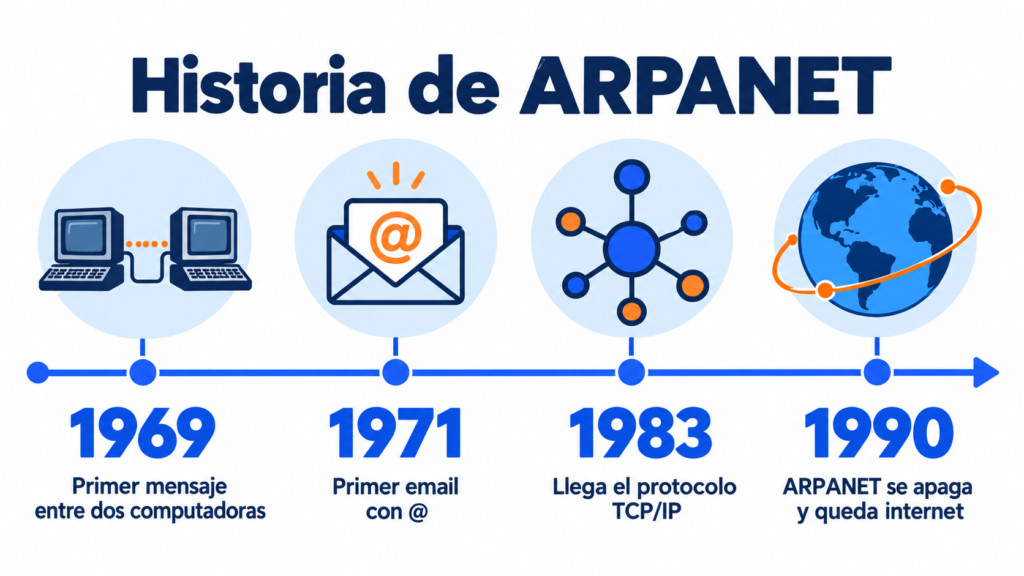
| 1969 | First message between UCLA and SRI (October 29); by December there are already 4 nodes |
| 1971 | Ray Tomlinson sends the first email between computers using the @ |
| 1972 | First public demonstration of ARPANET, in Washington |
| 1973 | First international connections, to Norway and the United Kingdom |
| 1978 | The first unsolicited bulk email, the first spam, is sent |
| 1983 | ARPANET adopts the TCP/IP protocol on January 1, and MILNET is created for military use |
| 1990 | ARPANET is shut down: the internet has already replaced it |
The first four nodes were UCLA, the Stanford Research Institute (SRI), the University of California, Santa Barbara and the University of Utah.
What was the first message sent over ARPANET?
It was “LO”. Charley Kline, a student at UCLA, was trying to type “LOGIN” on an SRI computer. The system crashed after the second letter.
An hour later they tried again and the connection worked. That is why people say the internet began with a crash.
How did ARPANET work?
The network split each message into small packets. Each packet traveled along whatever free path it found and, on arrival, the packets were put back together in order.
Each node had an IMP (Interface Message Processor), a machine that acted as a router. At first, the network used a protocol called NCP.
In 1974, Vint Cerf and Bob Kahn published the design of TCP/IP, intended to connect different networks to each other. When the network adopted it in 1983, it became the first piece of a network of networks: the internet.
Email was born on ARPANET and still works today
More than 50 years later, email still lands straight in your email client. Try it with Mailrelay.
What is the difference between ARPANET and the internet?
ARPANET was one specific network. The internet is the union of thousands of networks that speak the same language, TCP/IP.
| Aspect | ARPANET | Internet |
|---|---|---|
| Period | From 1969 to 1990 | From the 1980s to today |
| Who used it | Universities, research centers and the US military | Anyone, individual or business |
| Protocol | NCP and, from 1983, TCP/IP | TCP/IP |
| Size | From 4 nodes to a few hundred | Billions of devices |
| Services | Remote access, file transfer and email | Web, email, social media, video and much more |
And the web was not born on ARPANET. Tim Berners-Lee invented it at CERN in 1989, when the internet already existed.
ARPANET and the birth of email
In 1971, Ray Tomlinson, an engineer at BBN, sent the first message from one computer to another over the network.
He chose the at sign to separate the user from the machine name, and every email address still follows that pattern today.
Email soon became the most used service on the network.
In 1978, a DEC salesman named Gary Thuerk sent an ad to about 400 ARPANET users. It was the first spam in history and it caused many complaints.
The SMTP protocol also dates from that era; it was defined in 1982 in RFC 821. It is the same protocol servers use today to deliver your emails.

The lesson of 1978 still holds. Email works when the recipient has asked for it, which is why today we talk about permission, antispam filters and email authentication.
How Mailrelay helps you
Mailrelay sends your campaigns with a protocol inherited from that era, SMTP, but with everything modern email requires.
It helps you authenticate your domain with SPF and DKIM, automatically cleans up bouncing addresses and handles unsubscribes. And if you need to send from your website or app, you have SMTP and an API.
The free account includes up to 80,000 emails a month and 20,000 contacts, with human support by chat, ticket and phone.
Send your newsletters with Mailrelay
Up to 80,000 emails a month and 20,000 contacts for free, with human support on every plan.
Frequently Asked Questions
These are the most common questions about ARPANET.
What is ARPANET in a nutshell?
It is the computer network created by the US Department of Defense in 1969. It was the forerunner of the internet.
What does ARPANET stand for?
It is the acronym for Advanced Research Projects Agency Network, the network of the ARPA agency (now DARPA).
When was ARPANET born?
The first message was sent on October 29, 1969, from UCLA to the Stanford Research Institute. The network was shut down in 1990.
Was ARPANET built to survive a nuclear attack?
No. It is a myth. Its goal was to let universities and research centers share computers and work together.
Email between computers was born on ARPANET in 1971, with Ray Tomlinson and the @. The first spam was also sent there, in 1978.