Email marketing for dentists: emails that fill your schedule without putting your patients' data at risk
How to get your patients to come back for their check-ups and not miss their appointments, while protecting their health data and respecting professional ethics
Email marketing for dentists is the use of email to stay in touch with a dental clinic’s patients: reminding them of appointments and check-ups, keeping them informed and building their loyalty.
For a dental clinic, the challenge is rarely getting the first patient. It’s getting them to come back.
Making sure they don’t forget their check-up, don’t miss Tuesday’s appointment and, when a friend asks about a dentist, mention your name.
Email helps with all three, as long as you use it carefully. A clinic handles health data, and that changes what you can send and how.
What is email useful for in a dental clinic?
Its most profitable use is the simplest one: getting patients to come back. A timely reminder about their regular check-up fills gaps in the schedule that would otherwise stay empty.
The second use is reducing no-shows. A reminder the day before the appointment, with the time and address, prevents forgotten visits and leaves room to reschedule.
And the third is trust. A newsletter with useful tips keeps your clinic on patients’ minds between visits, with no need for aggressive advertising.
Which emails can a dental clinic send?
These are the most useful ones. You don’t need to start with all of them: with the welcome email, appointment reminders and check-up reminders, you have the essentials covered.
| Who it’s for | Example subject line | |
|---|---|---|
| Welcome | New patient | “See you on Thursday: how to get here and what to bring” |
| Appointment reminder | Patient with an appointment | “We’ll see you at the clinic tomorrow at 5:30 pm” |
| Check-up reminder | Patient due for a check-up | “It’s been a while since your last check-up” |
| Newsletter | Patients who opted in | “Three habits that keep your gums healthy” |
| Survey | Patient after their visit | “How was your visit yesterday?” |
| Birthday | Patients who opted in | “Happy birthday from the whole team” |
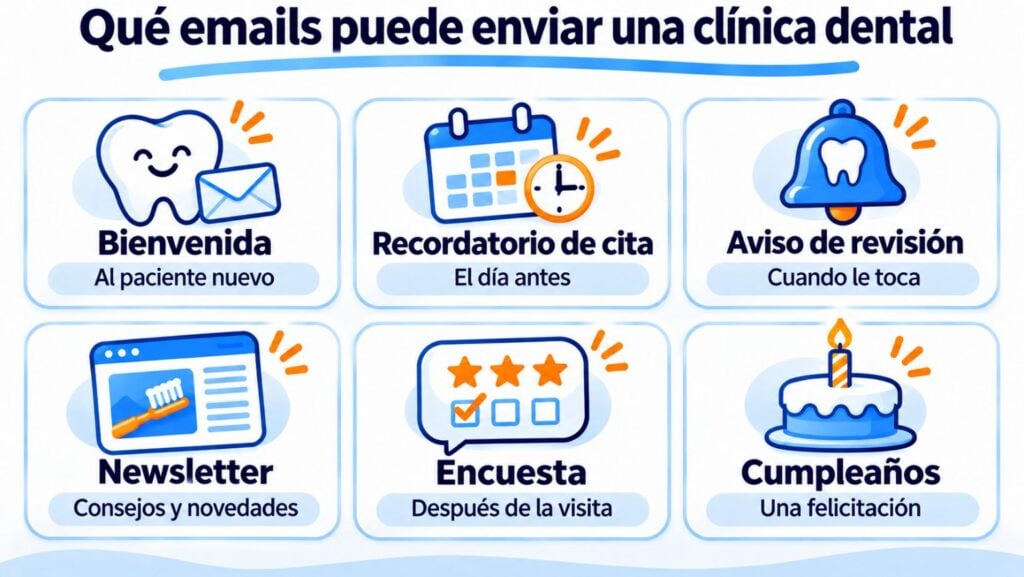
The welcome email is useful even before the first visit. Tell patients how to get there, where to park, which documents to bring and how to change the appointment if something comes up.
For reminders, you can start from the Appointment reminder template. They are transactional emails: they are part of the service and patients expect them.
The check-up reminder works best when it is sent based on each patient’s last visit date, rather than to the whole list on the same day.
The dentist decides the interval for each patient; the email only reminds them that the time has come.
The post-visit survey tells you what to improve. With a single question, like the NPS one, you get a simple satisfaction indicator.
And the birthday email is a thoughtful touch patients appreciate, as long as they have agreed to receive this kind of message.
Fewer gaps in your schedule
Appointment reminders by email and SMS, check-up reminders and a newsletter for your patients, free for up to 80,000 emails a month.
Health data: what you shouldn’t use in your emails
This is the most important difference between email marketing for dentists and email marketing for any other business.
Health data is a special category under the GDPR and has enhanced protection, including under Spain’s LOPD.
In practice, this means you shouldn’t use diagnoses, treatments or medical history data to segment your campaigns or personalize your marketing emails without the patient’s explicit consent.
An email like “Since you’re having orthodontic treatment, you’ll be interested in this offer” reveals health information and isn’t a good idea.
Nor is a subject line that lets anyone who sees the inbox guess a treatment.
To segment, use data that isn’t health data: the date of the last visit, the clinic location, the language, or whether the person is a patient or only asked for information.
Store them as custom fields and create a segment for each send.
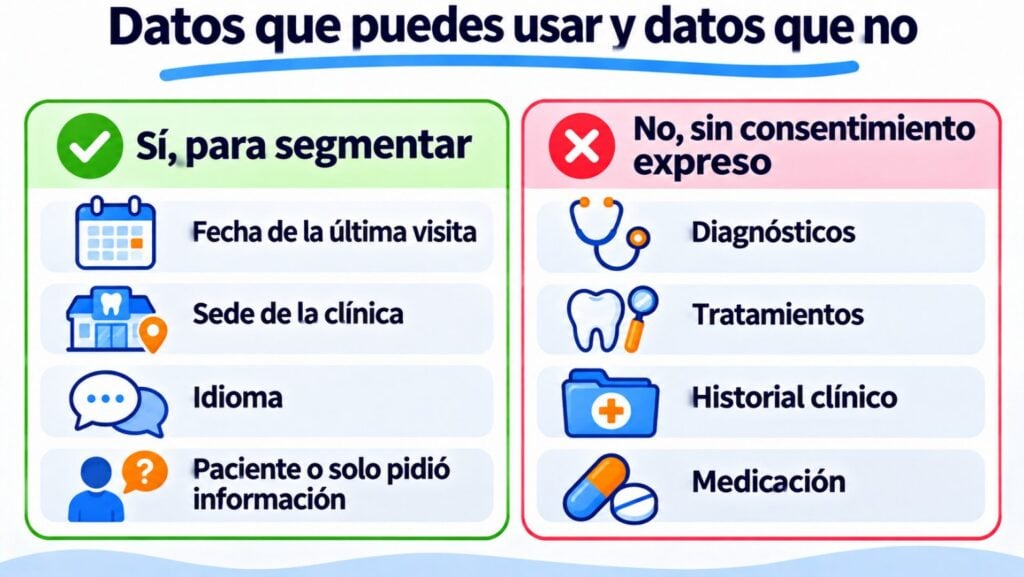
With this data you can do almost everything a clinic needs: send check-up reminders, remind patients of appointments and send a general newsletter to all patients.
Which rules does a dental clinic’s email marketing have to follow?
Besides protecting health data, a clinic has to follow the rules for any commercial communication as well as those of the profession.
The first is permission. Appointment reminders are part of patient care.
The newsletter and promotions, on the other hand, need the patient’s consent, under the GDPR and Article 21 of Spain’s LSSI.
Explain it in your privacy policy and ask for it on the registration form, with an unticked box such as “I want to receive tips and news from the clinic by email”.
With double opt-in you have proof of that permission.
The second is professional ethics. Spain’s Code of Dental Ethics and Professional Conduct devotes an entire chapter to dentists’ advertising.
Before sending promotions with prices or discounts, check what your professional association says. Something similar happens in other professions, as you’ll see in email marketing for lawyers.
As a general rule, avoid promising results, comparing your clinic with others or showing photos of patients without their written permission.
The third is privacy when sending. Never send an email to several patients with the addresses visible: it reveals who the clinic’s patients are.
An email marketing platform sends an individual email to each one and adds the unsubscribe link.
You’ll find the rest of the general obligations in legal email marketing.
The newsletter is the email that keeps the relationship going between visits. If every send is an offer, people stop opening it.
Practical tips work better: how to choose a toothbrush, what to do in a dental emergency at the weekend or how to prepare a child for their first visit.
Clinic news works well too, such as new opening hours or a new team member.
Write for all your patients at once, without referring to anyone’s specific treatments. And at the end of each email, make it clear how to book an appointment.
One newsletter a month is usually enough. It’s the foundation of loyalty in email marketing for dentists, along with other loyalty messages such as season’s greetings at the end of the year.
Email or SMS for reminders?
Both, if you can. Email lets you include more information: the address, a map, what to bring or how to change the appointment.
SMS is read almost immediately and works well as a short reminder a few hours before.
Many clinics send the email reminder a couple of days before and an SMS on the morning of the appointment.
That way the patient has all the information and a last reminder they won’t miss. If your patients prefer WhatsApp, see what WhatsApp Business allows.
Common mistakes in a dental clinic’s email marketing
The first is using treatments to personalize. It may seem more relevant, but it exposes health data and can make patients uncomfortable.
The second is sending only promotions. A discounted teeth whitening every month wears down the relationship and, depending on how it’s presented, may clash with professional ethics rules.
The third is sending the check-up reminder to the whole list on the same day.
Someone who came in last week won’t understand it, and someone who hasn’t been in for two years needs a different message.
And the fourth is forgetting about patients who stopped coming. A friendly email to win them back, like a winback campaign, costs little and fills part of the schedule again.
How Mailrelay helps with your dental clinic’s email marketing
With Mailrelay you can store each patient’s last visit date, clinic location or language in custom fields. That way you send each group only what applies to them.
Automations, included in the free account, send the welcome email to every new patient or the birthday greeting without you having to remember.
And from the same platform you can also send reminders by SMS, as we explain in how to send SMS from your computer.
Each patient receives their own email, so nobody sees the others’ addresses.
The servers are in the European Union and Mailrelay acts as the processor of your data, under the GDPR.
With open and click statistics, available in the free account and in Enterprise, you can see which tips interest your patients most.
The free account lets you send up to 80,000 emails a month to 20,000 contacts, with human support on every plan.
Get your patients back for their check-ups
Create your account, import your patients with their last visit date and schedule the first reminder.
Frequently asked questions about email marketing for dentists
These are the most common questions from clinics that are just getting started.
Do I need permission to send appointment reminders?
Reminders for an appointment the patient has booked are part of their care, not advertising.
Even so, it’s a good idea to tell them on the registration form that they will receive them by email or SMS.
Only to those who have consented to receive commercial communications. Ask for it on the registration form or at the first visit, with an unticked box.
Can I send promotions for a specific treatment?
You can tell patients about the clinic’s services in a general newsletter.
What you shouldn’t do is choose who to send it to based on their treatments or history, because that means using health data.
Related posts
If you want to see how email is used in other sectors or review the rules and channels mentioned in this post, keep reading here.