Social ads: what they are, platforms and how to advertise on social media
The platforms, formats and steps to make your social media ads deliver results
Social ads are paid ads on social networks such as Facebook, Instagram, TikTok or LinkedIn. They let you show a message to people who don’t follow the brand yet, chosen by their age, interests or behavior.
They are also known as social media advertising. Other common terms are paid social and social media ads.
Social refers to social networks, and ads is short for advertisements. Social ads are the paid part of a social media strategy. The other part is organic posts, which you don’t pay for.
| Organic posts | Social ads | |
|---|---|---|
| Cost | Free (only the time it takes to create them) | You pay for impressions, clicks or results |
| Reach | Mostly your followers | Any user who matches your audience |
| Targeting | Limited | By age, location, interests and behavior |
| Results | Slow and cumulative | Fast, for as long as you keep investing |
Each network has its own ads manager. The process is similar on all of them:
1. You choose an objective. Awareness, website traffic, engagement, leads or sales.
2. You define the audience. By demographics, interests or behavior. You can also use custom audiences, such as people who visited your website, and lookalike audiences based on your customers.
3. You set the budget. Daily or lifetime, and how much you’re willing to pay.
4. You create the ad. Text, image or video and a call-to-action button.
The network then delivers the ads through an auction. Depending on the objective, you pay per thousand impressions (CPM), per click (CPC) or per result.
Social ads platforms
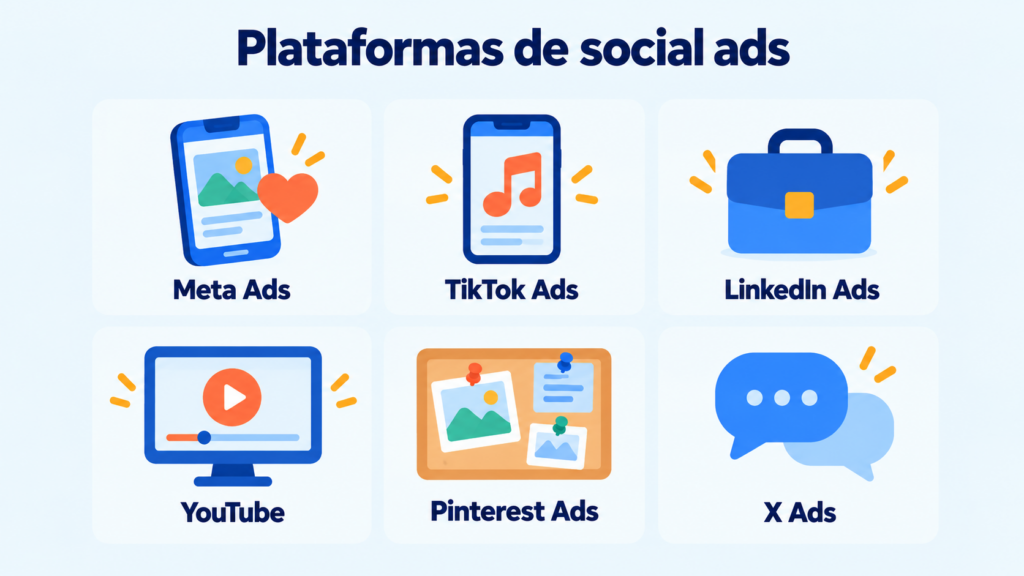
These are the most widely used ones and what each is best for:
| Platform | Where the ads appear | Best for |
|---|---|---|
| Meta Ads | Facebook, Instagram and Messenger | Almost any business that sells to consumers |
| TikTok Ads | TikTok | Young audiences and short-form video |
| LinkedIn Ads | Companies and professionals (B2B) | |
| YouTube (Google Ads) | YouTube | Videos, and ads before or during videos |
| Pinterest Ads | Home decor, fashion, recipes and ideas | |
| X Ads | X (formerly Twitter) | News, events and conversation |
Social ads formats
The most common formats are:
Image. A photo or design with a short text.
Video. From a few seconds to several minutes. It’s the fastest-growing format.
Carousel. Several images or videos that users swipe through, each with its own link.
Stories and reels. Full-screen vertical ads between stories or short videos.
Lead forms. Users leave their details without leaving the social network.
Advantages and disadvantages
| Advantages | Disadvantages |
|---|---|
| Fast results | When you stop paying, the results stop |
| Very precise targeting | Costs rise during highly competitive periods |
| Budget control, starting with little money a day | Ads wear out and need to be refreshed |
| Real-time metrics | You depend on each platform’s rules |
| They enable remarketing | Cookies and privacy limit tracking |
Keep every click from your ads
Send the traffic from your ads to a Mailrelay form and turn visitors into subscribers.
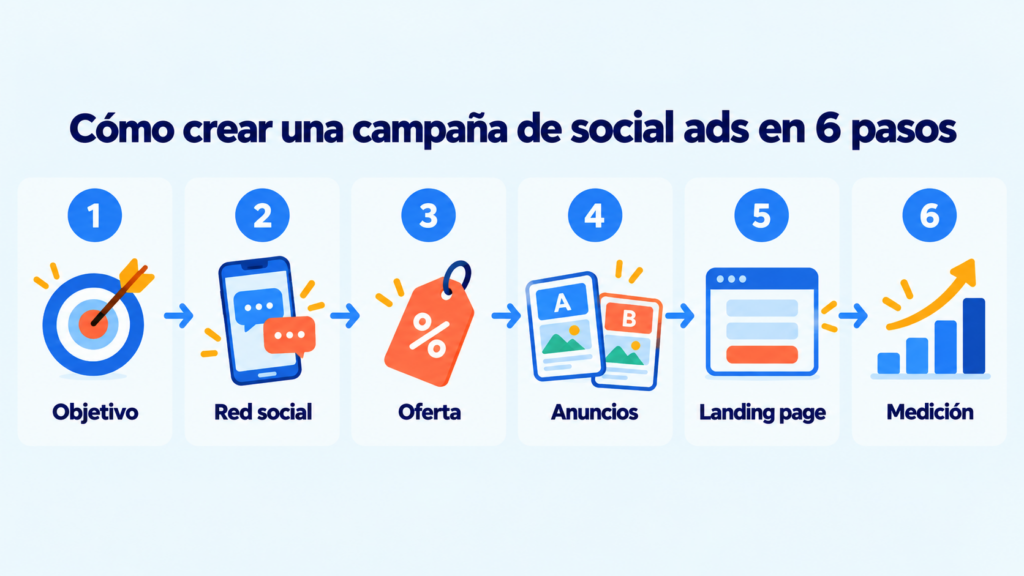
1. Define the objective and the metric. For example, getting sign-ups at a specific cost.
2. Choose the network. The one your buyer persona uses, not the one that’s trendy.
3. Prepare the offer. A discount, a free trial or a lead magnet, such as a downloadable guide.
4. Create several versions of the ad. Try different copy and images, as in an A/B test.
5. Send the click to a page built for it. A landing page with a simple form.
6. Measure and adjust. Check the CTR, the cost per result and the ROAS, and move the money to what works.
Social ads and email marketing
Social ads bring in traffic while you pay. Email lets you keep those people once the campaign ends.
That’s why many of your ads should aim for subscribers, not just sales. Anyone who leaves their email in a subscription form or a lead form becomes a contact you own. You can then send them a welcome email and your newsletters without paying again for every impression.
It also works the other way around: you can upload your list to the social network to exclude existing customers or to create lookalike audiences. Only do this if your contacts gave their consent for that use, as the GDPR requires.
How Mailrelay helps you
With Mailrelay you can create the form or page your ads lead to and send the welcome email automatically. You can also import the contacts from your lead forms and store which campaign each one comes from in a custom field.
The free account includes up to 80,000 emails a month and 20,000 contacts, with human support by chat, ticket and phone.
Send your newsletters with Mailrelay
Up to 80,000 emails a month and 20,000 contacts for free, with human support on every plan.
Frequently Asked Questions
These are the most common questions about social ads.
They are paid ads on social networks, shown to an audience chosen by its data and interests.
Social media marketing is the whole social media strategy, both organic and paid. Social ads are only the paid part.
It depends on the network, the audience and the competition, because the price is set in an auction. You can start with just a few euros a day.
The one your audience uses. Meta Ads suits most consumer businesses, LinkedIn Ads suits B2B and TikTok Ads suits young audiences.
Yes, to create custom audiences or exclude customers, but only if your contacts gave their consent for that use.