Digital mail
Everything that used to arrive in your mailbox and now reaches your screen
Thirty years ago, a bill, a letter from the bank or a fine arrived in your mailbox at home. Today almost all of that arrives on a screen. We call that change digital mail.
The term is mostly used as a synonym for email. But it covers a bit more. It also includes official notifications, certified deliveries over the internet and paper letters that are scanned.
What is digital mail?
Digital mail is any correspondence that is sent, received and stored in electronic format over the internet. It replaces the paper letter carried by a postal service.
Its best-known form is email, used by about 4.48 billion people worldwide according to The Radicati Group (2024). That’s why, in everyday use, saying “digital mail” or “email” means almost the same thing.
And yet not all digital mail is ordinary email.
Types of digital mail
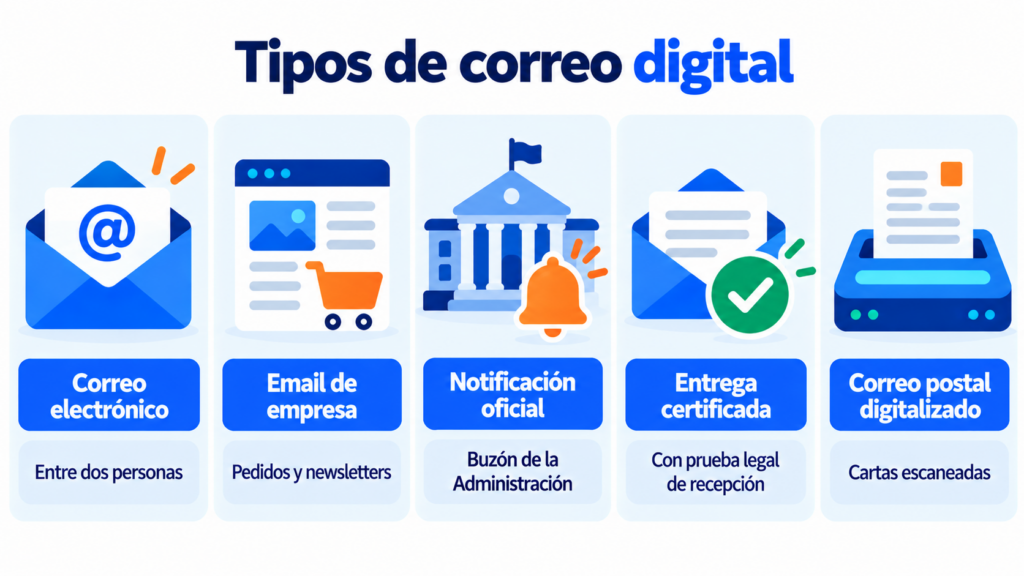
These are the forms of digital correspondence you may come across, from the most common to the most specialized:
| Type | What it is | Example |
|---|---|---|
| Messages between two email addresses, through providers such as Gmail or Outlook | A quote sent to you by a supplier | |
| Business-to-customer email | Automated or marketing messages that a brand sends to its contacts | An order confirmation or a newsletter |
| Official electronic notification | Communications from public authorities that you read in a secure mailbox | A notification from the Spanish Tax Agency in DEHú |
| Certified electronic delivery | A delivery with legal proof that it was sent and received, similar to a burofax (a certified letter) | A payment demand with acknowledgment of receipt |
| Digitized postal mail | Paper letters that are scanned and delivered in digital format | The digital mailroom of a large company |
WhatsApp messages, SMS and push notifications are also digital communication. Even so, they are not usually considered mail. They are short messages, meant more for conversation than for keeping a record.
Digital mail and postal mail: differences
Postal mail has not disappeared, but it has lost ground in almost every respect:
| Aspect | Postal Mail | Digital mail |
|---|---|---|
| Speed | From one to several days | Seconds |
| Cost per delivery | Stamp, paper and printing | Almost zero, even for bulk sends |
| Reach | Depends on each country’s logistics | Global, all you need is an internet connection |
| Tracking | Only with certified deliveries | Opens, clicks and bounces in real time |
| Storage | Physical files | Searchable and in the cloud |
| Risks | Losses and delays | Spam, phishing and spoofing |
Paper still has advantages in some cases. A physical letter stands out because few arrive, and there are older people or people without internet access who still depend on it. That’s why many companies combine both channels, in an omnichannel or direct marketing strategy.
Digital mail in public administration
In Spain, dealings with public authorities are increasingly digital. Law 39/2015 requires companies, entities without legal personality and certain registered professionals to communicate electronically. Citizens, on the other hand, can choose.
Notifications don’t arrive in your email, but in a secure mailbox. The most important one is the Single Enabled Electronic Address (DEHú), which brings together those of many public bodies. Your usual email or webmail only receives a notice that you have something pending.
It’s a good idea to check it often. If you don’t open a notification within ten calendar days, it is considered rejected and the procedure goes ahead.
Certified electronic delivery: the digital burofax
A normal email doesn’t prove that the recipient received it. That’s what certified electronic delivery services are for, regulated in the European Union by the eIDAS Regulation.
These services keep proof of sending and receipt, with date and time. If the provider is qualified, the law presumes the integrity of the content and the accuracy of those dates. They are used for claims, contracts or notices that could end up in court.
The digital mailroom
Many large companies still receive hundreds of letters a day: invoices, contracts, claims. A digital mailroom opens them, scans them and sends them electronically to the relevant department.
With optical character recognition, the system reads the content, classifies it and makes it searchable. It’s especially useful for remote teams. That way nobody has to go to the office to pick up their letters.
No, although it’s a common question. A social network has public profiles, followers and an algorithm that decides what content each person sees. Email is private communication, from one person to another or from a company to its subscribers.
That difference is its great advantage for brands. On social media, reach depends on the platform. With digital mail, the message reaches the inbox of whoever has subscribed. And the contact list is yours: nobody can take it away from you by changing an algorithm.
Take your digital mail to the next level
With Mailrelay you create newsletters and automations without coding, and see in real time who opens and clicks.
Create a free accountHow companies use digital mail
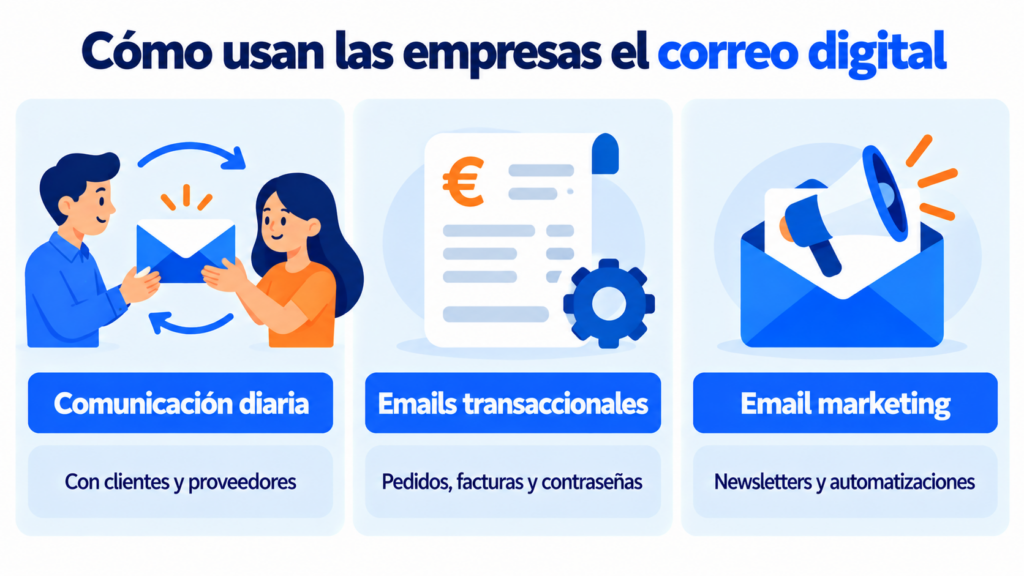
For a company, digital mail serves three purposes:
- Day-to-day communication with customers and suppliers, from a corporate email address on the brand’s domain.
- Automated messages, such as purchase confirmations, invoices or password resets. These are transactional emails.
- Email marketing: newsletters, promotions, welcome emails and automations to sell and build loyalty.
In the third case, what makes the difference is sending to people who want to hear from you. You need each contact’s consent, under the GDPR, and you need to look after your deliverability so you don’t end up in spam. Because an email nobody sees is useless. If you want to see each type of message with examples, check out our guide to emails.
How Mailrelay helps you with your digital mail
With Mailrelay you can send newsletters, campaigns and automations without knowing how to code. You get a visual editor, segmentation, real-time statistics and SMTP for your transactional messages.
The free account allows up to 80,000 emails a month and 20,000 contacts. And human support by chat, ticket or phone is included in every plan, including the free one.
Send your campaigns for free with Mailrelay
Up to 80,000 emails a month and 20,000 contacts, with human support on every plan.
Try Mailrelay for freeFrequently asked questions about digital mail
Are digital mail and email the same thing? In everyday use, yes. In a broader sense, digital mail also includes official electronic notifications, certified delivery and scanned postal mail.
What are the advantages of digital mail? It’s instant, almost free, reaches any country, can be searched and archived, and lets you measure who opens and clicks.
Is email a social network? No. It is a private means of communication, with no public profiles or algorithms deciding what you see.
What is a digital mailroom? It’s a service that receives a company’s postal mail, scans it and distributes it in digital format to each department.
Is an email legally valid? It can be used as evidence, but it doesn’t guarantee that the recipient received it. That’s what certified electronic delivery services are for.