SendGrid: what it is, pricing, pros, cons and alternative
What it offers, what it costs and when to choose another option
SendGrid is a cloud platform for sending email at scale, both transactional and marketing messages. It has belonged to Twilio since 2019, and thousands of companies use it so their apps can send confirmations, alerts and newsletters.
If you’ve landed here, you may be comparing providers. Or maybe you spotted “sendgrid.net” in an email and want to know what it is. This guide covers both, plus what it costs today and when another option makes more sense.
What is SendGrid?
SendGrid was founded in 2009 in Colorado (United States) by Isaac Saldana, Jose Lopez and Tim Jenkins. The idea was simple: give developers a reliable sending infrastructure, so they wouldn’t have to build and maintain their own mail servers.
In February 2019, Twilio completed its purchase in a deal valued at around 3 billion dollars. Since then it has been called Twilio SendGrid, and its website is now part of Twilio’s. According to the company, the platform delivers more than 200 billion emails every month.
Today it offers two products that you buy separately:
- Email API: sending through an API or SMTP from your website, app or online store. It’s the option for automated emails such as a sign-up, an order or a password reset.
- Marketing Campaigns: a dashboard to create campaigns and newsletters, manage contacts, segment them and automate some sends.
What is SendGrid used for?
Mainly, for sending email from software. Picture an online store: every time someone buys, the system calls the API and the customer recieves a confirmation within seconds. The same goes for verification codes, invoices or shipping notices.
It also lets you send email marketing campaigns. But its strength lies on the technical side, and marketing teams without developers tend to notice.
What is sendgrid.net and why does it show up in your emails?
Plenty of people search for “sendgrid.net” after seeing it in an email. The explanation is simple.
When a company sends through SendGrid without authenticating its own domain, Gmail shows the label “via sendgrid.net” next to the sender. It means the message is signed with the provider’s domain rather than the company’s. To remove it, the sender needs to set up DKIM and SPF for their domain. On top of that, the platform rewrites links to track clicks. That’s why you may see addresses containing “sendgrid.net” when you hover over a button.
Is that email trustworthy? In most cases, yes, because thousands of legitimate businesses use the service. However, security firms such as Cofense have documented phishing campaigns sent from stolen accounts on the platform. Because the domain alone guarantees nothing, check the real sender and don’t click if you weren’t expecting the message.
SendGrid pricing in 2026
The biggest change came in 2025: the company dropped its free plan. From May 27, 2025, free accounts had 60 days to move to a paid plan before their sending was paused. Now there’s only a 60-day free trial, limited to 100 emails a day and 100 contacts in Marketing Campaigns.
These are the starting prices Twilio publishes as of September 2026:
| Product | Plan | Starting price | What you get |
|---|---|---|---|
| Email API | Essentials | $19.95/month | 50,000 to 100,000 emails a month |
| Email API | Pro | $89.95/month | Up to 2.5 million emails, dedicated IP and subusers |
| Email API | Premier | Custom | High volumes |
| Marketing Campaigns | Basic | $15/month | Editor, segmentation and A/B tests |
| Marketing Campaigns | Advanced | $60/month | Automations, dedicated IP and up to 200,000 contacts |
| Marketing Campaigns | Custom | Custom | High volumes |
Keep in mind that the final price grows with volume. And if you need transactional emails and campaigns at the same time, you’ll pay for both products. Taxes and overages are extra.
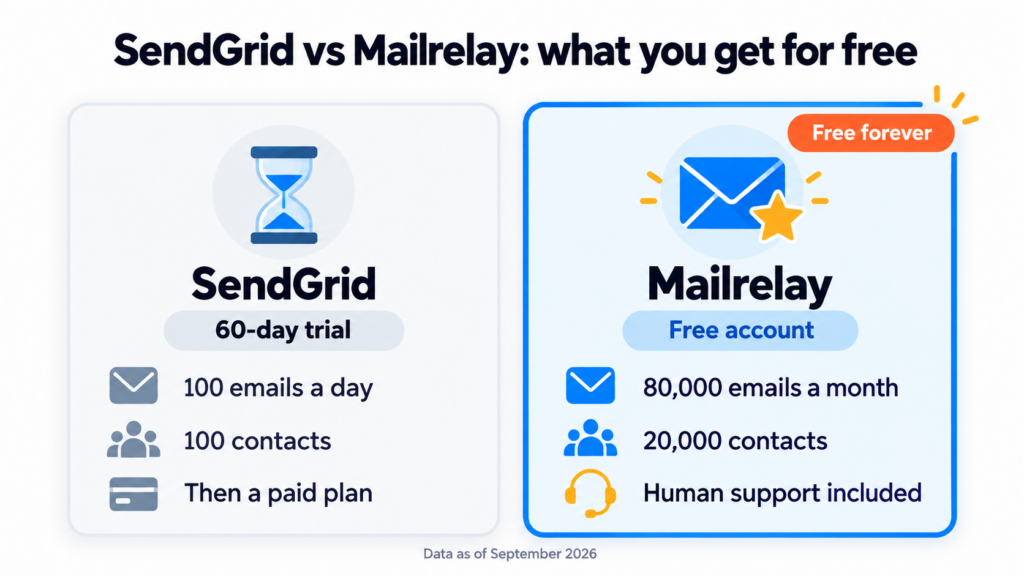
Looking for a SendGrid alternative with a free plan?
With Mailrelay you get up to 80,000 emails a month and 20,000 contacts for free, with no time limit and human support included.
Create a free accountSendGrid advantages
The main one is its infrastructure. The platform handles a huge volume of mail every month and works closely with the major mailbox providers. It also offers deliverability tools such as domain authentication, branded links and suppression management.
For developers, it’s very convenient. It has extensive documentation, libraries for the most popular languages, event webhooks and dynamic templates. Plus, as part of Twilio, it combines easily with Twilio’s SMS, WhatsApp and user verification tools.
Higher plans add some useful extras: a dedicated IP with automated warm-up, address validation and advanced statistics.
SendGrid disadvantages
You’ve already seen the first one: there’s no free plan. For a newsletter that’s just starting or a small business that wants to try before paying, that’s a big drawback.
The second is complexity. Setting up API keys, DNS records or the event webhook is easy for a developer. For a marketing team without technical support, not so much. Also, in the Email API plans, personalized support is an extra you pay for.
There are other details worth checking before you sign up. On Essentials, you can only search the activity of your sends from the last three days. You don’t get a dedicated IP until the Pro plan, and in Marketing Campaigns, automations are reserved for Advanced.
SendGrid compared with other alternatives
If you’re after a technical sending service, its direct rivals are Mailgun, Amazon SES and Postmark. Amazon SES is usually the cheapest by volume, although it takes more setup work. Mailgun, for its part, follows a very similar approach and is also built for developers.
If you need campaigns with a visual editor, the comparison changes. That’s where platforms like Mailjet, Brevo or Mailrelay come in, bringing newsletters, automations and transactional email together in a single account.
Mailrelay, a SendGrid alternative with a free plan
At Mailrelay we offer what many users miss in SendGrid. Our free account lets you send up to 80,000 emails a month to 20,000 contacts, with no time limit. And it isn’t a stripped-down version. It includes the drag-and-drop editor with AI writing assistance, segmentation, custom fields, A/B testing, automations and reports with click maps.
We also cover the technical side. You can send transactional emails via SMTP or API. The free account includes a 30-day trial of this service, and paid plans include it as standard. You also get a REST API to manage contacts and campaigns, webhooks and a WordPress plugin.
What if you run into a problem? Our team helps you by chat, ticket and phone in several languages —on the free account too—. If you’re switching providers, we’ll help you with the migration of your contacts and with setting up your sending domain.
Switch from SendGrid to Mailrelay without the hassle
Newsletters, automations and transactional email via SMTP or API in one account. We help you migrate and set up your domain.
Try Mailrelay for freeFrequently asked questions about SendGrid
Is SendGrid free? Not anymore. Since 2025 it only offers a 60-day trial with a maximum of 100 emails a day. After that, you need a paid plan.
Is SendGrid owned by Twilio? Yes. Twilio bought it in 2019, and today its brand name is Twilio SendGrid.
Is an email sent from sendgrid.net safe? Usually, yes, because many legitimate businesses use the service. Even so, always check the sender and be wary of unexpected messages asking for data or payments.
Which is better, SendGrid or Mailgun? It depends on your case. Both are built for developers and their prices are similar. If you also want to send newsletters without coding, you’re better off with an email marketing platform that includes a transactional API.