Buying email databases: why you shouldn’t and how to build your own
Why a purchased list hurts your emails and how to get subscribers who actually want to read you
Why a purchased list hurts your emails and how to get subscribers who actually want to read you
Many companies don’t know how to start building an email database so they can get going with their own mailing strategy.
It’s true that starting from scratch can feel overwhelming, because getting subscribers isn’t easy: the beginnings of an email marketing strategy demand a lot of effort and planning.
When a business faces this situation, it’s common to give in to the temptation of buying databases to kick off its email sales campaigns.
However, we can’t say this is a good strategy. In fact, it can’t even be called a strategy…
“Buying databases is a morally objectionable practice that also brings more serious legal problems, which in many cases are not taken into account.”
In this article I want to talk to you about whether there is any benefit to be gained, as well as the possible drawbacks your business may suffer if you engage in this kind of practice.
Want to find out more? So let’s get to it!
“Databases are organized files that companies keep to store the records of information they gather from their customers. They can include personal data, contact details, etc.”
Among the functions that studying this information serves, I can highlight some of the most useful ones in marketing, such as:
And that’s true, but if and only if the data in the databases used is reliable. Keep in mind, too, that they contain sensitive personal information that requires special handling (if you don’t want to face repercussions).
In any case, to build an email list you can choose to follow solid acquisition strategies (like the ones I’ll tell you about at the end of this article) or take the fast track: buying databases.
This way, you pay to get all the data other companies have collected through their marketing strategies, and you “save” yourself a lot of headaches.

If a business decides to buy databases, it must take into account the legal aspects involved. In fact, in 2018 data protection law became much more restrictive in this regard:
Therefore, although buying databases is not penalized as such, it would make no sense to pay for contacts you won’t be able to use to generate new sales, right?
However, there is a “legal loophole” here: a file of this kind compiled by another company could be used if it is rented. This happens when users give their express consent to also receive commercial communications from third parties.
The question here is whether reaching people who don’t know your products or services, and haven’t shown any interest in them, has any value for your business…
In Spain, two laws regulate the use of email for selling. Here’s the summary:
| Law | What it requires | Maximum penalty |
|---|---|---|
| GDPR and LOPDGDD | A legal basis for processing the data (usually consent) and informing people who processes it and for what purpose | Up to 20 million euros or 4% of annual turnover |
| LSSI (art. 21) | Prior, express consent to send commercial communications by email, except to customers who have already bought similar products | Up to 150,000 euros for mass mailings without permission |
Buying a list doesn’t give you that consent. At best, those people agreed to receive emails from another company, not yours. You can see the details of the Spanish regulations in the LOPD. And anyone who doesn’t want to receive advertising can sign up for the Robinson List.
Outside Spain the rules change, but the idea is the same in almost every country: no permission, no commercial email.
Setting aside the legal aspects of buying databases, another aspect that should concern you is the reliability of the information collected in them.
First of all, keep in mind that you will be dealing with a company that has let down the users who trusted it, since it is willing to sell all the data its customers provided.
Obviously, the moral integrity of this kind of business is rather doubtful, so you shouldn’t take the risk without any guarantee.
On the other hand, look carefully at the options you have for buying a database, and how reliable that data will be for your business:
There are businesses that deal directly in buying and selling databases.
This kind of business offers certain guarantees, since it is their specialty. You’ll need to assess whether the data is up to date, whether it can be segmented, etc …
Some are willing to sell their own data, but getting this from your competitors is the hard part.
You can always buy data from a business that has nothing to do with yours and end up with data that is of no use to you.
Many bloggers or internet users compile their own contacts for non-commercial purposes.
They are sometimes willing to sell their data to companies related to their field.
These are usually small databases and, although the people on them are interested in related topics, they are normally not users with commercial interests.
The third aspect to consider and weigh carefully before thinking about buying a database is spamtraps, or trap accounts, a topic I encourage you to learn a bit more about in the next section.
These are email accounts created by organizations in order to keep track of spammers. In other words, they act as a trap to analyze the emails each domain sends, and so identify those who don’t follow the rules.
Therefore, when you buy emails from a database, you also risk it containing trap accounts, so your domain could end up on blacklists or suffer damage to its sender reputation.
Although, at first glance, buying databases may seem like a good idea to get your email marketing campaigns off the ground quickly, the reality is that it’s not a smart decision.
What may seem like a fantastic short-term solution may lead nowhere after a while or, worst of all, end in situations like the following:
The first problem you’ll run into is how buying these databases affects your brand image.
Users who receive your emails without prior consent won’t have a positive opinion of your business, since they will receive them with distrust. As a result, they won’t be receptive and will by no means end up becoming your customers.
Also keep in mind the word-of-mouth effect. A large number of users annoyed with your brand can end up causing some kind of crisis that you didn’t foresee at first.
Directly related to the previous point is the high number of unsubscribes you can get from each send to a purchased database.
The fact that you spend a significant amount of money on a database of email accounts won’t make it data from users interested in your business, which (in the best case) will cause quick, sudden unsubscribes.
Also, you should know that a disproportionate drop in the number of subscriptions to your database will negatively affect your domain’s sender reputation.
However up to date databases may be, when they pass through several hands it’s no surprise that they contain misspelled emails or accounts that are no longer in use.
This will cause a high bounce rate and, what’s worse, they will be hard bounces. They are bounces from accounts that will never receive the emails.
Users will be receiving unsolicited emails about topics they may not be interested in, so it’s more than likely that many won’t even open them, leaving them abandoned in the inbox or deleting them straight away. This seriously affects the mailings you send.
In other words, if you buy email databases you’ll lose the chance to send interest-segmented emails that get a good open rate.
As I’ve already mentioned, all these problems caused by buying databases will end up directly affecting your sender reputation. A reputation that is tied to the domain you send your emails from.
In turn, this can affect your domain’s ranking or how some online services perceive the quality of your website.
Related to the previous point, if your sender reputation is bad because you send commercial emails to users who haven’t asked for them, you may end up being considered a spammer (and a bad one).
The worst part of ending up in this situation is that, just as it’s relatively easy to end up on a blacklist, it’s tremendously hard to get off it and enjoy a good domain reputation again.
Since 2024, Gmail and Yahoo have required bulk senders to keep their complaint rate below 0.3%. With a purchased list, spam complaints skyrocket from the very first send.
If you go over that limit, your emails stop reaching the inbox. And not just the ones from that campaign: also the ones you send afterwards to your real customers. You’ll find all the details in the bulk sender requirements.
If you’re thinking about getting contacts quickly, these are the three options and what each one involves:
| Buying a database | Renting a list | Building your own list | |
|---|---|---|---|
| Permission for your brand | No | Only if they accepted third-party offers | Yes |
| Legal risk | High | Medium | None |
| Interest in your business | Low | Low | High |
| Effect on your deliverability | Very negative | Negative | Positive |
| Cost | One-off payment and risk of fines | Payment for each send | Time and an email tool |
| Long-term result | Unsubscribes, complaints and blocks | Few sales | Returning customers |
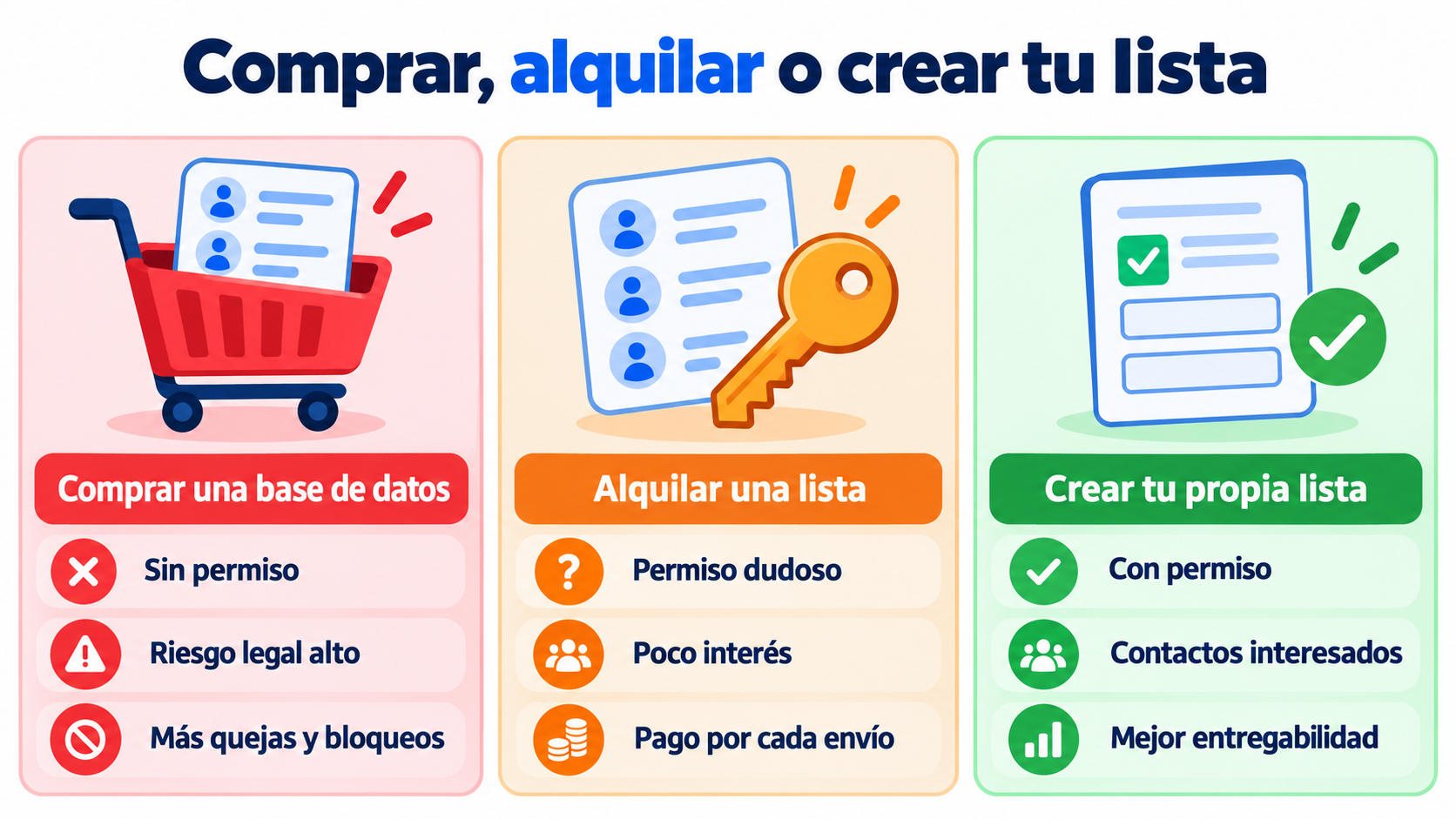
Building your list takes longer, but it’s the only option that keeps adding value as the months go by. Every contact you get knows who you are and wants to hear from you.
Build your list without buying contacts
With Mailrelay you create double opt-in forms and get subscribers who actually want to read you.
I told you at the beginning of this article that buying databases can’t be considered a strategy as such. And, as you’ve seen, it commonly ends up leading to a list of problems and obstacles you’ll have to face.
What solution is left? Obviously, the legal creation of a quality email database. The one with which you’ll get truly positive results in the medium and long term.
To do so, I recommend putting the following actions into practice:
The first step you should take is to plan a real strategy, one that has nothing to do with buying databases:
With the strategy well defined, it’s time to implement contact or subscription forms on the channels you’ve chosen.
Don’t expect your email list to grow quickly. There will be times of greater or lesser growth, depending on the acquisition actions you carry out.
One of the most important aspects of building your own data collection is that you’ll be able to get to know your users much better.
Thanks to this, you have the opportunity to segment based on the data that interests you most, depending on your sales potential via email.
Segmentation is key to personalizing your emails and optimizing your messages. Therefore, a database built from scratch with a specific goal, and shaped by listening to your users, will always be far more reliable than a purchased one.
These are the most common ways to grow your email database legally:
| Method | How to do it |
|---|---|
| Form on your website | A visible subscription form in the header, footer or blog |
| Pop-up | A pop-up that appears when visitors scroll down the page or try to leave |
| Lead magnet | A guide, template or discount in exchange for the email address (lead magnet) |
| Checkout | An unchecked box to receive news when placing an order |
| Physical store | A digital receipt or a discount for signing up at the checkout |
| Landing page | A landing page for each ad campaign |
| Webinars and events | Registration for a webinar or an in-person event |
| Social media | A link to your form in your bio or posts |
| Contests and giveaways | A clear sign-up, with permission to receive emails |
| Recommendations | A gift for anyone who invites a friend to subscribe |
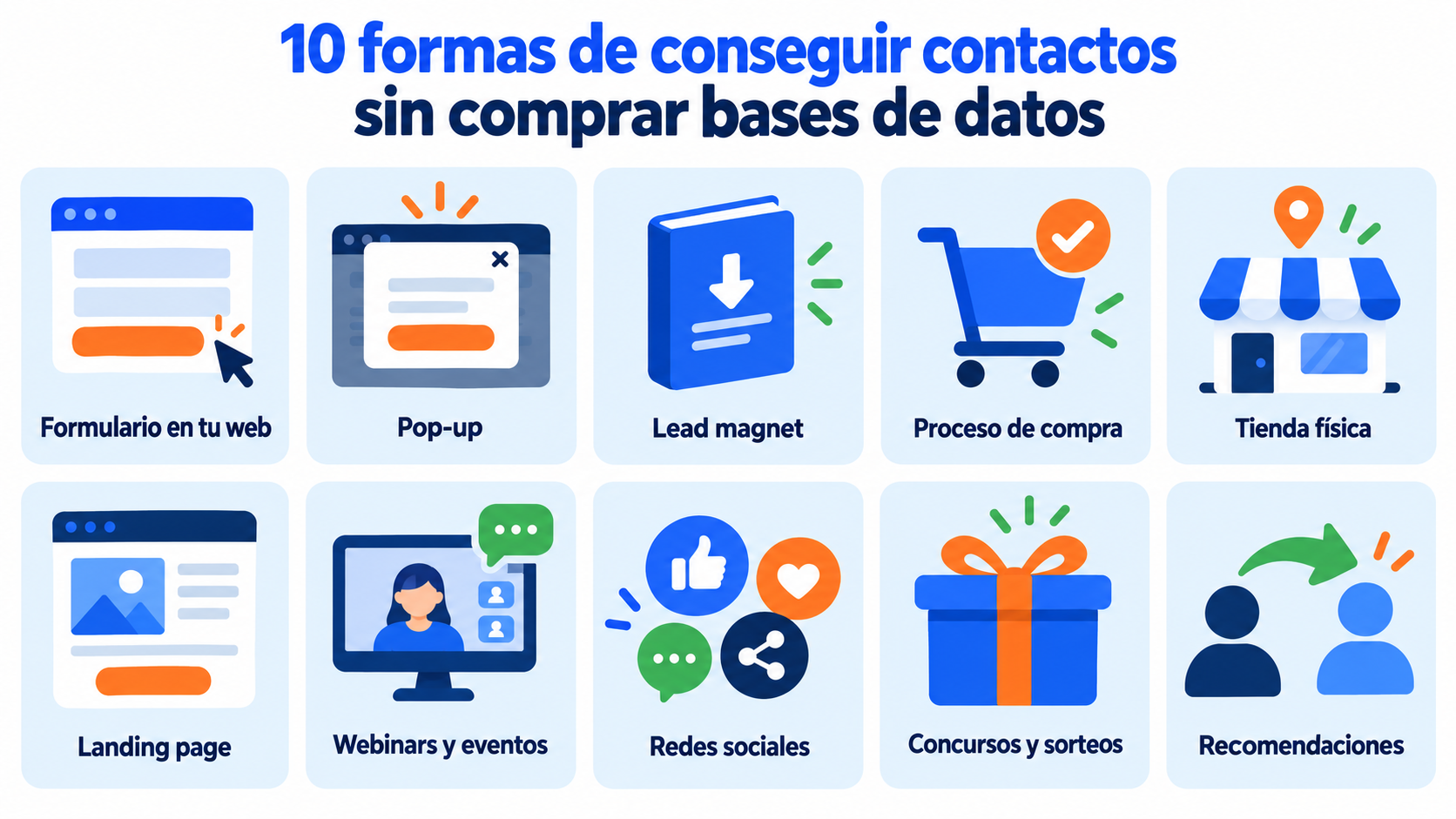
Whatever the method, use double opt-in. Only people who confirm their email address get on your list, and you have proof of consent.
These two texts are a starting point. Adapt them to your business and check the full legal text with your advisor.
Text next to the form checkbox:
I want to receive news, offers and tips from [Your company name] by email. I can unsubscribe at any time with one click. More information in the privacy policy.
Confirmation email (double opt-in):
Subject: Confirm your subscription to [Your company name]
Hi,
Thanks for signing up for our newsletter. To start receiving it, confirm your email address with this button: [Confirm my subscription]
If you didn’t sign up, ignore this message and you won’t hear from us again.
Start attracting subscribers today
Design your form, add it to your website and send your first newsletter for free.
If you already have one, the safest thing is not to send it anything. These are the steps:
Don’t import it into your email sending tool. Reputable email marketing platforms require your contacts to have given their permission.
If you’ve already sent emails, stop. Every new send adds bounces, complaints and the risk of being blocked.
Delete the data. Keeping personal data without a legal basis is also a problem.
Check your reputation. Look at your complaint rate, hard bounces and whether your domain appears on any blacklist.
Start building your own list. With the methods in the table above, you’ll have your first real subscribers in a few weeks.
With Mailrelay you create double opt-in subscription forms and add them to your website in minutes. New contacts are automatically added to their subscriber groups.
If you already have your own permission-based list, you can import your contacts from a CSV or Excel file. The free account includes up to 80,000 emails a month and 20,000 contacts, with human support by chat, ticket and phone.
Send your newsletters with Mailrelay
Up to 80,000 emails a month and 20,000 contacts for free, with human support on every plan.
These are the most common questions about buying databases.
Using it to send commercial emails without each person’s prior consent goes against the LSSI and the GDPR. That’s why it isn’t a safe option.
Some companies sell them, but those individuals haven’t given permission to receive your emails. Sending them advertising exposes you to penalties.
Business emails are also personal data when they identify a person, for example if they include their first and last name. The LSSI also requires consent to send advertising.
It depends on your traffic and what you offer in return. With a visible form and a good lead magnet, it’s common to get your first few hundred contacts in a few weeks.
Well-targeted ads pointing to a landing page with a form get you contacts who have given permission. It’s an investment that actually stays in your business.
It’s not recommended. These tools collect addresses published on websites or social media without their owners’ consent, so sending them commercial emails breaches the GDPR and the LSSI. They also tend to include old addresses and spamtraps, which sends bounces soaring and damages your sender reputation.
Attracting your own subscribers and building a community around your brand gives you real opportunities and lets you better understand how your business is perceived.
In the long run you’ll also avoid many potential legal problems, so your business will grow safely and reach its goals little by little. Because, as the saying goes, it’s better to take it slow and do it well.
And what about you? What do you think about buying databases and their impact on an email marketing strategy?
Buying lists usually leads to email marketing deliverability problems, so it’s better to build your list with double opt-in and contacts who want to receive your emails.