8 email examples for your business, with templates
A basic sample email, sample addresses and business templates to copy

A basic sample email, sample addresses and business templates to copy
An email example shows how a real email is written: sender, recipient, subject line, greeting, body, sign-off and signature. In this guide you’ll first find a simple example and some sample email addresses, followed by 8 business email examples, each with a template to adapt to your business.
If you’re reading this, it’s because you’ve decided to take the plunge with an email marketing strategy and you’re looking for a starting point: inspiration from email examples for offering services, introducing your company or simply guidance on how to write a business email.
And that’s no surprise. According to The Radicati Group, there were 4.48 billion email users worldwide in 2024, and around 361.6 billion emails were sent every day.
This helps make email marketing the most widely used means of communication for generating sales over the internet and the ideal place to build a real relationship with your customers.
It’s a tool living through a golden age, no doubt about it, and at Mailrelay we know that very well.
Before we look at business emails, let’s start with the basics. Here’s a simple email example between two people who work together:
From: Laura Gómez ([email protected])
To: Carlos Ruiz ([email protected])
Subject: Thursday’s meeting: time changeHi Carlos,
I’m writing to let you know that Thursday’s meeting with the sales team has moved from 10:00 to 12:00, in the same room.
I’ve attached the agenda. If you can’t make it at that time, let me know and we’ll find another slot.
Best regards,
Laura Gómez
Marketing Manager
Short as it is, this email has every part an email needs:
| Part | What it is | In the example |
|---|---|---|
| Sender | Who sends the email | Laura Gómez |
| Recipient | Who receives it. You can add more people in CC or BCC | Carlos Ruiz |
| Subject line | A brief summary of why you’re writing | Thursday’s meeting: time change |
| Greeting | Opens the message with the recipient’s name | Hi Carlos, |
| Body | The message itself, ideally in short paragraphs | The time change and what to do if he can’t make it |
| Sign-off and signature | Closes the message and gives the sender’s details | Best regards, Laura Gómez |
If you want to dig deeper into each part, you’ll find more details in our post on email structure.
An email address always has three parts: the username, the @ sign and the domain. For example, in [email protected], “firstname.lastname” is the username and “gmail.com” is the domain.
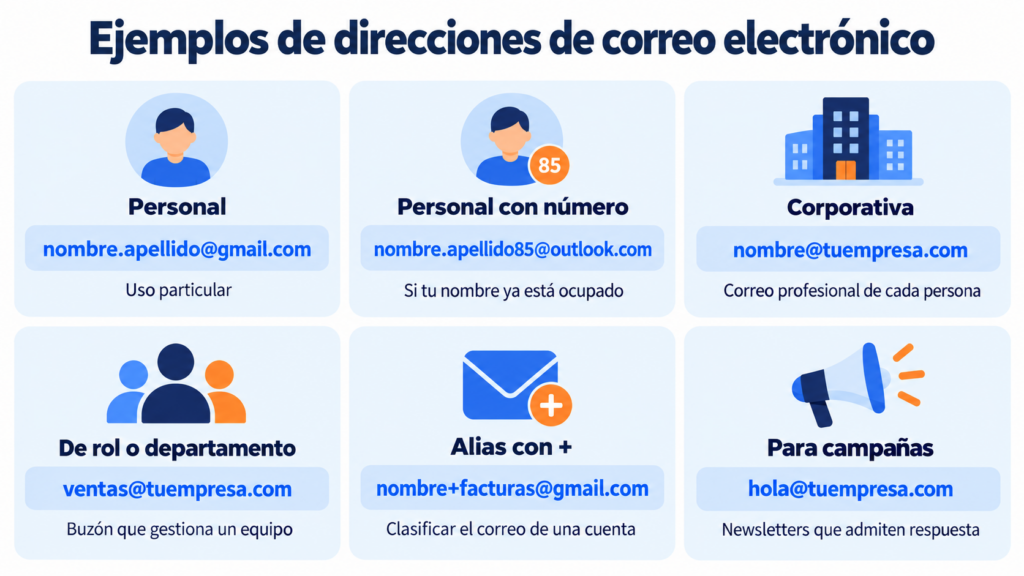
These are the most common types of address, with an example of each:
| Type | Example | What it’s used for |
|---|---|---|
| Personal | [email protected] | Personal use, with a free provider such as Gmail or Outlook |
| Personal with a number | [email protected] | When the name is already taken at the provider |
| Corporate | [email protected] | Each person’s work email, on the company’s domain |
| Role or department | [email protected], [email protected] | Mailboxes managed by a team rather than a single person |
| Alias with + | [email protected] | Sorting the mail that arrives in the same account |
| For campaigns | [email protected] | Sending newsletters and promotions from an address that accepts replies |
To send business emails, it’s best to use a corporate email address on your own domain, which inspires more trust than a free account. Even better if it’s an address that accepts replies, for the reasons we explain in our guide to noreply emails.
If you want to learn more about the rules an address has to follow, see our post on email addresses.
To reach your audience without being intrusive, it’s best to balance selling with something else for the user: entertainment, value, trust… When writing, keep two principles in mind for every type of email:
Emailing is a valid tool for any business. It doesn’t matter whether it’s a physical or an online business, it works wonderfully. You just need to be clear about your purpose.
To inspire you as you design your own strategy, here are 8 email marketing examples and templates we’ve prepared for you. If you’re looking for more samples, here are some more email marketing templates to copy. And if you’re looking for complete campaigns for your subscriber list, we have 20 email marketing examples with subject line, preheader and text.
Use it to welcome people, add a short introduction about who you or your company are and what you offer. In short, tell them how you help people with problems or needs similar to theirs.
Generally, the structure of this type of email is:
If you received this email, it can only mean one thing:
You’ve decided it’s time to take back control of your company’s finances. Congratulations!
Taking action is the first step and you’re already on the right track.
But before we start this journey together, you need to know how this works:
1. I send emails frequently, so get used to seeing my name among your notifications.
2. In each and every one of them I’ll tell you something about my services so you realize your company could do much better with my help.
3. Income comes first. Providing value is great, but in finance the most important thing is a positive balance at the end of the month.
If it stresses you out that your inbox fills up with emails about finance, if you have no interest in improving your company’s profitability, or if you’re only looking for information within your reach on Google…
This isn’t for you.
I recommend you unsubscribe as soon as possible so I don’t bother you any more. Seriously, no hard feelings.
But if you know you can get much more out of your business, if you’re looking for a team of experts to grow your company, and if you want to hear the experiences of business owners in your same situation…
Stay.
Have you already made a decision?
Then we’ll “see” each other in the next email.
Warm regards,
Ana Trenza
P.S. A quick question: what is the reason you subscribed to this list? What led you to send me your details to receive my emails?
Tell me and I’ll see what I can do to help you solve that problem.
Let’s suppose we’re a custom travel company. To adapt it to your company, just replace the parts in red with your details:
Hi,
I’m so glad to see you here!
I’m writing to welcome you and offer you the [Guide to a Trip to Paradise] I promised you. You can download it here.
If you’ve made it to this email, I suppose you know what I do. Just in case, here’s what I do in a few words: [I design custom trips for you that are dreams come true].
From now on I’ll send you an email every Friday to tell you about the experiences of some of my [travelers] and the latest travel news. If you’d like me to write about a particular destination, just tell me by replying to this email.
Also, I want to let you know that I’ve just launched the [special trips around Spain] section, which I’ve named [Spanish Passion]. I invite you to visit the website and see all the wonders we have [in our country].
See you in my next email 🙂
Warm regards,
The Morning Traveler
P.S. If you’re not following me on social media yet, here are my details so you can:
Twitter [@laviajeramañanera]
Instagram [@laviajeramañanera]
Facebook [@laviajeramañanera]
What could a business email example look like?
For our product business email example, we have Cocunat. This natural cosmetics store writes its emails in English even though it’s Spanish, which says a lot about its target audience and the brand positioning it’s after.
We like it for its balance between CTAs and its copy about the products, which is far from conventional.

Cocunat email example
You know my thing is making [define the product or service] happen, and I have [X] years of experience and [X] [projects, products] [organized, sold, published] under my belt.
I know things often don’t turn out the way we want. However, we shouldn’t lose heart; we should look for solutions tailored to us and to our budget, of course.
One of the biggest worries my clients have when planning their [your product. Examples: renovations, trips, medical visits] is [main barrier or objection of your customers]. They don’t know whether they’ll have extra expenses that will force them to change their plans, or whether a personal circumstance will keep them from [enjoying, using] their [product or service].
I understand them perfectly; these are universal problems. We all have them, after all.
Since I’m not a fortune-teller, I tell them to think about:
● [Benefit 1]
● [Benefit 2]
● [Benefit 3]
And I also tell them the best way forward is to take action, and that I can help them build the best option for each of them.
So don’t think twice and [tell me what you need / buy your product / hire your X]
[CTA button to get the service or product]
Warm regards,
Promotions are for offering discounts or perks for a limited time and are characterized by having an end date.
Because they’re tied to a date, they let us set off two very effective psychological triggers in the customer:

Here’s the template inspired by the email example you just saw:
Hi!
We have an exclusive offer for special customers that you can’t miss.
Until [date] all our [services or products] come with a fantastic [% discount].
Take advantage of this unique opportunity, because we won’t have these prices again for a long time.
Here’s your discount code: [Code]
Just go to the website and enter that code at checkout. It’s that easy.
Hurry, they’re flying off the shelves!
[CTA button I WANT MY OFFER NOW]
Copy these templates into your campaigns
Paste the text into Mailrelay’s visual editor, adapt the design to your brand and send it to your list for free.
This is the email that follows the previous one.
Never, I repeat, never skip the follow-up email.
The follow-up email has three goals:
As a follow-up email example, we go back to Ana Trenza, who in this case reminds us of an offer for a product she recommends.

Here’s the template for the email that would follow the previous example:
Hi!
I don’t know if you got to see my email from yesterday.
Sometimes we receive so many emails that it’s impossible to deal with them all. Or maybe it ended up in your spam folder.
That’s why I want to make sure you know there are only a few chances left to take advantage of the promotion. The offer ends soon.
In case you don’t remember it, here’s a quick summary:
[% discount] on all our [services or products]
Until [date]
To get the discount, enter [Code] at checkout.
So don’t wait, they’re flying off the shelves.
[CTA button I WANT MY OFFER NOW]
Warm regards,
[Name] from [Company]
[Claim / slogan / value proposition]
🔗 You may also be interested in: 4 templates for sending mass follow-up emails
If you have an online store, you can’t do without this email, because it has a very high conversion rate.
These are the basic ingredients for writing this email:
Let’s look at an email example from a brand that is doing very well in its email marketing campaigns: Blue Banana.

Blue Banana abandoned cart email example
But it doesn’t end here, because they don’t miss the chance to show you other related products.

Example of related products in an abandoned cart email
And here’s our template proposal:
Where did you go?
We noticed there’s something in your shopping cart and just wanted to remind you that it won’t be there forever.
You left this behind:
[product]
Maybe you left it half-finished for some reason. Can we help you with anything so you can complete your purchase? Write to us here.
If you’re sure about it, don’t wait; we’ll put your product back up for sale shortly.
Want to complete your purchase now?
Happy shopping
This type of email is used to present a blog post, video blog or podcast, with no direct sale included.
It consists of a cover letter introducing the topic, giving its context or a short story about the author.
In this case we’ve chosen an email from copywriter Rosa Morel as the example, in which she sends her post with an embedded video.

Rosa Morel content email example
This is our template proposal:
How are you? Honestly, at this point [of the year, of the season, of the summer] I wouldn’t know what to tell you. Some months feel like years; I’m sure it happens to you too.
Well, let me get to the point, time flies.
Today I’m bringing you a new post about [post topic], and here are 3 nuggets so you know what it’s about:
→ [point 1]
→ [point 2]
→ [point 3]
I want to read the post right now.
I’ll finish by reminding you that you can follow me on Instagram or Facebook to keep up with all my news, leave comments or ask anything.
See you in the next post!
Warm regards,
[Name of the sender]
P.S. I’d be delighted if you shared this content 😉
Automate your follow-up emails
With Mailrelay’s automations, your welcome and follow-up emails go out on their own at the right moment.
There’s nothing like a good success story to show the benefits of your product or service and build trust.
The basic points to cover in this type of email are:
Let’s look at the email example from the consultancy Consulting.com and its product Uplevel Consulting, a course on scaling businesses.
Hi, Javi!
This is Ashley Paquin, who used to run 1-on-1 business coaching sessions, helping struggling professional women reclaim a life with clarity and purpose.

Ashley knew how to help her clients solve all their problems.
What she didn’t know was how to scale her business to 6 figures and beyond using systems and group programs.
Let’s break it down:
Who? Ashley Paquin
Problem: it’s impossible to scale her one-on-one session business because her calendar is full.
Solution: joining Uplevel Consulting (my 9-week program that shows you how to scale to 7 figures with online courses and hyper-systematization).
Did it work? Yes. Ashley made $18,000 in sales in a single day.
Here’s Ashley telling part of her story:

Originally, after joining Uplevel, she closely followed my instructions and began migrating her 1-on-1 business to a highly scalable online group coaching model.
But of course, as happens naturally in life, problems show up.
Now, the question isn’t whether you’ll have problems, but how you RESPOND to problems and turbulence, which will define your character and, ultimately, your results.
So the question arises: how do we respond well to turbulence?
Well, one of the biggest tricks for navigating turbulence well and achieving long-term results is being part of a powerful community.
Community is paramount to results because when you face inevitable challenges, you can respond to them even more intelligently by drawing inspiration and unique, useful perspectives from a network of ambitious, relentless peers.
After Ashley conquered her challenges by using our community for inspiration, she has generated more than $500,000/month after her first day on the phone!
And it’s only day 1!
With that kind of results, on top of managing to scale through an online group coaching program, she was able to turn her record $18,000 into just another day at the office.
Javi, do you want to have $18,000 days like Ashley?
If so, click here to see whether we can help you and how.
-Sam
To support the story, we see two very well-integrated elements:
In the email we’ve chosen, they don’t forget to mention some of the benefits of their service: a powerful community of peers, scaling their business and breaking their revenue records, as well as including a CTA.
Here’s the success story email template, for you to adapt to your business:
We know that nobody learns from other people’s mistakes. However, we also know we don’t like being the first to try something. We leave the adventures for vacations.
When we want to buy a product or hire a service, the first thing we do is ask others who have already bought it to tell us what results it gave them, how much they paid, what they use it for, etc.
Well, let’s save you some work by introducing you to [Customer name].
Let’s look at their case; it’s sure to be useful to you:
Who are they? [Customer name]
What do they do? [Activity]
Problem: they needed a [product or service] for [needs]
Solution: [bought / hired] [product or service] and within [X days / weeks] started seeing results.
Did it work? Yes. [Customer name] achieved [Detail the results]
The best thing is to hear the story in their own words:
[Customer testimonial explaining what life was like before and after our product or service, at least 2-3 changes experienced].
On reflection, [Customer name]‘s story is very similar to that of each one of us. Most of us share the same needs.
What we don’t share are circumstances. Every [person / company / family] has a unique reality.
The tricky part is fitting the solution to those endless realities.
Want to know how [product or service] fits you and your circumstances?
If the answer is yes, click here and let’s get started.
[Name of the signer]
If there’s one email in which we can overcome objections, it’s this one. The frequently asked questions, or FAQs, that our customers usually have hold a very powerful secret for sales: what holds them back from taking the step.
One possible setup for an FAQ email could be:
Here’s an example email that fits this structure. It’s the Lanza Program from La Escuela de Nuevos Negocios.
Some people don’t like people who ask a lot of questions.
They say they’re insecure, that they don’t know what they want, that they’re just looking for excuses or that they’re simply bored.
I like them.
I love that in a mastermind session there are always people who bring questions, doubts and ideas they want to share.
It shows interest. By asking questions, you find answers… and those answers lead you to big changes.
That’s why I understand you haven’t joined LANZA yet.
You have doubts, lots of doubts. I know it’s a big investment and that before betting on it you want to know whether this program is the winning horse.
That’s why I’ve compiled the most common questions we’ve received these past few days and answered them right here in this email.
If you’re wavering about whether to join, some of these questions and answers will give you the key to deciding whether LANZA is for you or not.
1. Is this just another course about building online marketing businesses that don’t work in other sectors?
No.
LANZA isn’t a program created by marketers for other marketers. Far from it.
Among the program’s Beta students we have a gym owner, a bachata teacher, a masseur, a Feng Shui specialist, financial consultants… you name it!
The method and the program are designed to launch, scale and consolidate a digital business in any sector or niche. In fact, if nobody sells online in your sector… congratulations!
You have a unique opportunity to lead your sector in the world’s largest market: the online market.
2. LANZA is a BIG investment… will I get it back?
I’m going to be 100% clear with you and answer this question in a single word: yes.
I can’t promise specific results, I can’t tell you “you’ll make €2,000 in three months” like other programs do, and I don’t want to start doing complicated calculations worthy of the best mathematicians.
I’ll just tell you that the method works because I’ve been using it in different businesses since 1998. In these 20 years I’ve made thousands of mistakes, but I’ve distilled a lot of what works… and that’s what’s in this program.
In fact, I’m so sure it works that you get that “double or nothing” guarantee. I don’t like giving away €2,000, so you’ll understand how much I trust the method (as long as you do your part, of course!).
This investment is for life. Whether you’re just starting out, already have a business, or just want to work creating digital businesses for others.
[…….]
Doubts settled?
By now you should have all the information you need to decide whether LANZA is what your business needs (or not).
If your decision leads you to say “yes, I want to join LANZA!”, you know what to do… Click here and I’ll see you inside.
Warm regards,
Miquel Baixas
P.S. If you decide to join me and the hundreds of launchers already in the program, do it before February 15th.
On Thursday at 9:00 p.m. (Spanish time) we’ll close enrollment… and it would be a shame if you were left out for not acting sooner.
No more thinking, let me into LANZA!
Notice that they’ve made a very smart selection of questions so they can talk about the weaknesses that may hold back the potential customer, as well as the product’s features, benefits and value proposition.
Inspired by this email example, we’ve put together this FAQ email template for you:
I love proverbs. They’re all true. And “He who asks never errs” is as true as they come.
By asking questions you find answers… and those answers lead you to great decisions.
That’s why I understand you haven’t taken the plunge and bought yet.
It’s normal to have doubts; I know that before spending money you want to make sure your decision is the right one.
That’s why I’ve compiled the most common questions other customers have asked us and answered them in this email.
If you’re wavering about whether to [buy / hire], some of these questions and answers will give you the key to deciding whether this is right for you.
● [Question and answer 1]
● [Question and answer 2]
● [Question and answer 3]
● [Question and answer 4]
● [Question and answer 5]
All clear?
We trust that by now you have all the information you need to decide whether [your product / service] is what you need.
If the answer is yes, all you have to do is click here.
Warm regards,
[Your name or your company’s]
P.S. If there’s anything we left unsaid, feel free to ask us by email
[include your contact email]
Or on our social media:
[include link to your social media]
The 8 examples above are business emails. But a company sends many other types of email in its day-to-day work. You’ll find examples of each in these guides:
| Email type | What it’s for | Where to see examples |
|---|---|---|
| Formal email | Writing to a public body, a customer or a supplier in a professional tone | How to write a formal email |
| Introduction email | Introducing yourself or your company to a potential customer | How to introduce yourself to a client by email |
| Welcome email | Greeting a new subscriber or customer | Welcome email |
| Follow-up email | Picking up a conversation that has gone unanswered | Follow-up email |
| Transactional email | Confirming an order, a payment or a password change | Transactional email |
| Newsletter | Keeping your subscribers informed on a regular basis | Newsletter |
And if you’d like an overview of every type, our post on email has a complete classification.
Send your campaigns for free with Mailrelay
Up to 80,000 emails per month and 20,000 contacts, with human support on all plans.
After seeing all these email marketing examples with their respective templates, we have to end with a mantra that’s important not to skip when implementing any marketing strategy: measuring results.
There’s no point in writing a well-thought-out business email with polished copy if we don’t track it to know whether it works.
Every message we send has (or should have) a goal.
From a business introduction email for our company to a follow-up email or one offering services. All communications have a purpose and, if we don’t measure it, we’ll be wasting time and money.
These are the key email marketing metrics that show whether your work is paying off:
These three are the most relevant, but not the only ones.
There are other variables, such as the reply rate, the unsubscribe rate or the confirmation rate, that also give us a lot of information.
Mailing tools like Mailrelay automatically measure all these metrics, except the reply rate, both in automated sequences and in newsletters.
It’s important to measure metrics frequently, in context with the rest of the strategy, to find points for improvement. If we measure at different stages, we’ll be able to detect how our actions are performing and whether we need to make changes to improve results.
What is an email example? It’s a real message or a template that shows how an email is written: with a sender, recipient, subject line, greeting, body, sign-off and signature. It serves as a model for writing your own emails.
How do you write an email? Start with a clear subject line and a greeting with the recipient’s name. Explain why you’re writing in the first few lines, use short paragraphs and finish with a sign-off and your signature.
What is an example of an email address? An example of a personal address is [email protected], and one of a company address is [email protected]. They all have a username, an @ sign and a domain.
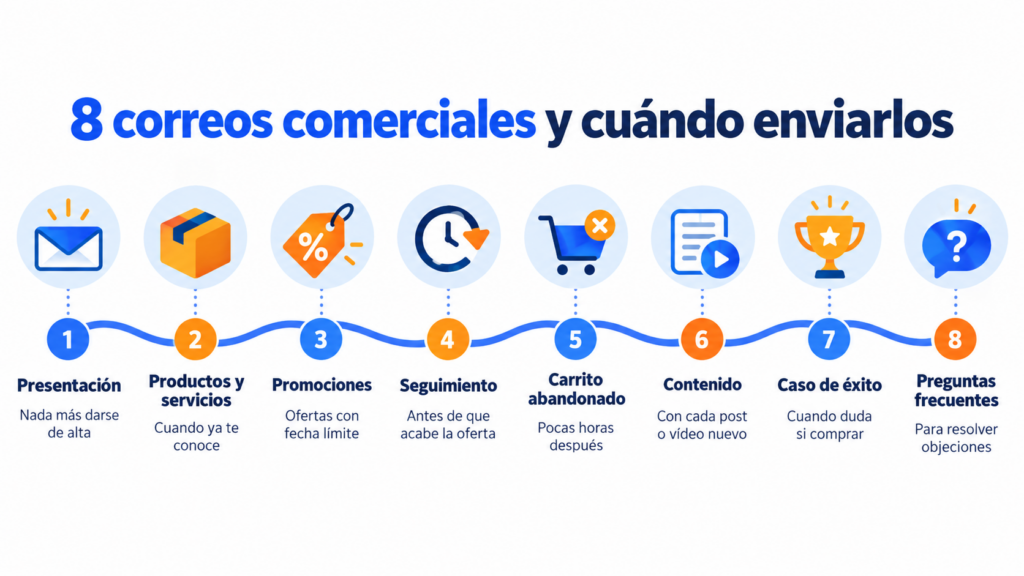
What business emails can a company send? The most common are the introduction or welcome email, the products and services email, the promotional email, the follow-up email, the abandoned cart email, the content email, the success story email and the FAQ email. You’ll find an example and a template for each one in this guide.
How do you send the same email to many contacts? With an email marketing tool like Mailrelay, which lets you send campaigns to your whole list with your own design and measure opens and clicks. Its free account includes up to 80,000 emails per month and 20,000 contacts.
After these 8 email marketing examples from companies that do it really well and the templates we’ve given you, there are no more excuses. It won’t be for lack of inspiration.
Use the templates, adapting them to your product or service, and tell us how it went in the comments.
At Mailrelay we have an email marketing service so you can work on your strategy from scratch, with a free account for up to 20,000 contacts. Get started now: take advantage of your free offer and sign up with us!