Value proposition: what it is, examples and how to create one for your business
What you offer, to whom and why it beats the alternatives, with a canvas and examples to create your own
A value proposition is the short text that explains what you offer, to whom and why it is better than the alternatives that customer has.
It answers the question anyone who lands on your website or opens your email asks themselves: why should I choose you?
It is not a slogan or a list of features. It is a concrete promise that the customer has to understand in a few seconds and that your product has to be able to deliver.
What are the elements of a value proposition?
A good value proposition usually has four parts. They don’t have to be in the same sentence, but they should be together: at the top of your website or at the start of your welcome email.
| Element | What it answers | Example for an online language school |
|---|---|---|
| Headline | What the customer gets | “Speak English at work in 6 months” |
| Subheadline | Who it is for and how they get it | “30-minute live classes for busy professionals” |
| Benefits | The 3 or 4 main reasons | Flexible schedule, native teachers, vocabulary for your industry |
| Proof | Why they should believe you | Student reviews, a free trial class |
If the headline needs an explanation to be understood, it is not a value proposition yet. It is a draft.
What is the difference between a value proposition, a USP and a slogan?
They are often confused because all three talk about what makes you interesting. The difference lies in their scope and how they are used.
| Concept | What it is | Where it is used |
|---|---|---|
| Value proposition | All the value you offer a specific customer | Website, landing page, welcome email, sales presentations |
| USP | The trait that only you have compared with the competition | Within the value proposition, as the main argument |
| Single-minded proposition | The single idea of a specific campaign | In the brief for each campaign |
| Slogan or tagline | The brand’s short, memorable phrase | Next to the logo, in ads |
In other words: the USP is one part of the value proposition, and the slogan is the way to remember it.
Some authors call a value proposition that includes a clear USP a “unique value proposition”.
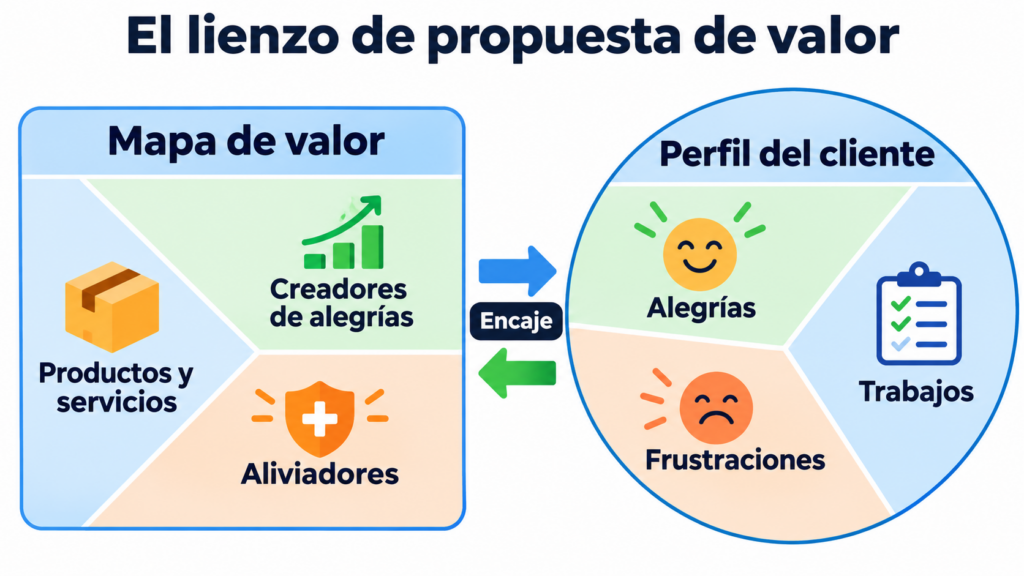
What is the value proposition canvas?
The value proposition canvas is a template for designing your value proposition based on what the customer needs, not on what you would like to sell.
It was created by Alexander Osterwalder with the Strategyzer team and popularized in the book Value Proposition Design (2014).
It complements the Business Model Canvas: it expands its value proposition block and places it opposite the customer segment. It has two sides.
| Customer profile (circle) | Value map (square) |
|---|---|
| Customer jobs: what they are trying to achieve | Products and services: what you offer |
| Pains: what bothers or worries them | Pain relievers: how you reduce those pains |
| Gains: what they would like to get | Gain creators: how you give them those benefits |
There is fit when your pain relievers and gain creators address the pains and gains that matter most to your customer.
If you fill in the value map without looking at the customer profile, the canvas loses its purpose.
Test your value proposition with your subscribers
Send two versions of your message and find out with an A/B test which one is more convincing. Start with Mailrelay’s free account.
How to create your company’s value proposition
You can do it in an afternoon with these five steps:
- Choose a single type of customer. If you have several, create a proposition for each one. Your buyer persona is a good starting point.
- Fill in the customer profile. Write down their jobs, pains and gains in their words, not yours.
- Fill in the value map. For each important pain, note which part of your product solves it.
- Write the proposition. A headline with the result, a subheadline with the how and three benefits. Check that your competitive advantage appears.
- Test it with real customers. Ask, measure and adjust.
How do you know which words to use? Ask your customers.
A single open question in your next newsletter (“What do you value most about our service?”) will give you the exact words that convince others.
Value proposition examples
These are examples from well-known companies, summarized in our own words, and two made-up ones for small businesses:
| Company | What it offers and why choose it |
|---|---|
| Netflix | Unlimited series and movies on any screen, for a monthly fee you can cancel whenever you want |
| IKEA | Designer furniture at low prices, in exchange for customers taking it home and assembling it themselves |
| Spotify | Millions of songs and podcasts free with ads, or ad-free with the paid version |
| Airbnb | Staying in private homes, with more space and a more local touch than a hotel |
| Online accounting firm (made up) | Your freelancer taxes up to date for a fixed fee, without going to the office |
| Neighborhood bakery (made up) | Sourdough bread baked every morning and reserved via WhatsApp so you can pick it up without waiting in line |
Notice that none of them talk about the company. They all talk about what the customer gains.
How to convey your value proposition in your emails
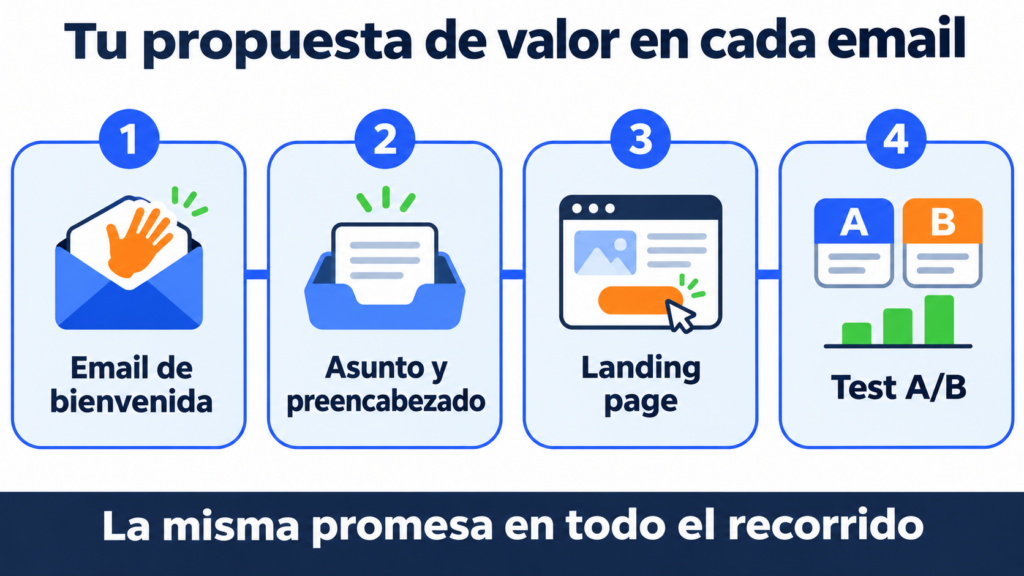
Your value proposition can’t stay on your website. Email is one of the places where it shows most whether it is clear or not:
- Welcome email: the welcome email is the moment to remind subscribers why they signed up and what they are going to receive.
- Subject line and preheader: they are a minimal version of your proposition. If they don’t explain what the reader gains, they won’t open it.
- Landing page: the landing page you link to has to repeat the same promise as the email.
Email also lets you check which wording works best. Send two versions of the same message with an A/B test and see which one gets more clicks. With your subscribers, the data arrives within hours.
How Mailrelay helps you
With Mailrelay you can bring your value proposition to every email and see whether it persuades. You can run A/B tests on the subject line and the content and create an automated welcome email. Automations are included in the free account.
You can also segment your list to speak to each type of customer with their own proposition. The free account and Enterprise give you open and per-link click statistics to see which message works best.
The free account lets you send up to 80,000 emails a month to 20,000 contacts.
Share your value proposition from the very first email
Create an automated welcome email that explains why they should choose you. Automations are included in the free account.
Frequently asked questions
These are the most common questions about value propositions.
What is a company’s value proposition?
It is the explanation of what the company offers, to whom and why it is better than the alternatives. A company can have a general value proposition and more specific ones for each type of customer or product.
What is a unique value proposition?
It is a value proposition that includes something only your company offers. It is related to the USP (unique selling proposition).
What is the employee value proposition?
It is what a company offers its employees in exchange for their talent: salary, work environment, flexibility or professional development. It is part of employer branding.
How long should a value proposition be?
Just long enough to be understood in a few seconds: a headline, a subheadline and three or four benefits. If you need several paragraphs, you haven’t chosen what matters most yet.
What is Netflix’s value proposition?
Unlimited series and movies, on any screen, for a monthly fee and with no commitment. Its website sums it up with unlimited content and the option to cancel whenever you want.