Elements of communication: what they are, how they work and examples
What it takes for a message to arrive and be understood, with examples from everyday life and from your emails
The elements of communication are the pieces involved every time someone passes a message on to another person.
They are the sender, the receiver, the message, the channel, the code, the context, the noise and the feedback.
They show up the same way in a chat at a bar, in a phone call or in the email you just received. If one of them fails, the message doesn’t arrive, or it arrives changed.
That’s why knowing the elements of communication is useful for more than passing an exam. It helps you understand why people sometimes don’t understand you.
What are the elements of communication?
Most textbooks talk about seven elements of communication, plus feedback when communication goes both ways.
This table sums them up with a simple example: Laura calls her colleague Carlos to let him know the meeting has been pushed back.
| Element | What it is | Example |
|---|---|---|
| Sender | Whoever creates and sends the message | Laura |
| Receiver | Whoever receives and interprets the message | Carlos |
| Message | The information being passed on | “The meeting is moved to 12” |
| Channel | The physical medium the message travels through | The phone line |
| Code | The system of signs both of them share | The Spanish language |
| Context | The situation in which it happens | A working Tuesday, with the meeting already scheduled |
| Noise | Whatever makes it hard for the message to arrive intact | Poor signal on the train |
| Feedback | The receiver’s response | “Perfect, I’ll be there” |
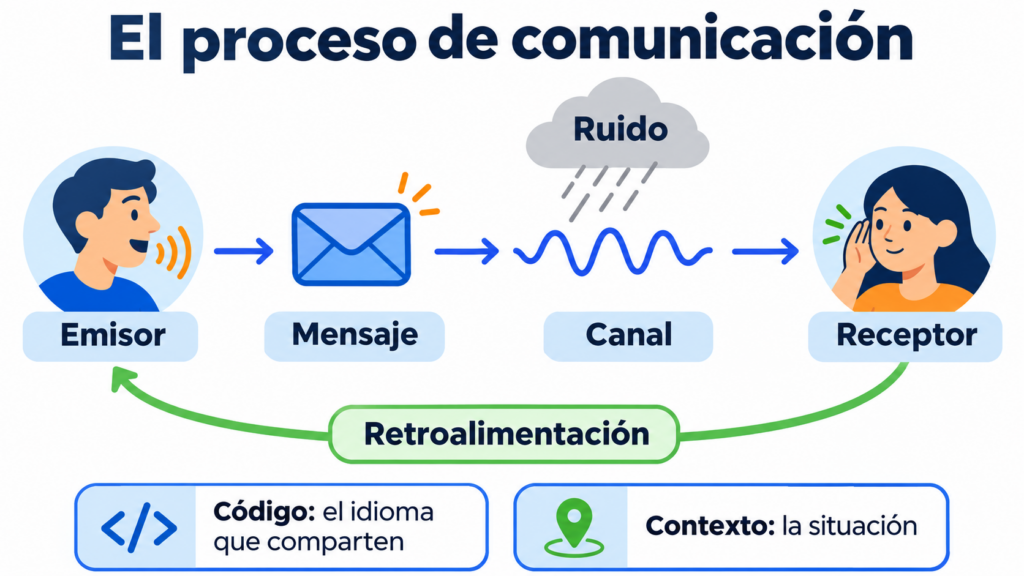
The code is the most overlooked element. Speaking the same language isn’t enough: technical words, gestures and emojis count too.
If Laura writes “see you in room B” and Carlos doesn’t know which room that is, the code fails.
The context changes the meaning of words. “Well done” can be praise or irony, depending on the situation and who says it. Great speakers know this, which is why they adapt their message to their audience, as the techniques of persuasion explain.
How does the communication process work?
The elements of communication follow a path that always repeats itself.
The sender has an idea and turns it into words, images or gestures. This step is called encoding.
Then the message travels through the channel to the receiver. Along the way, noise may appear and distort it.
The receiver decodes it: they translate those signs back into an idea.
If both share the code and the context, the idea that reaches the receiver will be close to the one the sender had.
And if the receiver responds, the process is reversed. That response is the feedback, and it is the only way the sender can know whether they’ve been understood.
This model comes from two classic theories. In 1949, Claude Shannon and Warren Weaver described a model designed for telecommunications, with a source, a transmitter, a channel, a receiver and a noise source.
In 1960, the linguist Roman Jakobson proposed six factors of language: sender, receiver, message, code, channel and context. They are the basis of the elements of communication taught in schools today.
What is noise in communication?
Noise is the element of communication that blocks or distorts the transmission of the message. It isn’t always a sound: the obstacles in the listener’s mind are also called noise.
Four types are usually distinguished:
- Physical: traffic, a conversation in the background or poor signal.
- Technical: a channel failure, such as a video that cuts out or a file that won’t open.
- Semantic: words the receiver doesn’t know or understands differently.
- Psychological: prejudice, tiredness or lack of interest that keep the receiver from paying attention.
The more noise there is, the more important feedback becomes.
Asking “Did that make sense?” is the simplest way to check that the message got through.
What is the difference between a channel and a communication medium?
The channel is the physical support a specific message travels through: the air in a conversation, the paper of a letter or the network in an email.
Communication media are the tools that use those channels to reach many people at once, such as the press, radio, television or the internet.
Every medium uses a channel, but not every channel is a communication medium.
The elements of communication in an email
An email is a good example for seeing all eight elements of communication working at once. It also helps explain why some campaigns don’t achieve what they set out to do.
| Element | In an email |
|---|---|
| Sender | The sender: the name and email address the subscriber sees |
| Receiver | The recipient or the group of subscribers you send to |
| Message | The subject line, the text and the images |
| Channel | Email itself, from server to server all the way to the inbox |
| Code | The language, the tone and the format (HTML or plain text) |
| Context | When the email is sent and what the subscriber expects from you |
| Noise | Spam filters, a design that isn’t responsive or too many emails in a row |
| Feedback | Replies, clicks, unsubscribes and complaints |
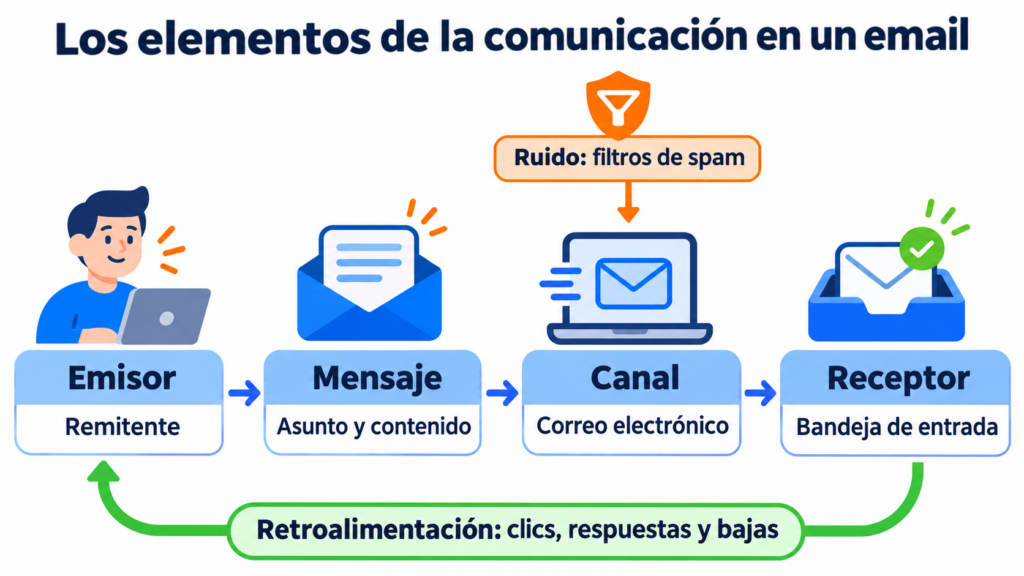
Noise is the element that affects a campaign the most. You can write the best message in the world.
But if it ends up in the spam folder or doesn’t display well on mobile, the receiver will never get it the way you intended.
Feedback, on the other hand, is the great advantage email has over other media.
Every send tells you how many people clicked, what your unsubscribe rate is and which topics interest people most. With that data you can segment better and fine-tune your next message.
With Mailrelay you can take care of both. The editor’s templates are responsive, and you set up SPF and DKIM from the dashboard to improve your deliverability.
And with the free account you see the opens, clicks, unsubscribes and complaints for every send.
Make sure your message arrives and is understood
With Mailrelay’s free account you can send up to 80,000 emails a month and see what each subscriber does with them.
Frequently asked questions about the elements of communication
These are the questions that come up most often when studying them.
How many elements of communication are there?
It depends on the author. The most common approach is to talk about seven elements of communication (sender, receiver, message, channel, code, context and noise) and add feedback as the eighth. Jakobson spoke of six, leaving out noise and the response.
What is the most important element of communication?
None of the elements of communication works without the others. But if the sender and the receiver don’t share the code, the message isn’t understood even if everything else is right.
What happens if there is no feedback?
Communication is one-way: the sender doesn’t know whether their message has arrived or how it has been understood. This happens with a TV ad or a poster.
Related entries
If you want to keep exploring communication and email, these glossary entries help you take a closer look at each element.